What Happens When Two Swedes Design a Nantucket Beach House
When Nordic interior designer Charlotte Save first met the owner of this home, the connection was immediate. Together, they designed an island haven to age beautifully.
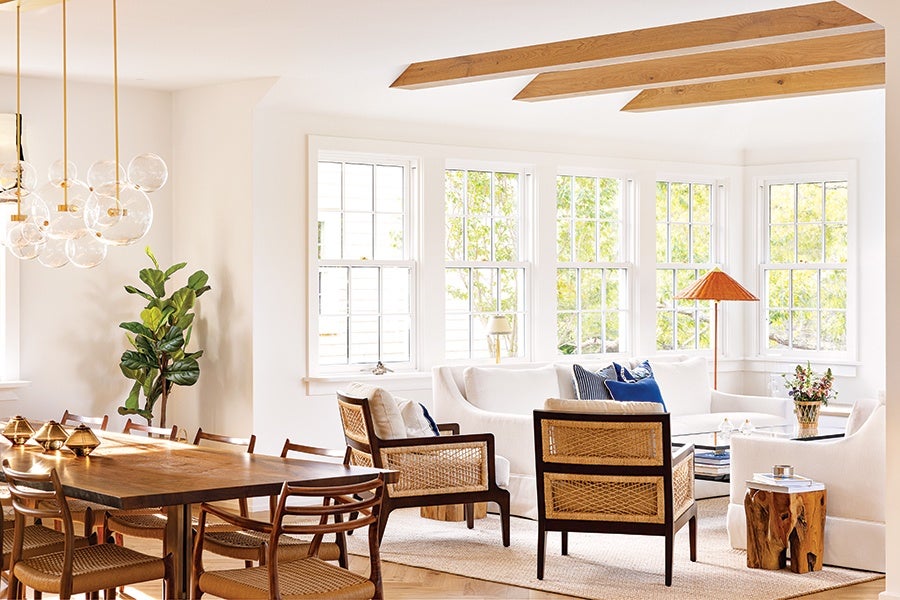
Rather than leaning into a traditional nautical aesthetic, the interiors of the home celebrate natural light, texture, and thoughtful detailing—a softer, more timeless approach to coastal living. / Photo by Hayley Dayimeless
This article is from the summer 2026 issue of Boston Home. Sign up here to receive a subscription.
When interior designer Charlotte Save first met the owner of this home, the connection was immediate. Both women are Swedish, both have lived internationally, and both share an instinct for interiors that feel restrained, layered, and quietly confident. The homeowner, a Boston-based professional building a 3,000-square-foot summer retreat on Nantucket, wanted a beach house—but not the obvious kind. No overt coastal clichés. No heavy furniture. And absolutely no marble countertops. Instead, she envisioned a home that felt European in its sensibility: pared back, timeless, and flexible enough to host 40 guests one weekend yet feel intimate on a Tuesday night alone.
Set on the edge of Nantucket’s historic district, the house adheres to the island’s rigorous architectural standards while introducing a refined Scandinavian undercurrent. For Save, who grew up surrounded by centuries-old European buildings, that respect for context felt natural. “We wanted it to feel timeless,” she says, “like it could age beautifully with her.”
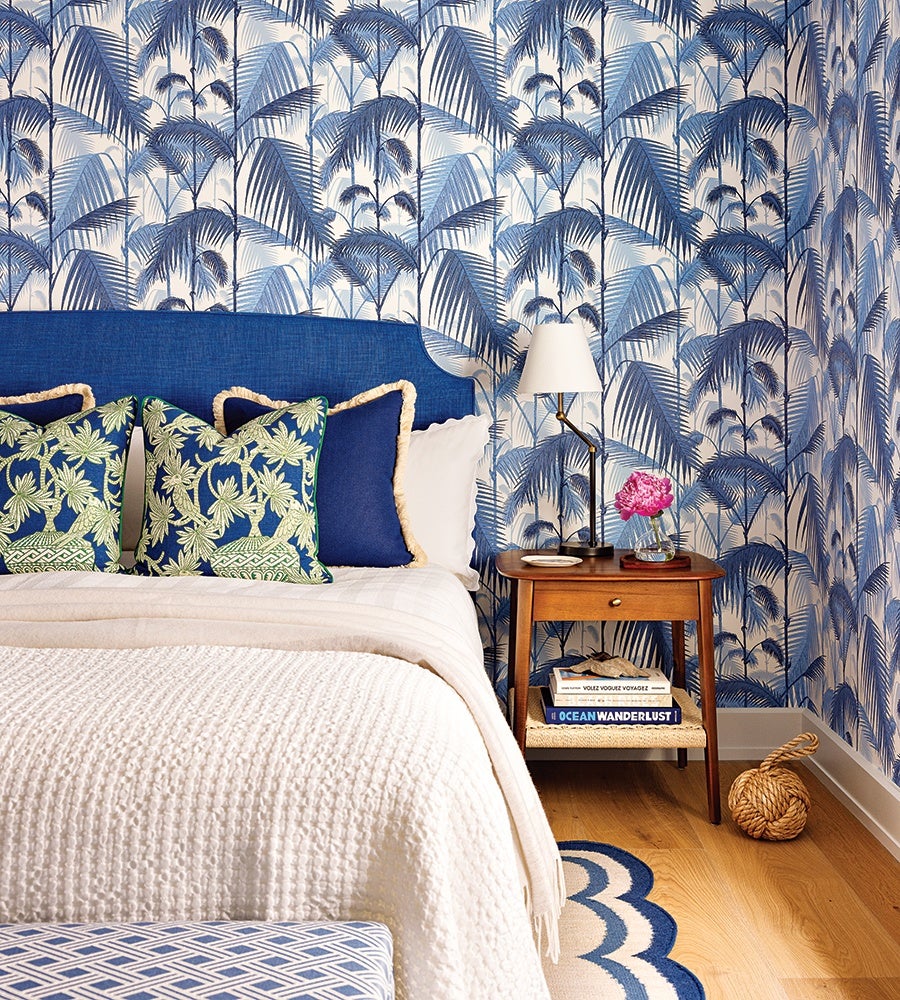
In one of the lower-level guest rooms, a blue-palm wallcovering by Cole & Son is paired with a Serena & Lily headboard and a scalloped-edge rug that evokes a wave motif, calling to mind the ocean down the road. / Photo by Hayley Day
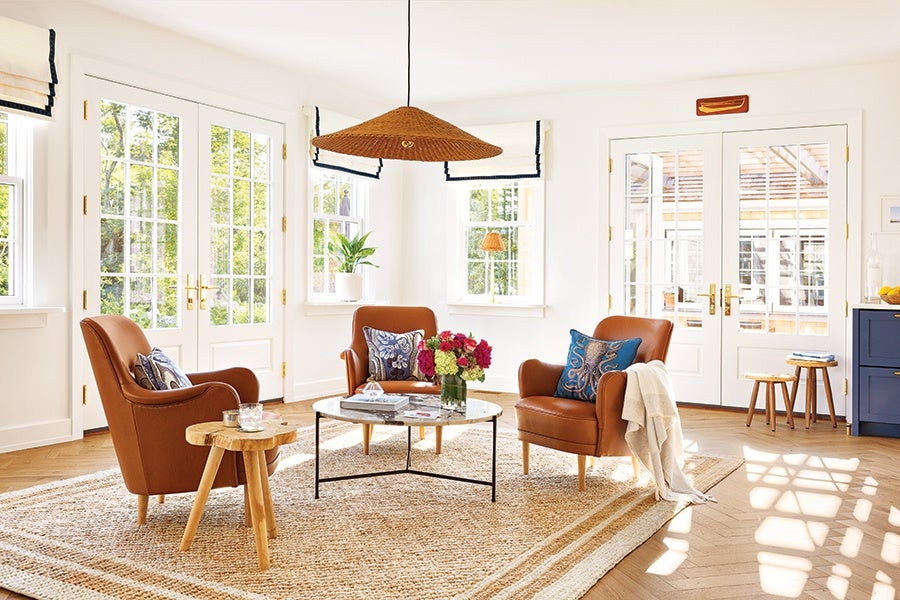
A bar area on the main level is furnished with chairs from the Swedish brand Carl Malmsten, which Save had upholstered in leather. Underfoot is a Serena & Lily rug, while the woven light fixture is from Fern Living, a Danish maker. / Photo by Hayley Day
Light became the guiding principle. Windows wrap nearly every room, so Save chose furnishings elevated on legs—an approach inspired by Austrian designer Josef Frank—to allow the eye to travel uninterrupted from floor to wall. Varnished oak floors laid in a herringbone pattern anchor the main level, setting the stage for furnishings chosen as much for lightness as comfort. In a seating area off the entryway, caramel-toned leather lounge chairs catch and reflect sunlight rather than absorb it. “When you have that much light, you want it to bounce,” Save explains.
At the heart of the open-plan main floor is the kitchen, a space driven as much by performance as aesthetics. The homeowner loves to cook and entertain, and she was unequivocal about one thing: She needed a surface that could withstand a hot pan. Marble was out. In its place, Save specified porcelain for the countertops, backsplash, and perimeter surfaces—durable, resilient, and quietly elegant. The continuity of material keeps the space crisp and uncluttered.
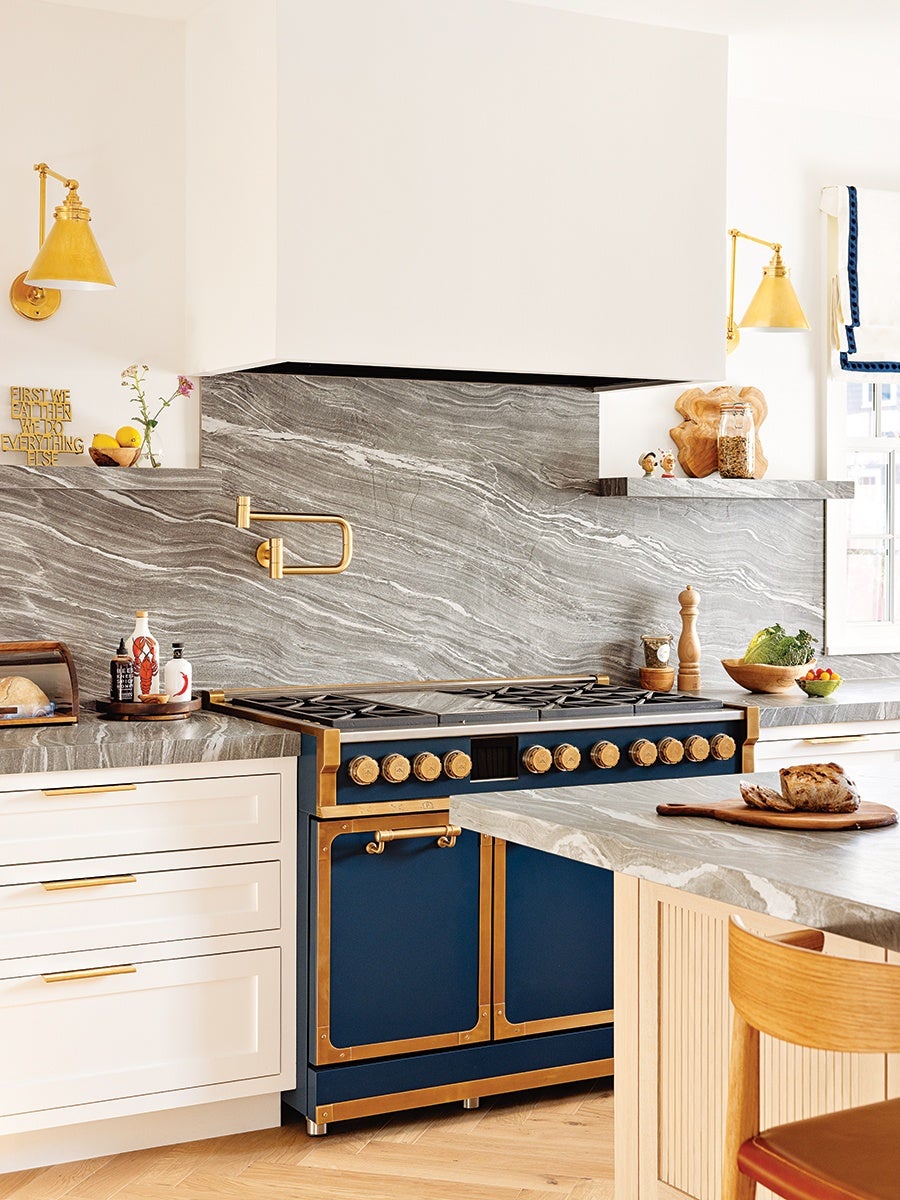
Brass Visual Comfort sconces flank the clean-lined hood above the striking blue Officine Gullo range. Brass-and-leather cabinet hardware is from Turnstyle. / Photo by Hayley Day
To prevent the kitchen from feeling overly built-in, the island was crafted in oak, designed to read as a piece of furniture rather than millwork. “It softens the room,” Save says. “It makes it feel more lived-in.” Leather-and-brass hardware from Turnstyle adds tactile warmth to the cabinetry, introducing texture that feels refined rather than flashy. An Officine Gullo range anchors the space with understated gravitas, reinforcing the European thread woven throughout the home.
Crucially, Save eliminated upper cabinets. Without them, sightlines remain open, and light circulates freely across the room, enhancing the connection between the kitchen, dining, and living areas. An Italian blown-glass chandelier hangs over the dining table, which has a subtle raw-edge detail selected for the way it balances the warmth of exposed wood beams, preventing the architecture from feeling too strict.
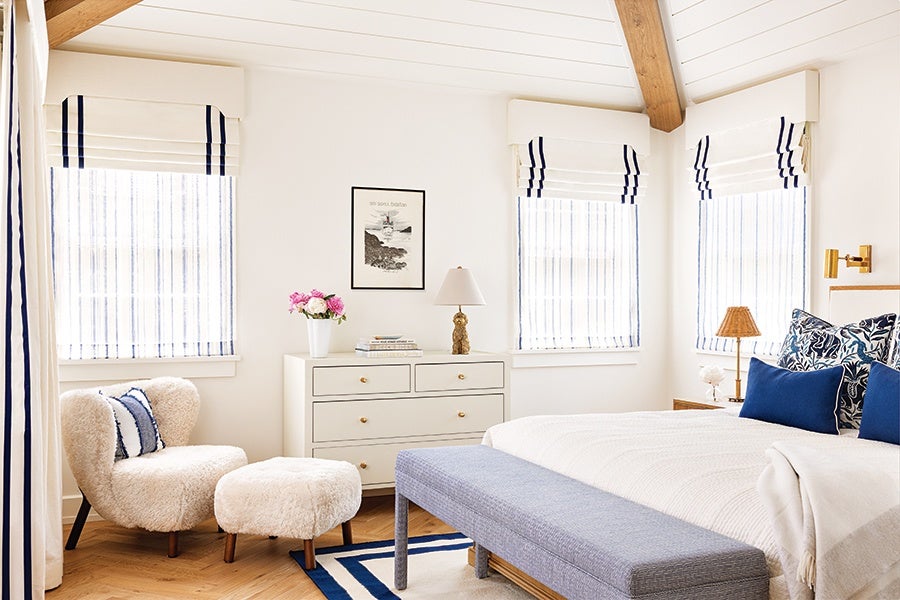
The primary suite’s vaulted ceiling is finished with white V-groove boards that intersect with natural wood beams. “It’s a nice detail without overdoing it,” Save says. The made-to-order rug is by British brand Jennifer Manners. / Photo by Hayley Day
While the first and second floors maintain a composed palette of whites and layered blues—raffia wallcoverings by Phillip Jeffries add texture without heaviness—the lower level introduces playfulness. A wallcovering inspired by a de Gournay mural sets the tone in one bedroom, while a lively blue-palm-pattern Cole & Son design sheathes the walls in another.
Island references appear in thoughtful gestures rather than theme. In a powder room off the mudroom, a brass porthole mirror hangs above a sculptural wood sink, while a bespoke nautical-chart wallpaper on the ceiling marks the home’s exact Nantucket location. “She’s a sailor,” Save notes, “so we wanted a nod to that without being overly literal.”
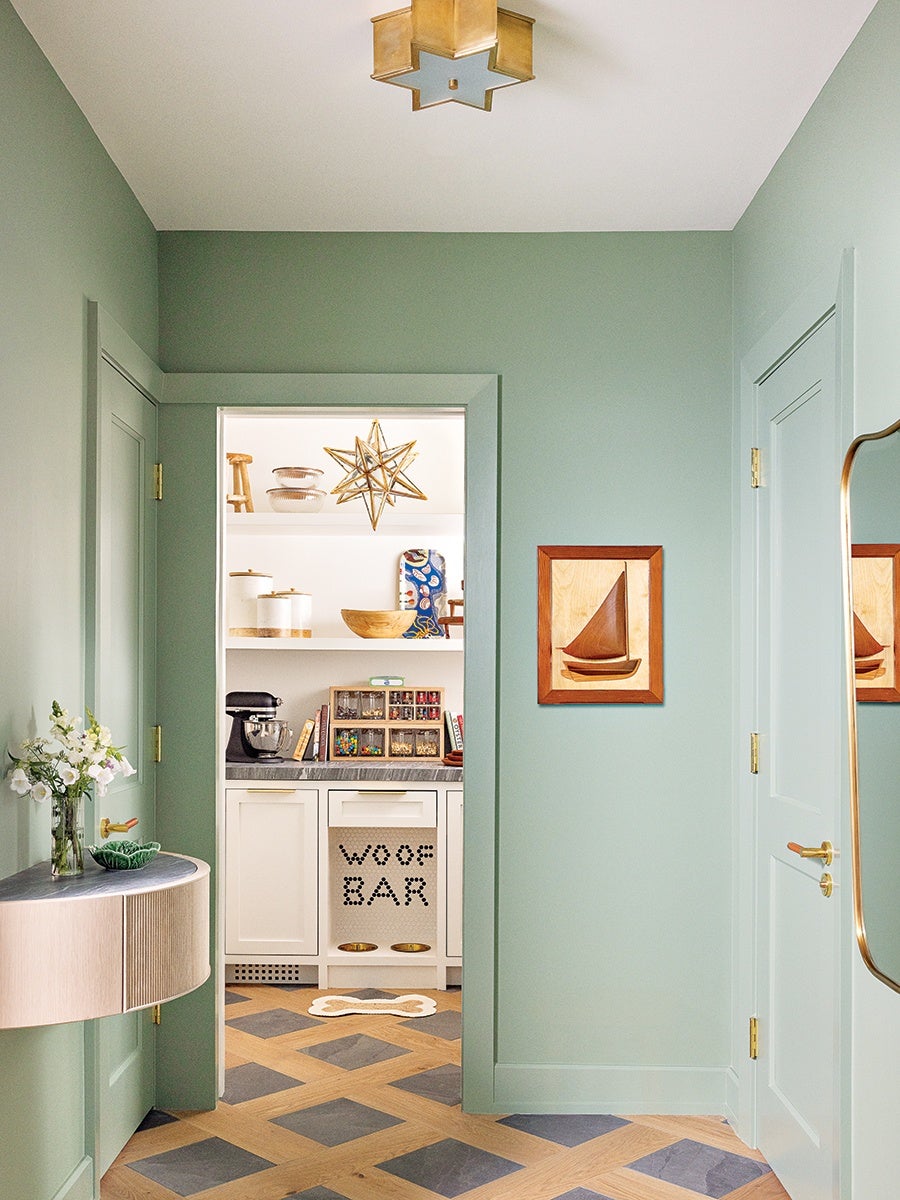
The mudroom was designed for durability with a porcelain tile floor intersected with wood for warmth and visual appeal. Walls are painted in Benjamin Moore’s “Summer’s Day.” Visual Comfort star light fixtures nod to nautical styling. / Photo by Hayley Day
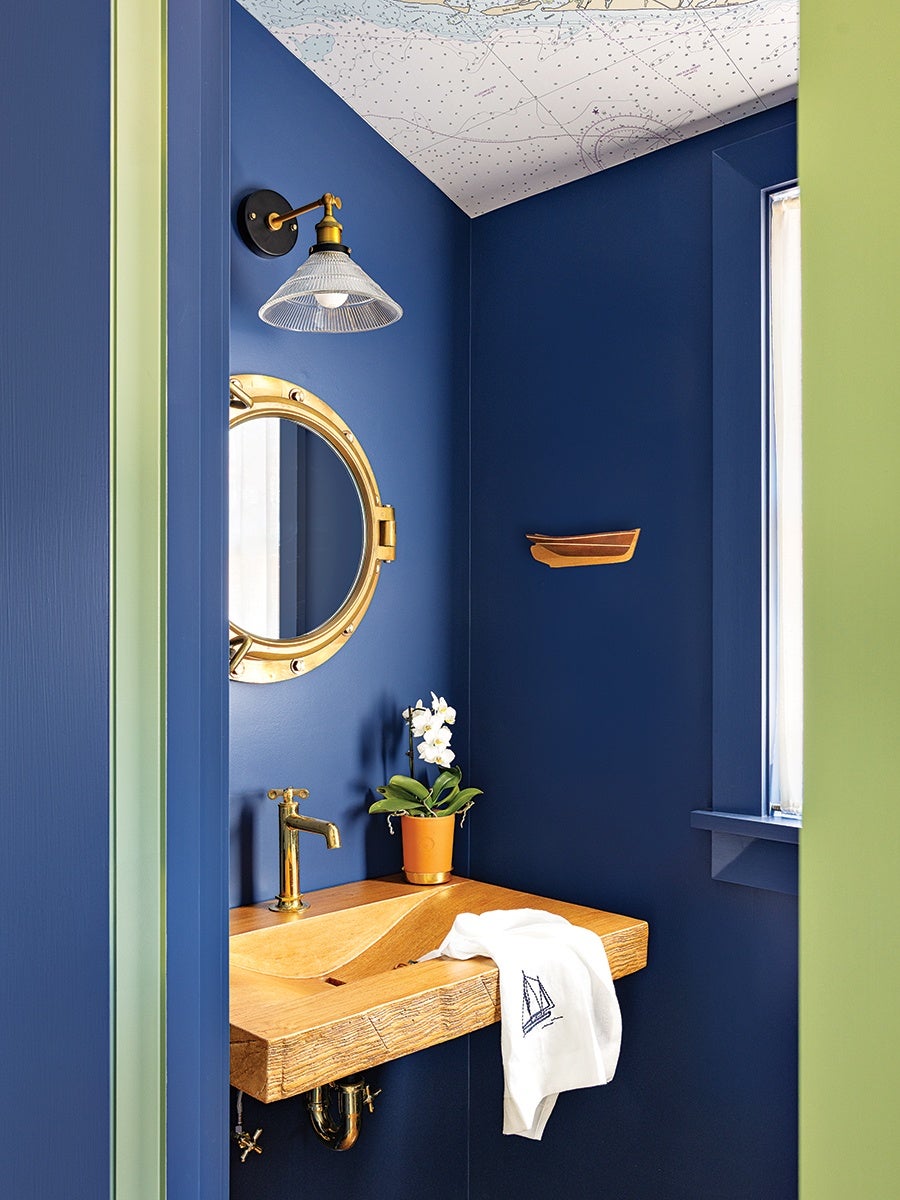
The powder room exudes a bit of maritime whimsy with the ceiling’s bespoke wallcovering, fashioned from a nautical chart, and the porthole mirror. The spare wood vanity nods to craft and utility, hallmarks of Nantucket’s architectural legacy. / Photo by Hayley Day
Practicality was essential—especially with a Bernedoodle in residence. The mudroom pairs oak millwork with durable porcelain- and slate-look tile designed to handle sand, wet towels, and muddy paws. Star-shaped ceiling fixtures from Visual Comfort add a subtle maritime wink, while the shade of green selected for the walls recalls both sea glass and the gardens surrounding the home.
“It’s an island house,” Save says, “but not on the water.” That nuance defines the project. Rather than lean into overt beach motifs, she created a home rooted in craftsmanship, light, and longevity. The result feels both Scandinavian and Nantucket at once—elegant, welcoming, and built to endure.
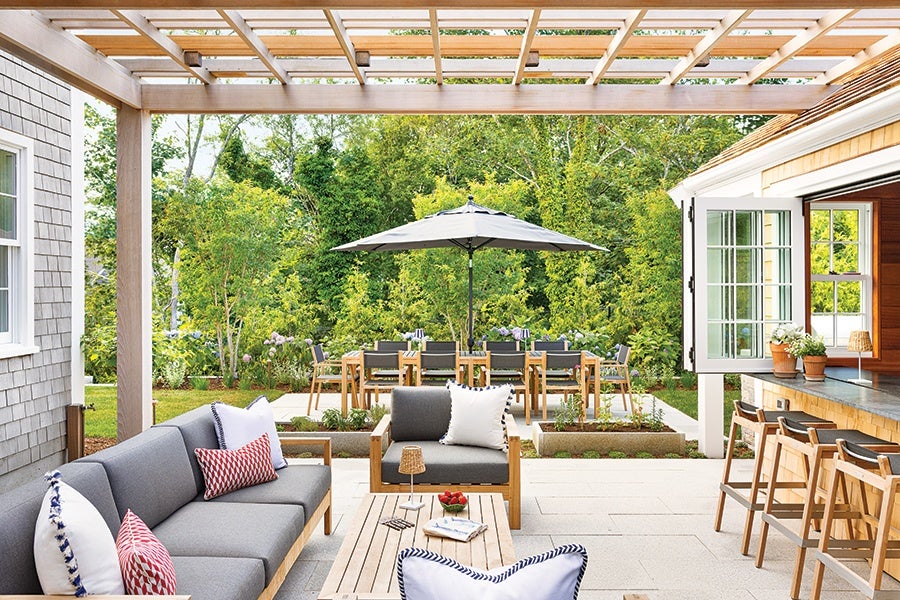
A fully-equipped outdoor kitchen with a mahogany-clad interior has folding windows that integrate the space with the patio area, allowing the person who is preparing food to be part of the socializing. / Photo by Hayley Day
Builder Cheney Custom Homes
Interior Designer Charlotte Save
First published in the print edition of Boston Home’s Summer 2026 issue, with the headline “The Long View.”