A Martha’s Vineyard Home Designed for the Whole Family—Without Sacrificing Privacy
A wooded island retreat balances communal gathering spaces with private wings for extended relative stays.
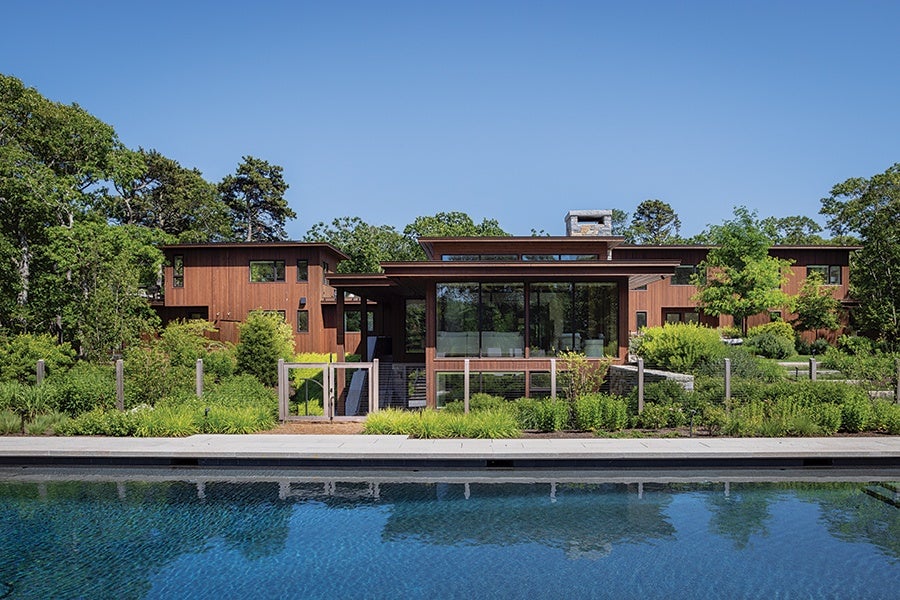
Photo by Michael J. Lee
This article is from the summer 2026 issue of Boston Home. Sign up here to receive a subscription.
The land came first. Two adjacent, heavily wooded parcels on Martha’s Vineyard, bordered by a pond alive with birdsong and marine life, felt almost enchanted. The wife compared it to Narnia. What followed was a home designed not just to sit lightly within that landscape, but to bring an extended family together—without sacrificing space to retreat.
The clients, a couple living outside of Boston, had visited the Vineyard over past summers and imagined having a home there one day. They began conversations with architect Travis Ritchie before they had even purchased the property. After one deal fell through, Ritchie’s realtor connection found a pair of adjacent parcels owned by a mother and daughter. Heavily wooded and bordering a lively pond, the setting “has this magical outdoor quality,” says designer Jennifer Palumbo, who helped bring that feeling indoors as well.
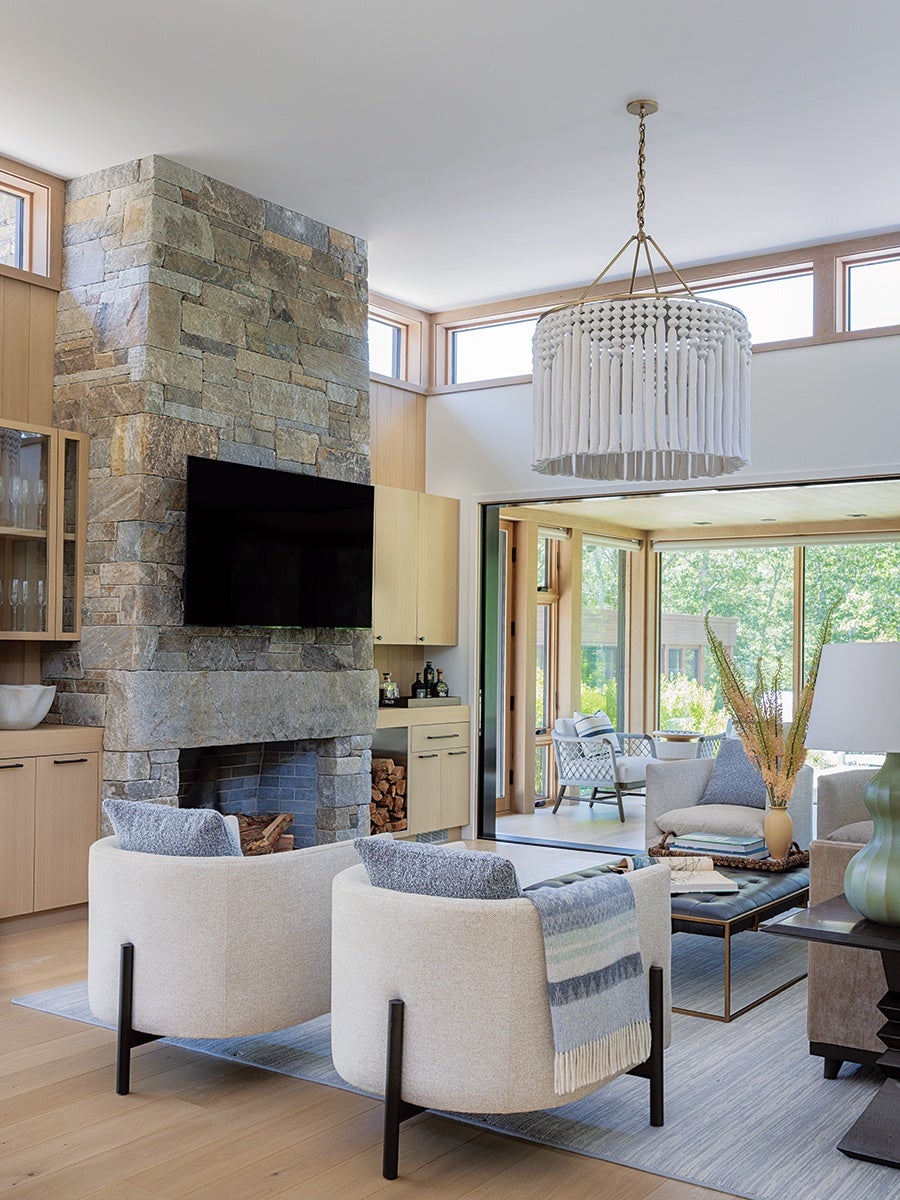
Furnishings with textural appeal—a leather-and-brass ottoman and a tasseled M2C Studio chandelier—enliven the living area. The adjacent sunroom can be closed off from the space with a sliding glass door. / Photo by Michael J. Lee
Though this was the clients’ first time working with a design team to create a custom home, they were decisive about what they wanted. The house would be a landing spot for their three adult children and a place where family and friends could comfortably visit for extended stays. Integral to the layout was that there were ample gathering spots for the family to be together, as well as private areas where one could go to recharge.
“The challenge was keeping the feeling of intimacy and laid-back comfort of a small house in larger spaces,” Ritchie says. He achieved that balance by creating a core of communal areas and separate wings for the homeowners and their guests. In the center of the home, the multifunctional great room opens to the kitchen and dining areas, flanked by a guest wing on one side and space for the homeowners on the other. As a result, “it’s a large house that doesn’t feel large,” Ritchie says.
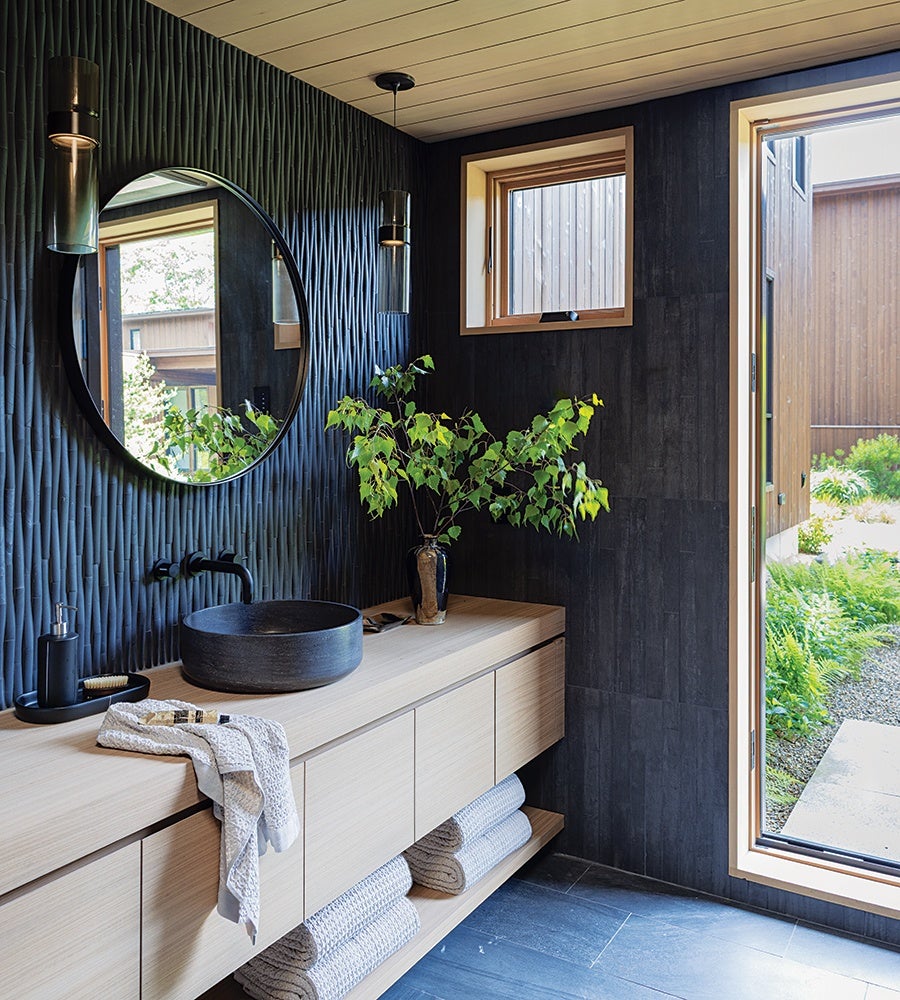
The daughter’s bathhouse is a place to get away. Palumbo used dark textured tile from Discover Tile on the walls and a floating vanity in lighter wood. The space also has a tub positioned under a large window that looks out into the forest. / Photo by Michael J. Lee
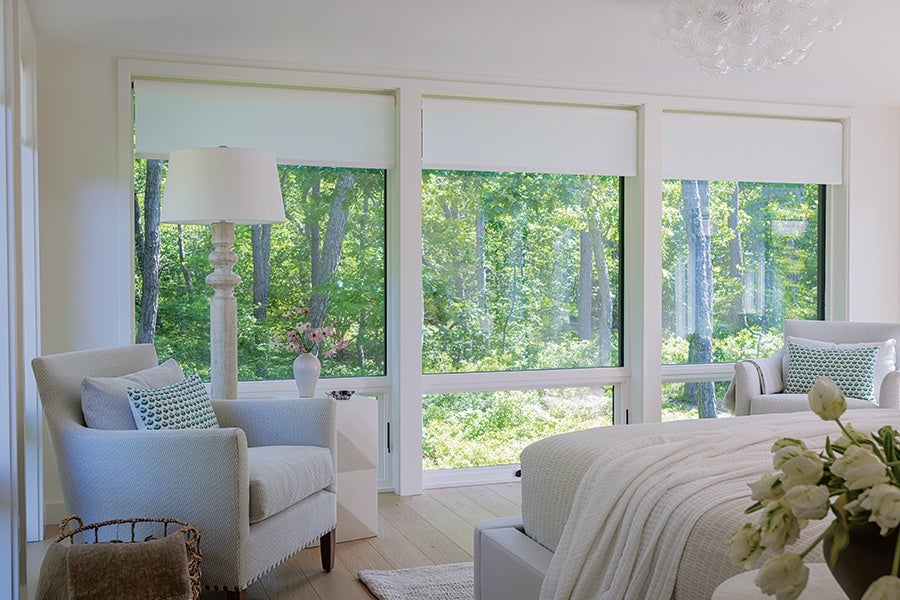
The primary bedroom is a neutral backdrop for the forest views outside with an RH bed, Annie Selke linens, and a pair of armchairs from Artefact. / Photo by Michael J. Lee
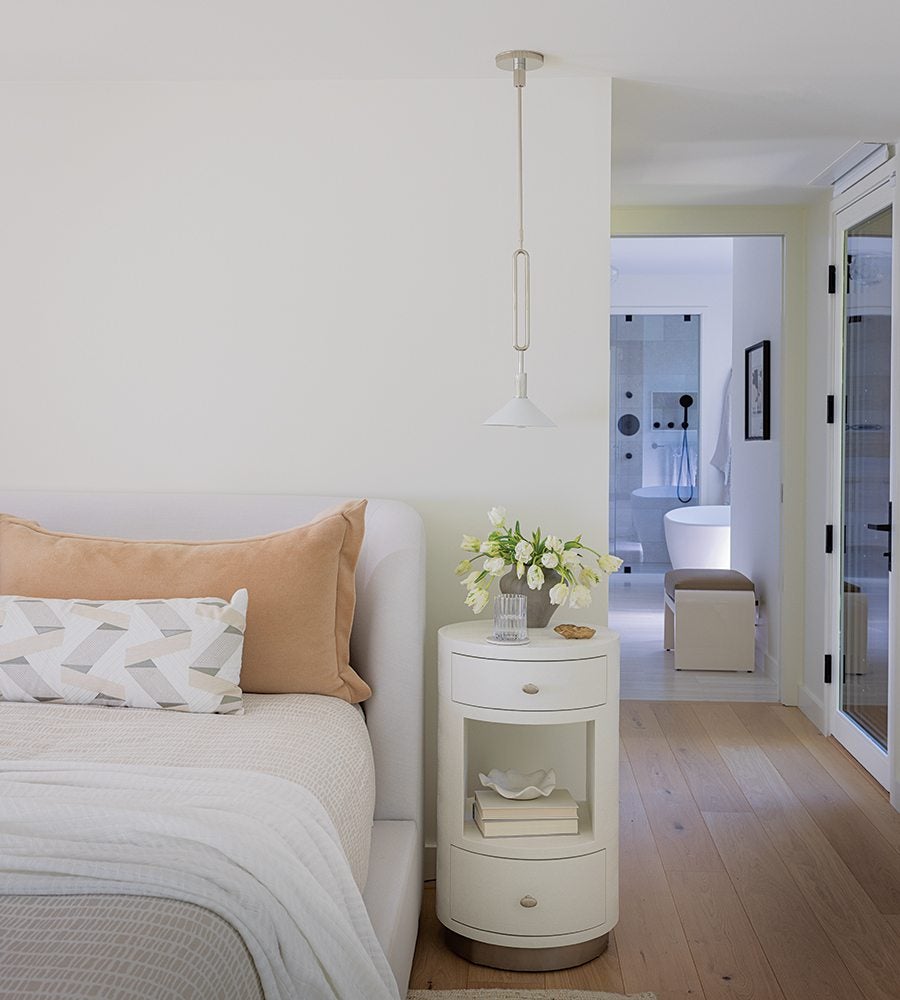
The primary suite gives the homeowners lots of privacy and space to relax. Made Goods’ “Nerine” bedside tables are paired with Visual Comfort “Argo” pendant lights. / Photo by Michael J. Lee
The homeowners have a private retreat in their primary suite. Expansive windows and Palumbo’s clean, neutral design keep the woodsy views in focus. A walk-through closet connects to a bathroom, outdoor spa, and shower. On the floor above, an office opens to an attached roof deck. In the guest wing, Ritchie stacked three en suite bedrooms above a first-floor garage, laundry room, and fourth guest room. Palumbo added flexibility by designing each guest suite with beds that can be combined into a king or separated into two twins, accommodating whoever is visiting.
Though the children don’t have dedicated bedrooms, their passions are woven into the design. The oldest son is a chef, reflected in the well-equipped main kitchen, an adjacent outdoor cooking area with a large bar and pizza oven, and additional prep space at the pool house. Their artist daughter has a studio over the garage, and her sister’s love of Japanese culture inspired an onsen-like bathhouse. The multitude of distinct spaces gives the property an almost resort-like feel, says Palumbo.
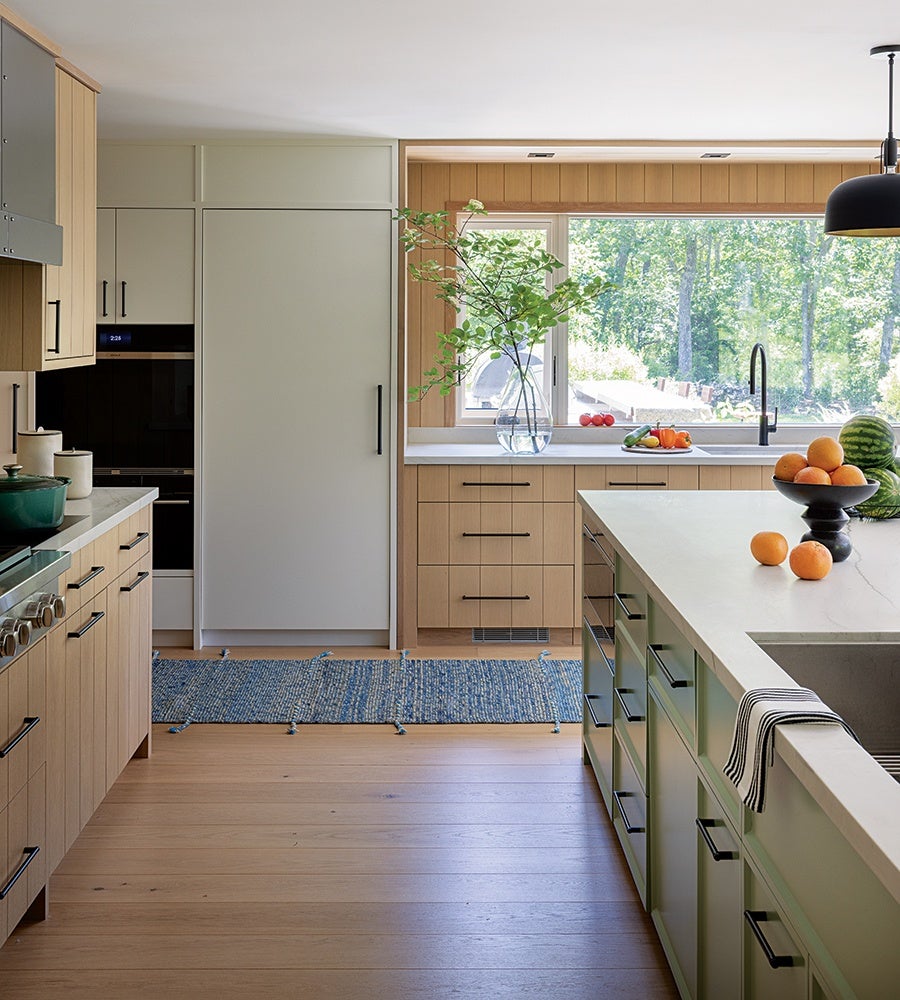
Ritchie used lower ceilings in the kitchen to differentiate the space from the dining and living room areas. Palumbo designed white-oak cabinets with plank-style fronts and used green, the client’s favorite color, as an accent on the island. / Photo by Michael J. Lee
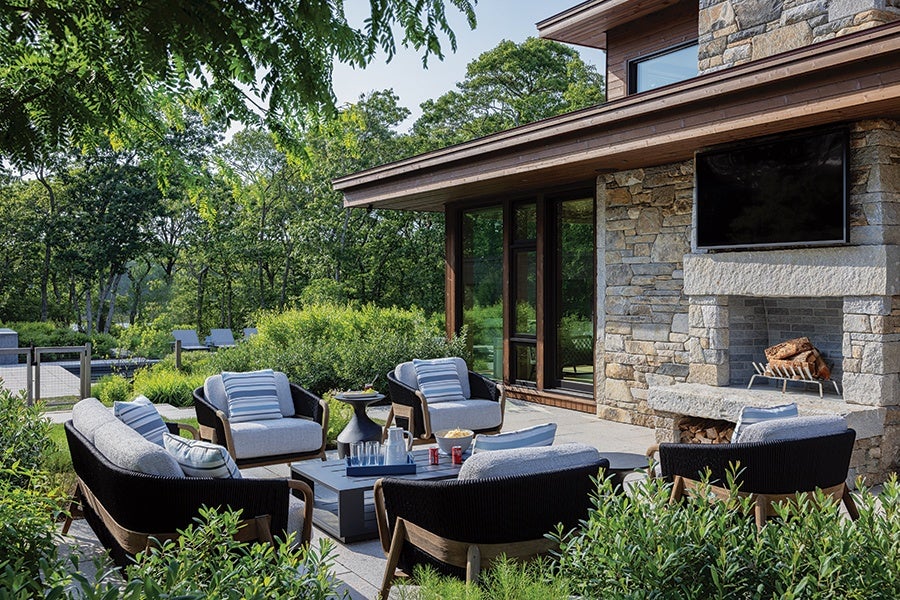
Palumbo chose a Palecek sofa and chairs for the outdoor seating area off the main home’s kitchen and dining space. The same natural-stone façade is used for both the indoor and outdoor fireplaces, one of many design details that enhance the indoor-outdoor connection. / Photo by Michael J. Lee
That feeling is reinforced outdoors, where landscape designer Matthew Cunningham created a carefully choreographed path system connecting the home’s various spaces that encourages exploration. While some trees were removed to accommodate the footprint, Cunningham’s team preserved the property’s sculptural oaks and low blueberry and huckleberry shrubs, layering in salt-tolerant, drought-resistant native plantings. “The house and garden are very much in sync,” Cunningham says. “Part of the experience of this place is being able to relax within the beauty of this unique island ecosystem.”
Palumbo carried that harmony inside by keeping the interiors fairly neutral, with lighter woods and subtle touches of green. Pared-back cabinetry and simple trim details allow the eye to rest on the surrounding forest and water views.
Enveloped in nature, with space to explore and room to retreat, the home offers the ideal setup for family vacations—whether the house is full of guests or serving as a quiet island escape.
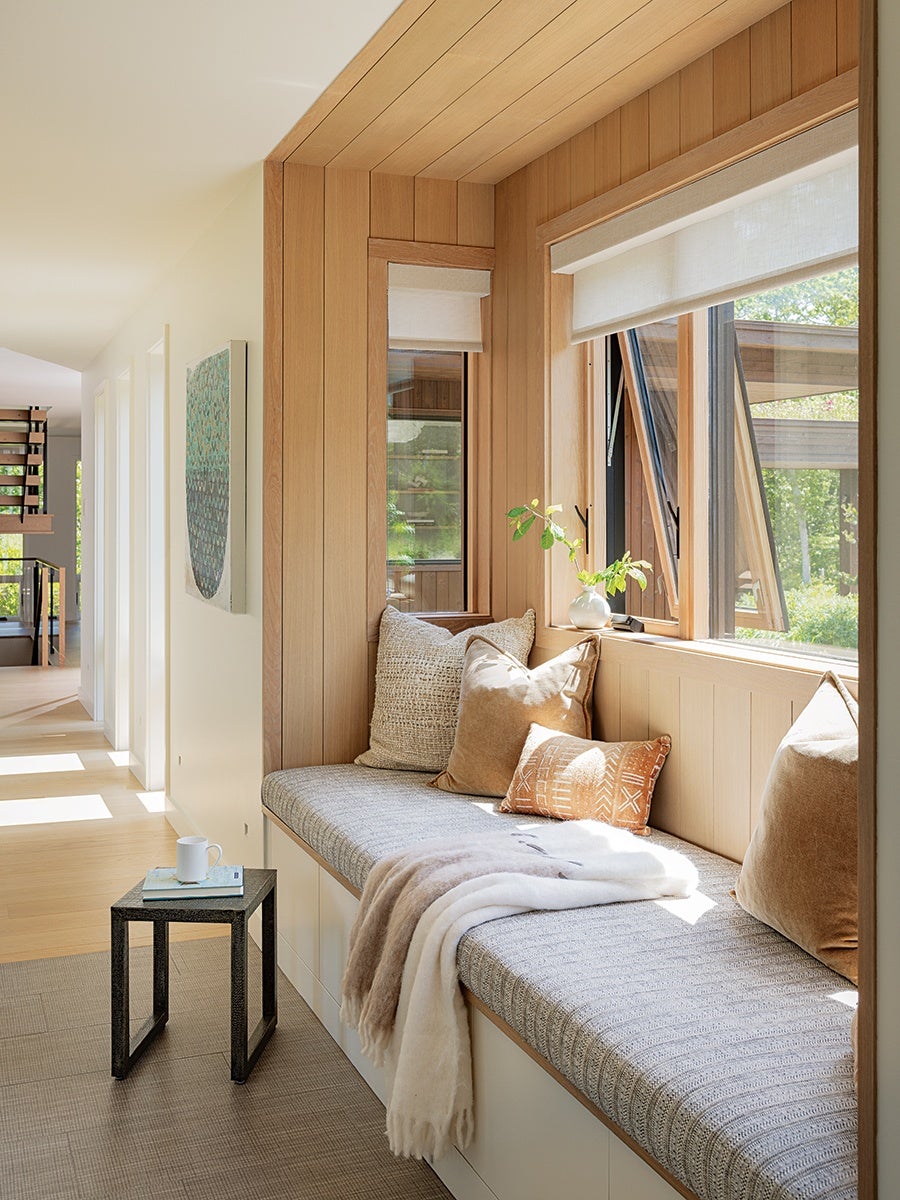
A window seat nestled in a sunny spot near the entryway has a cushion upholstered in Schumacher fabric. White-oak paneling gives the nook additional distinction. / Photo by Michael J. Lee
Architect R+D Studio
Builder Stedman Construction
Interior Designer Jennifer Palumbo Interior Design
Landscape Architect Matthew Cunningham Landscape Design
First published in the print edition of Boston Home’s Summer 2026 issue, with the headline “Together Apart.”