The A.R.T. Is Turning “Black Swan” into a Musical
The theatrical adaptation, directed by Tony Award winner Sonya Tayeh, opens May 26. Go see it before New York takes it from us.
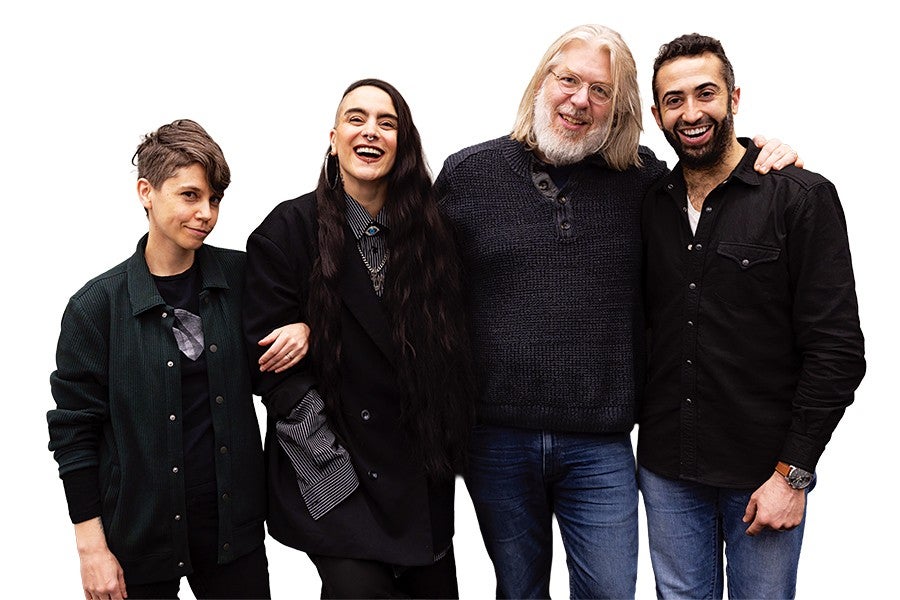
Black Swan playwright Jen Silverman, director and choreographer Sonya Tayeh, composer and lyricist Dave Malloy, and music supervisor and music director Or Matias. / Photo by Maggie Hall
The A.R.T. has sent Waitress to Broadway. Jagged Little Pill. Finding Neverland. At this point, the Loeb Drama Center is as much a launching pad with a Cambridge ZIP code as it is a local theater—and the question isn’t whether the next play heads to New York, but when. So, what’s next to be exported? Black Swan. Yeah. That Black Swan.
You remember the Darren Aronofsky cinematic fever dream, with Natalie Portman as a ballerina whose sense of reality is shattered. You recall exactly how that movie made you feel, and you probably haven’t fully recovered.
So here’s what we know. The book comes from Jen Silverman, a Guggenheim Fellow with Broadway cred, who was drawn to the challenge of losing the camera. The film lived inside Portman’s face—every twitch, every hallucination, every mirror showing something wrong. Silverman’s solution: songs that crack open Nina’s interior life in ways close-ups can’t. “There’s something about Black Swan in the context of a theater,” Silverman says, “where an audience is gathered live…with the people really pushing themselves to the furthest limit. And it isn’t a trick of photography—it’s actually happening right in front of you.”
Directing is Sonya Tayeh, the Tony winner behind Moulin Rouge! The Musical, which tells you the physicality is going to be extreme. The score is by Dave Malloy, who described his approach as threading Tchaikovsky through throbbing electronics. His words: “oboe, harp, and sampled swan sounds integrated into psycho-techno beats” as Nina spirals. And then there’s a team of magic designers—actual magic designers—building live illusions around Nina’s hallucinations.
The A.R.T.’s Ryan McKittrick, who helps develop these projects, says the adaptation process typically runs three to seven years, with rewrites happening as late as preview week. “The source material has to undergo a real transformation,” he told us, “so that the adaptation becomes a work of art that can stand on its own.” Translation: What you’ll see at the Loeb won’t be the movie with songs. It’ll be something new wearing the movie’s clothes.
The creative team is serious. The source material is beloved. The theater has a track record of sending exactly this kind of thing to Broadway. We don’t know yet whether this is the next Waitress, but the smart money keeps a close eye on what comes out of that building on Brattle Street. Tickets are on sale now for the musical’s run from May 26 through June 28. Go before New York takes it from us.
This article was first published in the print edition of the April 2026 issue, with the headline,“The Adaptation Factory.”