Why Is Everyone So Obsessed with Nantucket?
Cocaine in the wastewater. Billionaires fighting over a clam shack. A Christmas brawl that landed on TMZ. Why can’t we look away when something happens on the island?
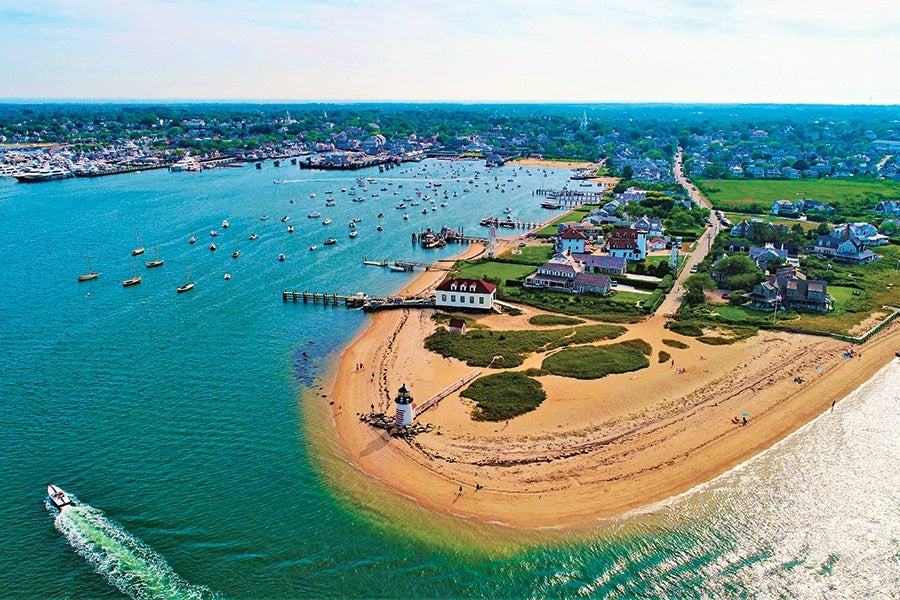
Photo via Shuttershock
Was it the first fight ever to break out at Nantucket’s annual Christmas Stroll? That we don’t know. But what we do know is this: It was the first Christmas Stroll skirmish ever to end up on TMZ.
On a misty Saturday this past December, the denizens of Nantucket, along with tourists who’d ferried over from the mainland for a visit, gathered in the island’s quaint downtown for the local chamber of commerce’s annual holiday celebration—a charming little affair featuring crafts, seasonal entertainment, all the hot chocolate you could drink, and a visit from Santa himself. Although, as we shall see, the man in the big red suit would soon be overshadowed.
The trouble started inside the Boarding House restaurant when a woman apparently bumped a man at the crowded bar. For whatever reason, the man didn’t take kindly to this; there may, in fact, have been a return shove. In any event, before you knew it, the hubbub inside the bar had spilled out onto the street. When the video starts—because of course there’s video—you see a group of guys pacing around, pointing fingers. Things actually look like they might be simmering down, until one guy makes an aggressive move toward another guy. He’s quickly restrained, but just a few feet away, a third guy takes this opportunity to coldcock a fourth guy, at which point a fifth guy jumps on the fourth guy’s back—and throws him to the ground.
Just like a Bruins game, the benches cleared.
A pack of people, including a sixth young man with a sweatshirt knotted around his neck, goes after Guy Number Five. But Number Five deftly eludes the swarm, ducking under one punch, then backpedaling, Muhammad Ali–style, to avoid another. His agility seems to throw the pack off their rhythm, and after a few more moments, calmer heads prevail. Exhale.

Nantucket is known for its postcard-perfect feel—unless, of course, you found yourself caught up in the Christmas Stroll brawl of 2025. / Photo via X/@ackcurrent
In a different age, of course, that would have been the end of that. But this being the age it is, the end was really just the beginning. Video of the tussle soon made its way into the hands of the Nantucket Current, a local news site, which posted the footage to its Instagram account. Over the next day or so, virality ensued. TMZ did an item about the incident, as did many other click-seeking publications, including Fox News, the New York Post, the Daily Beast, and the Daily Mail. When an eyewitness named Kathleen called into radio station Kiss 108 to talk about the fight—she described it as a battle between twentysomethings and sixtysomethings—video of that conversation was viewed more than 22,000 times. But who could blame people for being interested? As Kathleen put it, “It was like the Sharks and the Jets from West Side Story, only in Ralph Lauren and Burberry.”
View this post on Instagram
My hunch is that the Nantucket Christmas Stroll Brawl of 2025 will be a one-off; it’s hard to imagine the island’s powers that be allowing a rematch or teaming up with UFC for something bigger. That said, the buzz about the incident is absolutely emblematic of the current cultural fascination with all things Nantucket.
For decades, New Englanders looked at the island as the pretty, preppy destination just off the coast where a certain well-heeled segment of the population spent its summers. Today, though, Nantucket has become something more than that: a symbol to the rest of America—maybe even the world—of life among the billionaire class.
And they—and we—can’t get enough. Nantucket-set books and shows are having a moment. Nantucket-focused content creators are swimming in views. Meanwhile, journalists are spilling buckets of digital ink about Nantucket, from stories about the fast-rising cost of island real estate to its ever-swelling number of billionaires. (One estimate puts the total at more than 75, including financiers David Rubenstein and Stephen Schwarzman, Fidelity honcho Abigail Johnson, and former Google CEO Eric Schmidt.)
And then there are the delicious tales of Rich Nantucketers Behaving Badly, which includes not just the Christmas Stroll fight, God bless it, but also the tale of the über-wealthy Nantucketer who chainsawed his neighbor’s trees to improve his view of the ocean. There’s the recent litigation-filled feud among three Nantucket titans over a clam shack downtown. And then there’s the elevated levels of cocaine in Nantucket’s wastewater, discovered last summer and continuing into recent months (which, come to think of it, may explain all the other incidents).
What’s going on here? Well, in part it reflects our current cultural interest in money, which I’d argue is greater than at any point since the 1980s. Not only are business titans now treated like Hollywood stars—Jeff Bezos’s nuptials last year were covered like a royal wedding—but in a survey not long ago, nearly 50 percent of Gen Z and Millennial respondents described themselves as “obsessed” with becoming wealthy.
But I also think our great Nantucket fascination says something about Nantucket itself. As I learned on a recent excursion there, there’s something about the place, sociologically speaking, that’s not quite the same as other rich locales.
Then again, it’s possible I’m overthinking all this. As longtime Nantucketer David Worth opined to me, “Maybe it’s just human nature to enjoy the spectacle of privileged people with sweaters tied around their necks, young and old, pummeling one another.”
Fair.
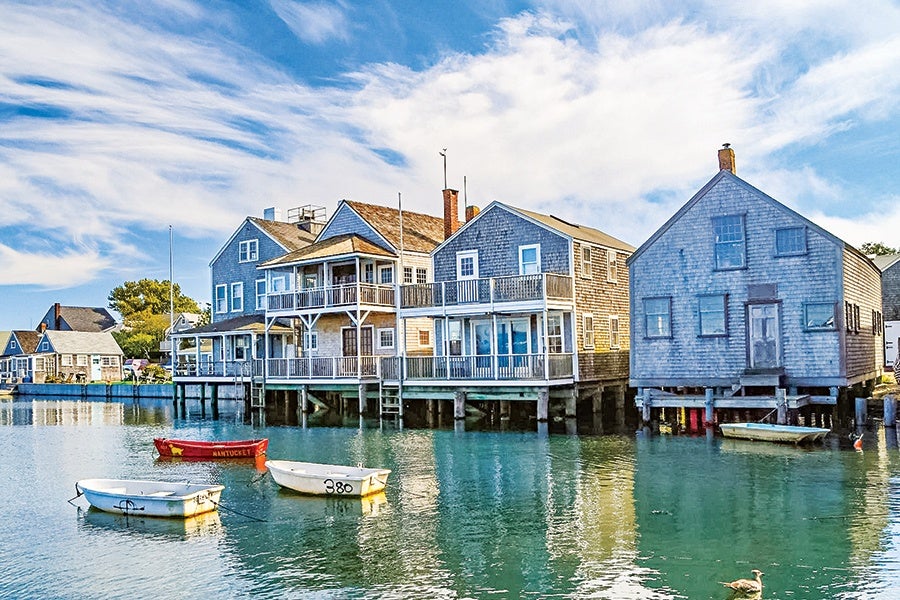
Photo by Dennis Weeks/Creative Commons
A few weeks after the Christmas Stroll, I find myself on a chilly January day in downtown Nantucket. Locals describe winter here as “peaceful,” although another apt term would be “dead.” As I texted my wife on the lonely ferry ride over from Hyannis, “I think there might be more golden retrievers on board than people.”
Fortunately, I discover that plenty of islanders, perhaps because they’re bored stiff, are game to chat, including Bernadette Meyer, an engaging woman who happens to be one of Nantucket’s most successful real estate agents.
“Nothing surprises me anymore,” she says when we start talking about Nantucket’s housing market. Not only have home prices nearly doubled since 2020—the median price now tops $3.5 million—but buyers, who once hailed mostly from New England and New York, are coming from all over, including Florida, California, Texas, and Europe. (The Texas connection initially perplexes me—it seems an odd cultural match—until I’m reminded that Houston in August is the most miserable spot in the entire Western Hemisphere.)
The common link among these New Nantucketers is money. Lots of it. Look at the windows of local real estate offices and you’ll see no shortage of houses on the market for $10 million, $20 million, $30 million. And oftentimes that’s just the starting point. Meyer tells me about a client of hers who bought a home on the island for $14 million—and is now putting another $15 million into it.
Of course, when it comes to extreme wealth, this isn’t—pardon another Texas reference here—Nantucket’s first rodeo. Back in the 18th century, the island was the center of the lucrative whale-oil industry, which helped light and lube a growing nation. “It was really the Silicon Valley of its time,” says William Cohan, the New York–based author and journalist who’s written frequently about Nantucket in recent years. (More on Cohan in a moment.) But the dominance of Big Whale Oil didn’t last forever, and when it was disrupted by electricity, Nantucket slumped. Indeed, as one local tells me, the difference between Nantucket in 1900 and Nantucket in 1960 wasn’t really that big.
So how did that Nantucket become the high-priced one we’re now obsessed with? Well, lots happened, but there were a few significant moments of change. One was the 1970s, when local land conservation efforts kicked into high gear; today, more than 50 percent of Nantucket is off-limits to development, which has not only preserved the island’s back-to-nature vibe but also created scarcity in the real estate market. The ’70s were also the period when New Yorkers first started summering on Nantucket in significant numbers, drawn by a runway extension at the island airport that allowed jets to take off and land.
Speaking of New Yorkers: Even more came in the late ’90s and early 2000s, when paydays on Wall Street started getting really huge. Nantucket real estate agent Robert Young—whose family has owned a bike shop in the wharf area for generations—remembers that in the year or two after Goldman Sachs went public in 1999, no fewer than 10 partners built pricey homes on Nantucket. Also going all in on Nantucket during that era was Boston developer Steve Karp, who in 2005 spent $75 million on 50 island properties and pushed the island, hardly a shabby place, in an even more upscale direction.
The most recent period of disruption was COVID. Suddenly running their businesses via Zoom, CEOs and finance titans began to realize they could really live anywhere, and many of them hightailed it to places like Wyoming, Colorado, and especially Florida. “Florida is a great place to live 10 months out of the year, but where were they going to go for the other two months?” asks Meyer. For a growing number of America’s wealthy, the answer has been Nantucket.
The island’s natural beauty is one reason for that; its chill vibe is another. Nantucket may now have the net worth of a midsize European nation, but its old ways still hold: Ratty summer shorts and worn Top-Siders are perfectly fine attire.
Of course, maybe the biggest reason for the mass gathering of the rich on Nantucket is what we might call Newton’s Third Law of High-Net-Worth Individuals, which states that if you put two billionaires together in the same space, they will instantly attract two more billionaires. And then those four billionaires will instantly attract four more billionaires…and so on.
“It’s an enclave,” Boston real estate developer Bruce Percelay, also the publisher of N Magazine and the Nantucket Current, says of the island. “People can be themselves here because they’re surrounded by other wealthy people. There’s no apologizing for your success.” Nantucket is so clubby, Percelay continues, that well-known people don’t even bother to unlist their phone numbers. I’m a little skeptical about that claim—until I go to the Nantucket Atheneum, ask for a copy of the phone directory, and indeed find numbers for David Rubenstein and Wendy Schmidt (wife of Eric).
While Percelay emphasizes chumminess, others point to a different reason for the gaggle of billionaires: status. One of those people happens to be Percelay’s media competitor, David Worth, a retired business exec who a few years ago put together a group to buy the Nantucket Inquirer and Mirror, the island’s 200-plus-year-old newspaper. (Worth is a fitting owner: His family was among Nantucket’s first white settlers.) “There’s a portion of the population that has got a lot of money and wants the validation that comes from being with other people with a lot of money,” Worth tells me. “They want the reflected status of attaching themselves to other wealthy people.”
It goes too far to say the influx of the rich has had no impact on Nantucket. They’ve certainly driven up real estate prices, which has, in turn, created a crisis for the non-wealthy people of Nantucket—many of whom are being priced off the island. It’s a problem, and most islanders know it.
That said, the general consensus is that Nantucket’s spirit hasn’t really changed. Today’s mega-rich Nantucket is not really so different from the merely affluent Nantucket that preceded it, nor from the middle-class Nantucket that preceded that. “You don’t usually see people driving around in Bentleys,” Percelay says. “Last summer I think I saw one, but that person does not get Nantucket.” He pauses. “Nantucket is a language. There’s an underlying expectation of behavior.”
To emphasize his point, Percelay tells me a story. Recently, an impressed-with-himself diner at local restaurant Galley Beach kept snapping his fingers, trying to get his server’s attention. When the server came over to ask how she could help, Mr. Finger Snapper said he was in a big hurry and needed to close out his tab right away. “Mine’s the Amex Black Card,” he instructed.
The server came back a moment or two later and unfurled her shirt, at which point any number of Black Cards spilled out and landed on the table. “Which one’s yours?” she asked.
Percelay laughs. “Don’t try to be important here.”
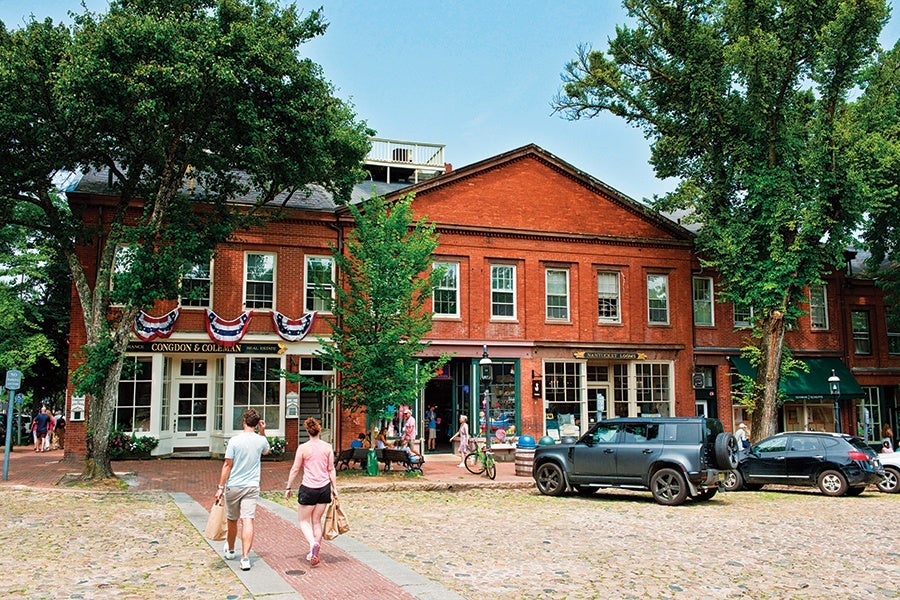
Photo by Paul Marshall/Alamy
Nantucket was never an unknown place—the island is central to Melville’s classic Moby-Dick; its signature red pants feature prominently in the nearly-as-influential The Official Preppy Handbook from 1980—but there’s no question there’s been an increase in interest in the island over the past decade, an uptick in its status. In 2016, the Financial Times was one of the first publications to report on the influx of Really Big Money in a piece headlined “Why Homes on Nantucket, Massachusetts Are Reeling in the Rich.” Two years later, Forbes noted that real estate prices on Nantucket had actually exceeded those in the Hamptons. Two years after that, Vanity Fair reported that some of those pricey homes, alas, were in danger of falling into the ocean thanks to climate change.
The author of that Vanity Fair piece was William Cohan, a Wall Street–exec-turned-writer who’s made a career out of reporting on the rich and powerful—and who’s arguably become the foremost chronicler of Nantucket’s (occasionally misbehaving) money crowd. In addition to that Vanity Fair story, Cohan has written pieces about the island for Town & Country, Air Mail, and Puck—the last of those offering a tasty account of a battle involving billionaires Steve Karp (of real estate fame), Charles Johnson (of Franklin Templeton Investments fame), and Charles Schwab (of, um, Charles Schwab fame) over a planned clam shack on Nantucket’s wharf. The gist: Johnson, and initially Schwab (who later changed sides), were concerned that said clam shack was going to attract Very Loud People, which billionaires who live nearby do not appreciate. After a going-to-the-mattresses period involving lawyers and threats and Johnson taking his private jet to a select board hearing, the dispute was resolved (with help from—he’s everywhere!—Bruce Percelay).
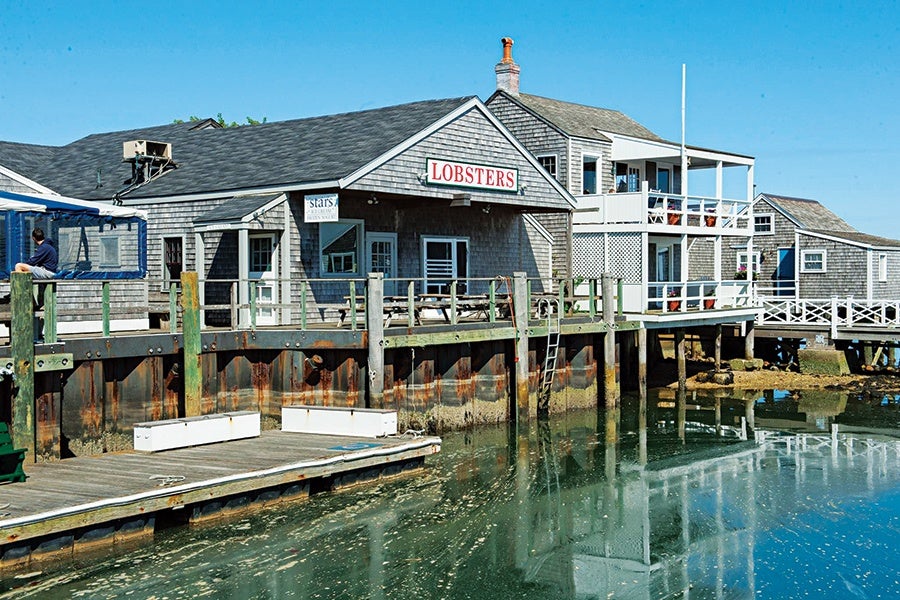
The Straight Wharf Fish clam shack was at the epicenter of a billionaires’ legal battle. / Photo by Gabriel Frasca and Kevin Burleson
Cohan has had some sport with Nantucket in recent years, but when we talk, it’s clear he has deep affection for the place. His family vacationed on the island when he was a kid, and in 2009, he bought a summer home there (albeit one whose existence is threatened by the coastal erosion he wrote about in 2019). Cohan tells me he and his wife have made great friends on Nantucket through the years—people who are smart, interesting, and accomplished. “It does attract people who’ve been successful,” he says. “And it’s fun to just hang out with them in this incredibly beautiful setting.”
As for the bad behavior he’s chronicled among the Nantucket billionaire set, Cohan says it might tell us more about the media age we’re in than Nantucket’s fundamental character. “There’s actually still a Puritan streak on Nantucket,” Cohan says. “But now with social media, one little thing happens and—boom!—it blows up.”
I should note here that not all of the news from Nantucket is of the scandalous or eye-rolling variety. There’s now a whole vein of Nantucket-related content online that’s decidedly celebratory and aspirational, offering ways that you, too, can be a Prep and no longer care about the trend cycle. “These 18 Nantucket-Inspired Dresses Will Make You Look Old Money Rich,” Us Weekly’s website gushed last year, rounding up a dozen-and-a-half outfits that are “comfy, classy and all sorts of chic” and that “start at just $18!” (A good Prep loves a deal.) Influencers have also become attuned to Nantucket. On Instagram, a search for #Nantucket will net you 1.2 million posts, while inputting “Nantucket” on YouTube will give you an endless stream of videos, from “My Favorite Places in Nantucket” (courtesy Rich Person Bethenny Frankel) to “A Week in My Life on Nantucket” to “I Survived on America’s Richest Island with $0.” (To which I say: too far, friend. A good Prep is thrifty, not a mooch.)
When it comes to #NantucketLife, no one has been more of an evangelist than author and Nantucket resident Elin Hilderbrand. Over the past quarter century, Hilderbrand, who’s sold more than 20 million books, has written two dozen bestselling beach reads that essentially feature Nantucket as the main character. Her secret? Her ability to blend beautiful Nantucket with bad-behaving Nantucket.
That was the secret sauce of The Perfect Couple, Hilderbrand’s 2018 novel that became a six-part Netflix series in 2024. Filmed mostly in Chatham (with some exterior shots of Nantucket for authenticity), the series had it all—money, sex, drugs, great settings, good cheekbones, and a deliciously nasty Nicole Kidman as the main character. It did so well—the series was among Netflix’s most streamed programs of the year—that this year Peacock is rolling out a streaming version of Hilderbrand’s The Five-Star Weekend, which filmed on Nantucket last fall. Hilderbrand told N Magazine that the series’ stars—especially Jennifer Garner—fell in love with Nantucket. “She’s like, ‘Elin, I am in heaven,’” Hilderbrand shared.
Which, you know, was basically correct.
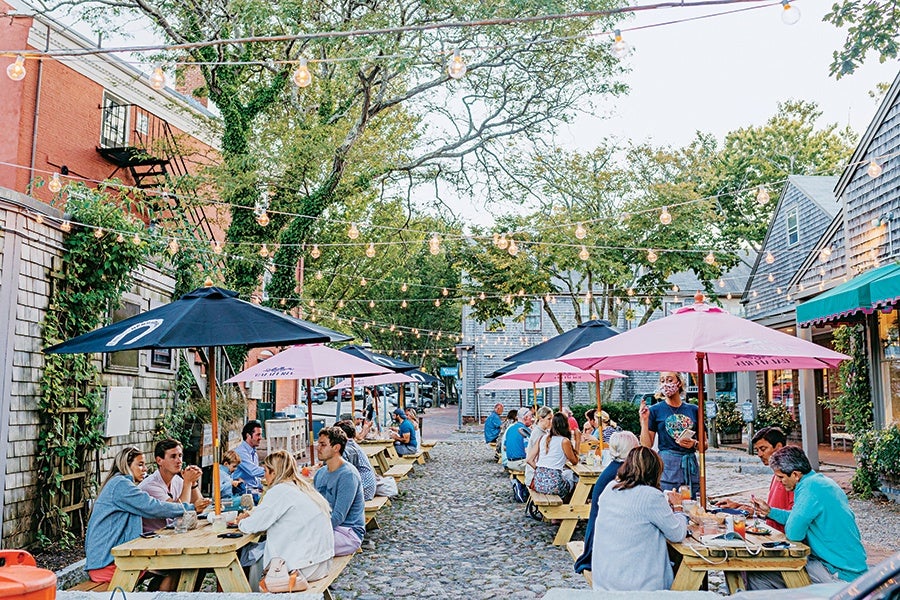
Photo courtesy of Nantucket Chamber/Emily Elisabeth
In many ways, the current cultural obsession with Nantucket is easy to understand. From Shakespeare to Succession, we’ve always been enthralled with the rich and powerful. On the one hand, we want to know what it’s like to live their lives; on the other hand, we can’t believe how good it feels when they behave like asses. It’s such a magical way to balance the scales—to chainsaw such people down to size. Okay, I might not be rich. But at least I’m not a douchebag trying to shut down somebody’s clam shack.
But I’d argue there’s an additional layer to our fascination with Nantucket. Most of the people I talked to for this story emphasized that, despite the number of billionaires on the island, it isn’t really like other ultra-wealthy places. There are lots of gorgeous homes, but most of them are not the old-money, ostentatious mansions you see in Palm Beach or Newport. There’s a social scene, but it’s not defined by the exhausting social climbing and name-dropping that typifies the Hamptons. And while of course there are wealthy boldfaced names on Nantucket, they’re not the kinds of “stars” you associate with Martha’s Vineyard (Oprah, Carly Simon, Larry David, the Obamas). Nantucket’s heavy hitters are people who—at least before COVID—got up and went to offices and sat in boring meetings and tapped things on computers, just like many of us do. They just happened to make a billion bucks doing it.
The point: For all its wealth, Nantucket is actually kind of…normal. Granted, it’s the most perfect version of “normal” you could imagine—the cute cottages! the unbelievable sunsets! the golden retrievers!—but “normal” nonetheless. Indeed, it’s the kind of place many of us imagined ourselves having access to if only we worked hard and got into good schools and played by the rules.
The problem? The world no longer seems to work that way—or maybe it only ever did for a few people. And so when it comes to Nantucket, the rest of us press our noses against the glass, fascinated, appalled, and occasionally envious, while fingering the fabric on an $18 frock.
It’s the kind of place many of us imagined having access to if only we worked hard and got into good schools and played by the rules.
How much longer will our Nantucket fascination last? Perhaps that question is connected to another: How much longer will Nantucket last?
I’m not referring to the shoreline erosion—though houses dropping into the ocean would at least have me checking my homeowner’s policy. I’m referring more to Nantucket as it currently exists.
Among a couple of people I spoke with, there was concern about the future, at least when it came to the have/have-not divide I mentioned earlier. “Here’s the misconception,” one person says. “The people who make their living on Nantucket are not wealthy. They struggle with the cost of living. They struggle for housing. The middle class is getting priced out.”
There’s a moral component to that complaint, but there’s also a practical one. The people we’re talking about are the ones who keep Nantucket running—cops and firefighters and teachers and nurses and town employees. A growing number have already abandoned ship, so to speak, and make their daily commute via ferry from the mainland.
To Nantucket’s credit, there are efforts afoot to deal with the issues. There are plans for more affordable housing, and Percelay has led the charge on ending hunger on Nantucket with an organization that pulls together all the different forms of support that are out there. All of that is to Nantucketers’ credit—it speaks to the sense of community people told me about—but the responses feel more like Band-Aids than actual cures.
Then again, if you have enough money, you can pretty much buy Band-Aids forever. And Nantucket has enough money.
The day I was leaving Nantucket, I took a walk. I’d seen a home listed for nearly $32 million, and I wanted to get a close-up look at it. The house was in the most affluent part of the island—Monomoy—and while that was a mile-and-a-half away from where I was staying, I decided to hoof it. The wind had kicked up, and so this was not the most enjoyable stroll I’d ever had. But after about 20 minutes I finally made it.
When I got there, I looked at the house, then got out my phone to double-check the address. This place?
It’s not that it wasn’t nice. It was really nice. It was on more than an acre of property, and the view was spectacular, and it had the cedar-shingled Nantucket look you see all over social media. Then again, it seemed like it could use a little work, and the house next door was kind of on top of it. $32 million?
I write that as if I were wrestling with whether I had an interest in this place, which, of course, I didn’t. Mostly because I don’t have $32 million.
But somebody does—probably someone who has a Black Card, maybe someone who speaks Nantucket. I hope they enjoy it. Then again, if I ever see that person in a video, caught up in a melee with a sweater tied around their neck, oh my God, I’m going to laugh so, so hard.
This article was first published in the print edition of the April 2026 issue, with the headline,“Fantasy Island.”