The Night They Came for the Nonantum Street Lines
In a Newton enclave with its own dialect, culture, and traditions, the removal of three painted stripes became a fight over who gets to stay.
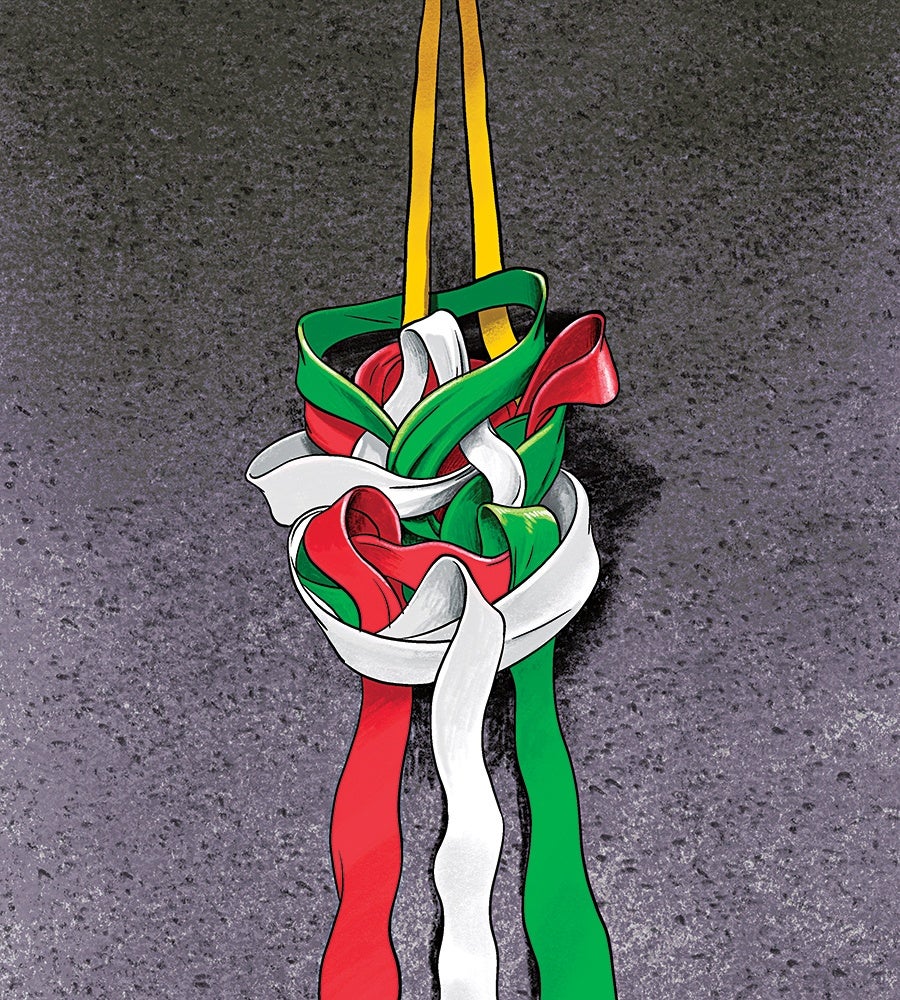
Illustration by Zohar Lazar
On June 26, 2025, in the dark of night, they came without warning. The dogs on Adams Street felt it first and started barking. Then the ground started shaking, and a loud grinding sound filled the summer air. Residents came out of their homes to see a vehicle moving slowly up the street toward Our Lady church, unleashing clouds of billowing dust on either side. “The only thing I could think was, ‘Are we being invaded?’” Daniella Proia said afterward. And in a way, she believes, they were.
The truck was grinding off the tricolor red, green, and white street lines that had marked these roads for as long as anyone’s mother’s mother could remember—a quiet tribute to the neighborhood’s Italian-American heritage. It was doing so three weeks before the Festa, the five-day celebration hosted by the St. Mary of Carmen Society that is the most important event of the year in Nonantum. Behind the truck came another vehicle, replacing the tricolored lines with standard yellow lines and then sealing them into place.
Residents came out and painted the old lines back on. Newton’s outgoing mayor had them removed again in August, citing public safety and traffic concerns. Then the story went national, and even international, circulated in the Italian press.
The lines were missing for eight months, until earlier this month, when Newton officials restored them. Residents say it’s the longest time they’d ever gone without the tricolor flourish. Their removal, Proia said, was like having something ripped from her body. And maybe that’s because the battle was never really about the lines. It was about something far harder to paint over: one of the last proudly working-class neighborhoods in Greater Boston, with a culture so specific it has its own mini dialect, trying to hold its ground against forces that want to erase what’s there.
“It’s like you’ve got this little neighborhood that’s kind of dancing to its own beat,” says Fran Yerardi, organizer of the Save Nonantum PAC. “It’s what neighborhoods used to be, and it’s just fighting to survive.”
The culture in Nonantum—also dubbed the Lake—last found its way into the national spotlight in 2014, when the neighborhood’s most famous son sat down with Conan O’Brien. Matt LeBlanc, raised in the Lake, gave an example to the late-night audience of something that might be heard on the streets of Nonantum: “We were down on the corner the other day, and there were some quiester jivals down there, mush”—meaning, for those who don’t speak Lake lingo, that there were some “really pretty girls down there, buddy.” LeBlanc noted, correctly, that some of his friends back home were losing their minds watching, because people who are truly from the Lake didn’t need anyone to explain it to them.
Nonantum is a village of Newton wedged between the Charles River and the Massachusetts Turnpike. It spans just over half a square mile and is the most densely populated of Newton’s 13 villages. Its history is the history of the working class. In 1778, industrialist David Bemis built a paper mill here, and for the next 150 years, the area was a center of manufacturing—wool, cotton, rope. Irish, French-Canadian, Italian, and Jewish immigrants came for the mill work and stayed. More Italian immigrants arrived as factories cropped up along Silver Lake—the body of water that gave the Lake its nickname before it was filled in during construction of Storrow Drive. A housing boom to construct dwellings for the workforce ensued between 1860 and 1910. For most of the century that followed, it remained a dense, close-knit neighborhood of single and two-family homes. Until recently.
The rest of Newton went a different way. An 1880 real estate listing in the Boston Evening Transcript advertised Newton as a city for “citizens of intelligence and refined culture.” Chestnut Hill got its wooded estates. West Newton Hill got its Victorian mansions. The Lake got its people—and kept them.
The slang LeBlanc performed for a national audience is not a novelty act. It is a living dialect, still spoken on these streets—words like wonga (money) and divya (crazy)—with roots that trace back to a lesser-known chapter of the neighborhood’s history: the Roma. The popular lore is that the lingo was picked up from traveling carnival workers. But according to Richard Dezotell, who grew up in Nonantum, Anglo-Roma families like his put down roots in Nonantum, married, and spoke the lingo with their Jewish and Italian neighbors—although they rarely discussed their heritage outside of the Lake for fear of anti-gypsy stigma.
For a culture this specific to survive, the people who carry it need to be able to afford to live here. That is becoming harder every year. “We’re a melting pot—a lot of people came from everywhere, not just Italy,” says Bo Pellegrini, a longtime resident. “We have our own culture.”
They also have a way of life that’s becoming increasingly rare in Boston. Jennifer Leone is a schoolteacher who built a home attached to her parents’, essentially turning it into a two-family on property that has been in her family for four generations. “It’s a really tight-knit community,” she says. “People know each other, watch out for each other, and help each other,” adds her mother, Linda Donalds. “It’s unique.”
But it turns out being unique hasn’t kept the neighborhood safe.
The threat to the Lake is not abstract. It’s arrived in the form of permits. Old single-family homes are being purchased and converted into multifamily buildings where each unit sells for more than the original house was worth. The younger generation, says Teresa Gentile Sauro, chair of the Nonantum Neighborhood Association, wants to stay—but increasingly can’t. “They’re knocking down these single homes and putting up two- to three-families, going over a million dollars,” she says.
Emilio Mazzola, who taught Italian at F.A. Day Middle School and Newton North High School for 40 years, says sometimes he cries over the fact that his children can’t afford to buy a home anywhere near the area where they were raised.
The affordable units in new developments are either too few or too expensive, even at the discounted rate. And in the wake of George Floyd’s killing, Newton city councilors voted to change their local-preference affordable-housing policy—which dictates how many affordable units are set aside for people from the area—from 70 percent to 25 percent. The goal was to address discriminatory effects and advance fair housing outcomes. The Newton voters who were most affected by this were working-class residents and municipal workers struggling to maintain community ties.
The frustration boiled over into city council meetings that became screaming matches. Residents told councilors they felt talked down to, that their concerns were not being taken seriously. The neighborhood organized its own PAC and successfully turned over seats on the council. Some residents came to see the removal of the street lines by outgoing mayor Ruthanne Fuller as retribution against an enclave that didn’t support her politically. (Fuller declined a request to comment.)
Nonantum’s predicament is sharpened by one additional irony: Despite having no direct MBTA bus stop, it’s still a preferred site for new development in Newton. “Whenever Newton has some greater social good to accomplish, but it requires installing something they wouldn’t want in their own backyard,” says Jordan Lee Wagner, a member of the neighborhood’s long-standing Jewish community, “they dump it in Nonantum.”
Newton’s new mayor, Marc Laredo, found an elegant workaround to the street lines impasse. By painting designated parking spaces which narrowed the road in March, he changed its classification—suddenly, the road required only a single white reflective strip rather than two yellow ones. The white stripe of the tricolor would serve that purpose perfectly. What had been ruled a traffic violation became, overnight, the legal solution. It was a genuine olive branch, and the neighborhood received it as one.
But Laredo is clear-eyed about what no mayor can undo. “It is almost impossible to battle market forces, in that Newton is a very desirable community,” he says. Close to Boston, great schools, “that’s what makes a community so attractive. And making a community attractive, by definition, is going to make housing prices somewhat higher. There’s always that trade-off.”
Residents are cautiously hopeful, for the first time in a while, that this administration might actually listen before it hands down decisions from on high.
The lines, now that they’re back, are red, white, and green. They will mark a street that looks, on the surface, like it always has. Whether the Lake can remain a place where the people who speak its language can afford to live is a question no amount of paint can answer.
“I think that is a massive step, and it’s going to carry a lot of goodwill,” says John Oliver, a city councilor who represents Nonantum. “I hope it’s a symbol of more to come.”
So does everyone else on Adams Street.
An earlier version of article was first published in the print edition of the May 2026 issue, with the headline,“The Writing on the Road.”