
So, You Want to Live in Plymouth?
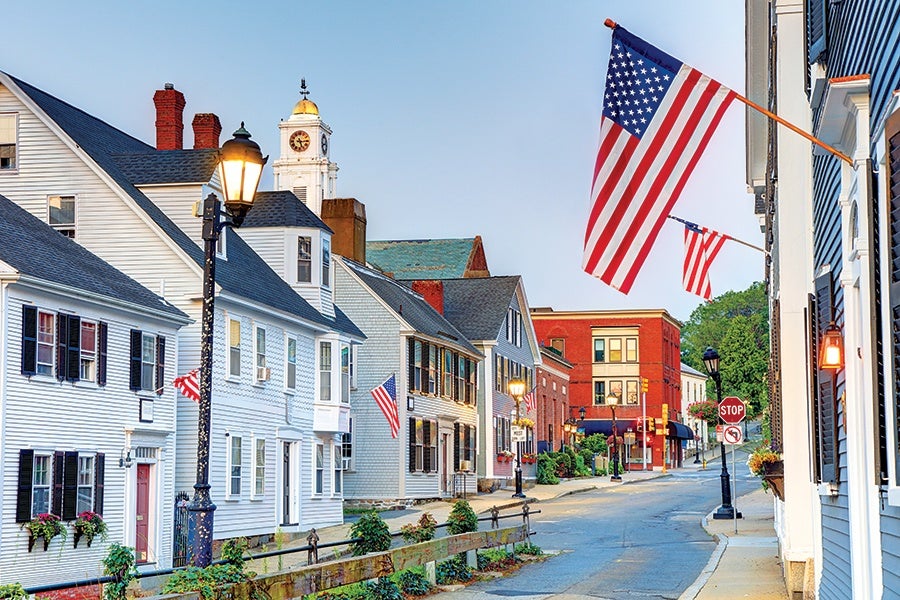
Photo by Dennis Tangney Jr./Getty Images
1. Pick Your Price Point
Real estate prices aren’t through the stratosphere here, at least not yet: Smaller single-family homes and condos hover between $600,000 and $700,000; for buyers looking for something more upscale, the Pinehills development features a mix of new, move-in-ready, and custom homes, with townhomes starting under $800,000 and single-families priced between $1 million and $2 million.
2. Plot Your Commute
Commuters have a pretty straight shot into Boston: The ride to South Station takes about an hour on the Kingston Line (about a 10-minute drive northwest of Plymouth). If you’d prefer to drive, Plymouth to Boston via Route 3 typically takes around 45 minutes, but during peak rush hour, the trip can stretch to 90 minutes.
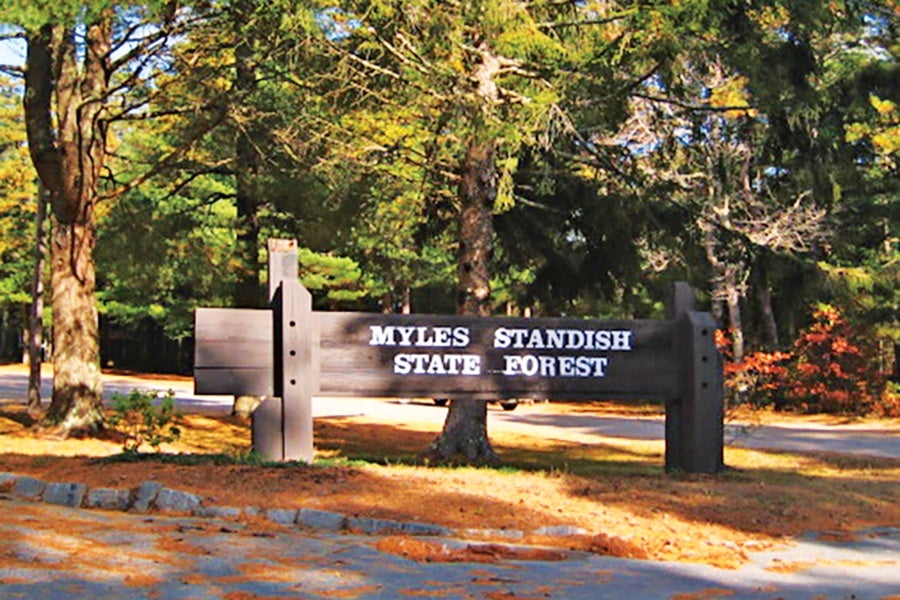
Photo via Creative Commons/OldPine
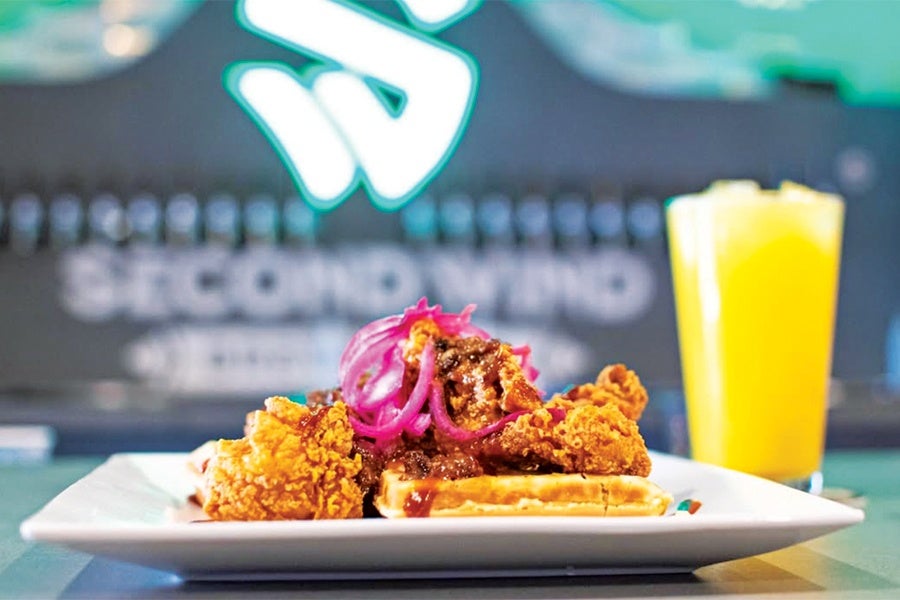
Photo courtesy of Second Wind Brewing
3. Take in the Vibe
Plymouth is often noted for its classic New England charm, particularly its downtown waterfront district. Second Wind Brewing opened its long-awaited Main Street Taproom and Kitchen last year; other popular spots include Vitamin Sea Brewing and Turmeric House, known for its Indian and Nepali dishes. For outdoor recreation, head to Myles Standish State Forest and Plymouth Beach.
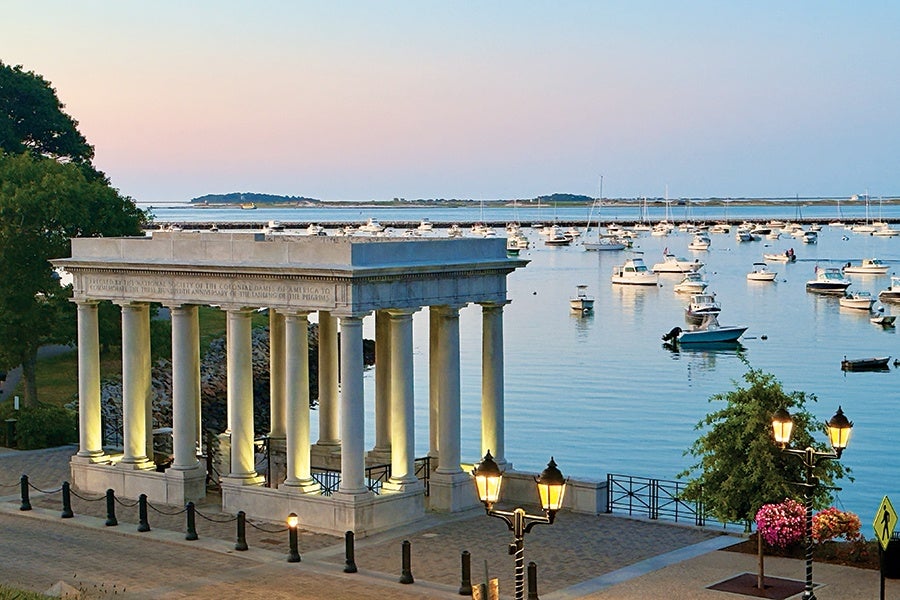
Photo by CapeCodPhoto/Getty Images
4. Check out the Culture
The town’s historical hub is centered around Plymouth Rock, thought to be the landing place of the Pilgrims aboard the Mayflower. If that’s not enough, the Plimoth Patuxet Museum’s exhibits include a full-scale reproduction of the ship. The Plymouth Center for the Arts, meanwhile, features galleries, classes, and workshops, and the Spire Center for Performing Arts hosts concerts, theater, and more.
5. Scope out the Schools
The public school system is made up of eight elementary schools, two middle schools, and two high schools, plus early-childcare options. There are a handful of public charter schools, including Rising Tide and Map Academy, but most private school options in the area are at least a 30-minute drive from town.
First published in the print edition of the June 2026 issue, with the headline,“So, You Want to Live in Plymouth?”
Photos: Catholic Charities Boston’s Annual Spring Celebration Gala
Catholic Charities Boston’s (CCAB) 19th annual Spring Celebration gala was its most successful yet, raising a record-breaking $1.8 million to support the organization’s mission. More than 400 supporters, along with community and business leaders, came together at the Fairmont Copley Plaza on May 27 to celebrate Catholic Charities Boston’s life-changing work.
Tim Sweeney, Liberty Mutual’s Chairman, President & CEO, received the organization’s 2026 John & Virginia Kaneb Justice and Compassion Award. In his heartfelt remarks, Sweeney said justice and compassion are not abstract ideals, but a collective responsibility. He also shared that the Liberty Mutual Foundation’s recently announced $600 million endowment will grow to $1 billion over the next few years to serve neighbors in need
CBS News Boston anchor Paula Ebben and Father John Unni of Saint Cecilia Parish emceed the event, which included a cocktail reception, dinner, a paddle raise to fund the mission, and inspiring videos of the people the organization serves.
Kelley Tuthill, President & CEO of Catholic Charities Boston, spoke about the individuals and families the organization serves and thanked supporters. “You give our neighbors hope that they won’t have to face their most difficult moments alone, and we are truly grateful to have you here,” Tuthill said.
Photography by John Gillooly

Archbishop of Boston Richard G. Henning, Kathy Flynn, Liberty Mutual’s Tim Sweeney, CCAB Board Chair Mark Kerwin, CCAB President & CEO Kelley Tuthill and former Boston Mayor Ray Flynn

Archbishop of Boston Richard G. Henning and CBS News Boston Paula Ebben

CBS News Anchor Paula Ebben and Father John Unni

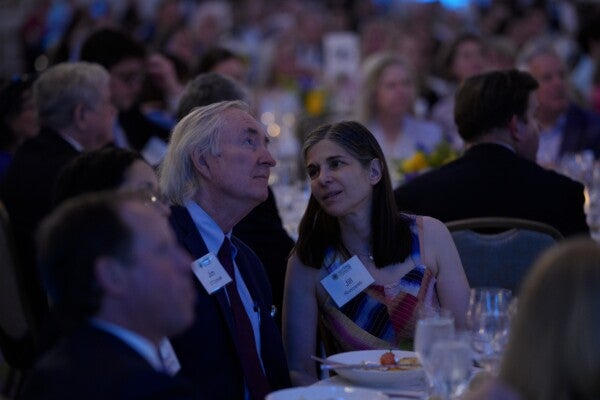
Dr. Jim O’Connell and Jill Roncarati
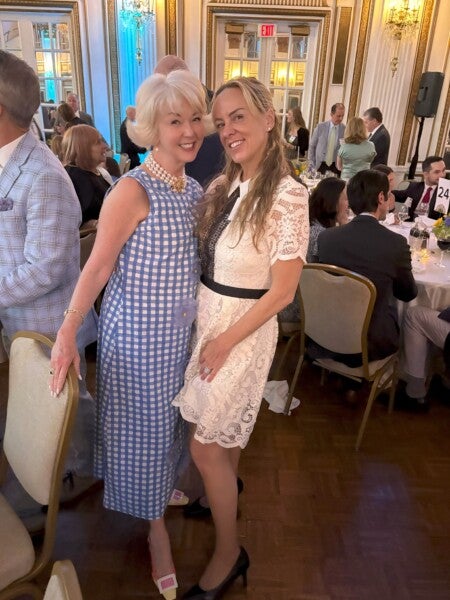
Elisha Daniels and Sue Brady Hartigan

Liberty Mutual Chairman, President & CEO Tim Sweeney

Liberty Mutual’s Tim Sweeney, Linda Hooley, Jay Hooley and Father John Unni

Suffolk Chairman & CEO John Fish, CBS News Anchor Paula Ebben, Catholic Charities Boston President & CEO Kelley Tuthill and Catholic Charities Boston Board Chair Mark Kerwin
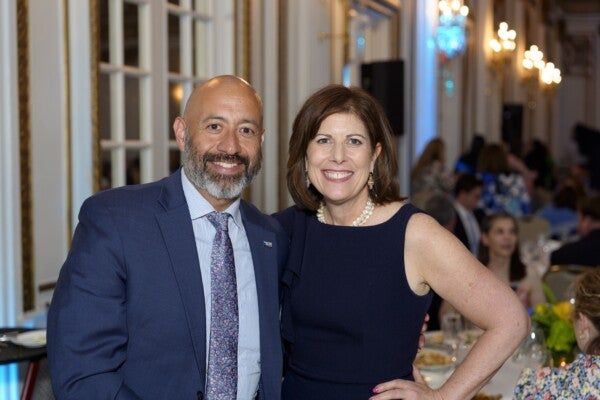
United Way of Massachusetts Bay President & CEO Marty Martinez and Catholic Charities Boston President & CEO Kelley Tuthill
| About Catholic Charities Boston For over a century, Catholic Charities Boston has served vulnerable individuals and families of all faiths and backgrounds. One of the most comprehensive non-profit providers of social services in Massachusetts, we offer programs across more than 20 locations throughout Greater Boston, with 450 employees serving thousands of individuals and families annually within the four core areas of Basic Needs, Family & Youth Services, Refugee & Immigrant Services, and Adult Education & Workforce Development. Rooted in our faith mission, we address critical social justice issues with compassion and aim to break the cycles of poverty in our communities by providing life’s necessities, education, and advocacy to move families toward self-sufficiency.For more information visit: https://www.ccab.org/ |
Six Summer Friday Essentials to Buy in Boston

Courtesy photo
For sunny rooftop lounging
Lunette Optic
One of the quickest ways to signal you’re off duty is with a great pair of sunglasses. At Lunette, you’ll find fashion-forward frames from luxury brands, along with the store’s signature line, Mora, that make more of a statement than your standard pair. Throw them on post-Zoom, and you’re instantly in vacay mode.
Back Bay and other locations, lunetteoptic.com.

Courtesy photo
For sunscreen you’ll actually want to reapply
Credo Beauty
A good summer Friday starts with SPF you won’t abandon after noon. At Credo Beauty, known for its rigorously vetted clean formulas, you’ll find sheer, mineral-based options that disappear into the skin without the usual chalky finish. It’s the one step that makes your “working from a patio” era feel just slightly more responsible.
Beacon Hill and Back Bay, credobeauty.com.

Courtesy photo
For carryalls that fit your laptop—and a bottle of wine
Loewe
Your bag should handle both sides of the day, fitting your work essentials while still feeling weekend-ready. Look to Loewe’s signature totes in woven leather or raffia for something that feels equal parts polished and escapist.
Back Bay, loewe.com.

Courtesy photo
For a well-timed pour
Simon Pearce
If your last email of the day involves a glass of rosé, you might as well pour it into something beautiful. New England maker Simon Pearce’s handblown glassware adds a sense of occasion to even the most casual Friday afternoon, making your kitchen counter—or back deck—feel a little more like a destination.
Back Bay and Chestnut Hill, simonpearce.com.
Courtesy photo
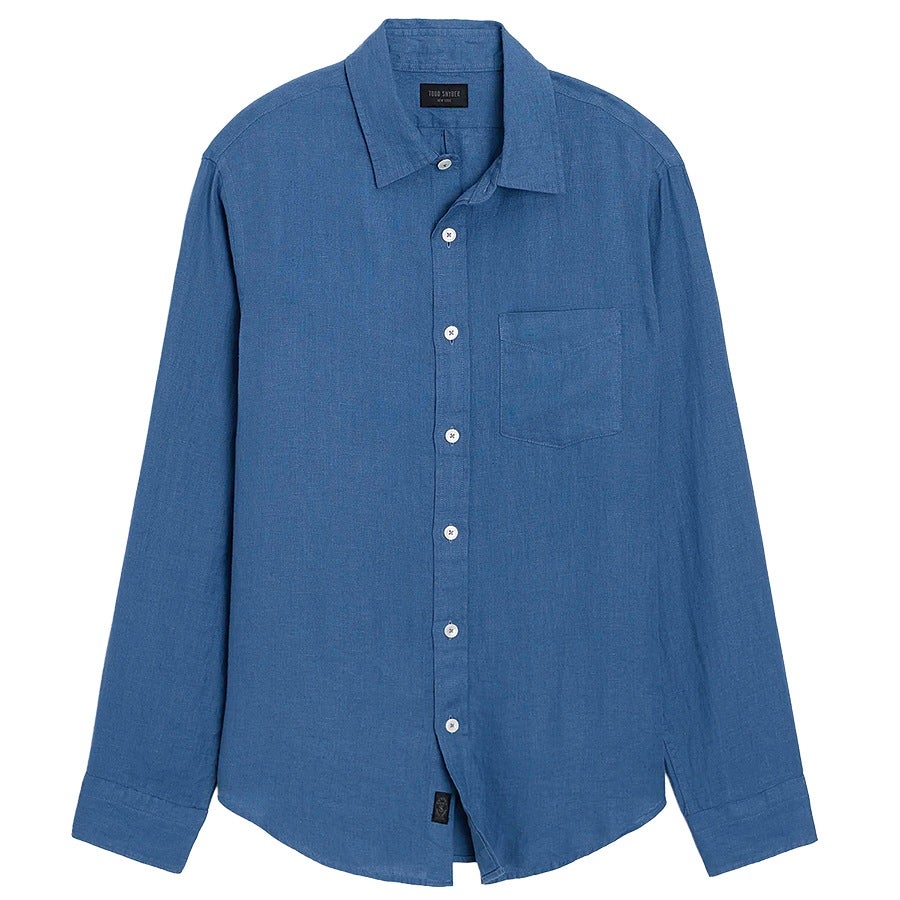
For the perfect al fresco shirt
Todd Snyder
Nothing bridges work and weekend quite like a linen button-down. Todd Snyder’s version is tailored enough for a last-minute meeting, but looks just right gently blowing in the breeze on your favorite Seaport patio. The slight rumple just makes it cooler.
Seaport and Chestnut Hill, toddsnyder.com.

Courtesy photo
For slides that go from desk to drinks
Veronica Beard
It’s no surprise that changing your shoes can simultaneously change your mindset. Swap your workday pumps for a pair of minimalist leather slides that can pull double duty at the office and wherever you’re off to next. It’s a small move that makes the whole outfit feel like a Friday.
Back Bay, veronicabeard.com.
This article was first published in the print edition of the June 2026 issue, with the headline,“Summer Fridays, Unplugged.”
A Lovely New Cottage Brings Light to an Old Truro Foundation
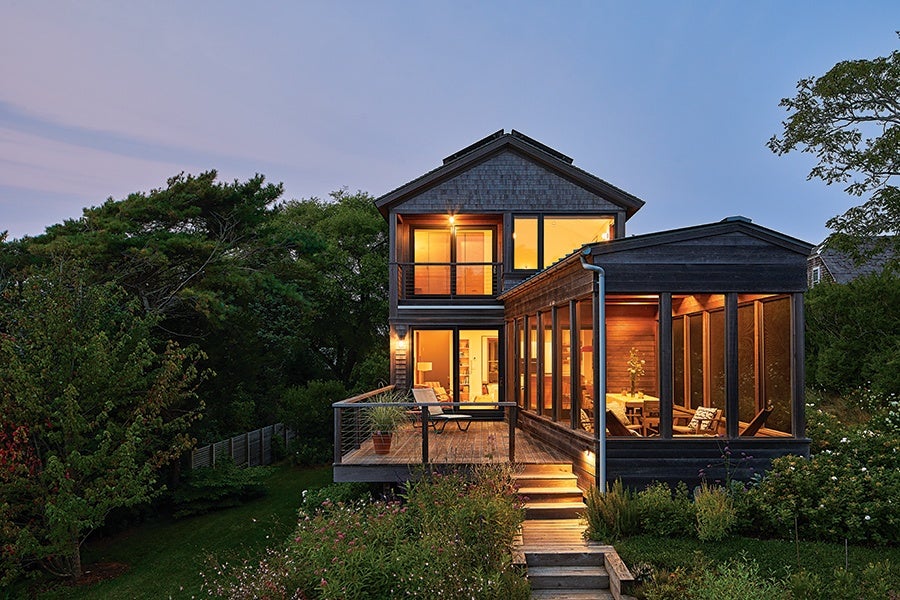
White-cedar and Alaskan yellow-cedar shingles marry native plants to maximize the lush natural environment of this Truro cottage, while oversized windows welcome sweeping tidal-marsh views. / Photo by Matt Kisiday
This article is from the summer 2026 issue of Boston Home.
Surrounded by a tidal marsh, this property on one of the prettiest roads in Truro was the ideal respite far away from the homeowners’ urban residence. Simple yet stylish, small but spacious, the new two-bedroom cottage accommodated them and occasionally their grown children so they could relive fond memories of Cape summers while creating new ones.
But the path to get here was studded with roadblocks. What began as a selective renovation of a 100-year-old home in a sensitive environmental and historic district morphed into a teardown when the design and build team learned there was structural damage and little history to salvage, says architectural designer Nick Waldman. With a clean palette, they built on the existing foundation, adding 3 feet along the north side and a breezy rear porch that rakes in the view.
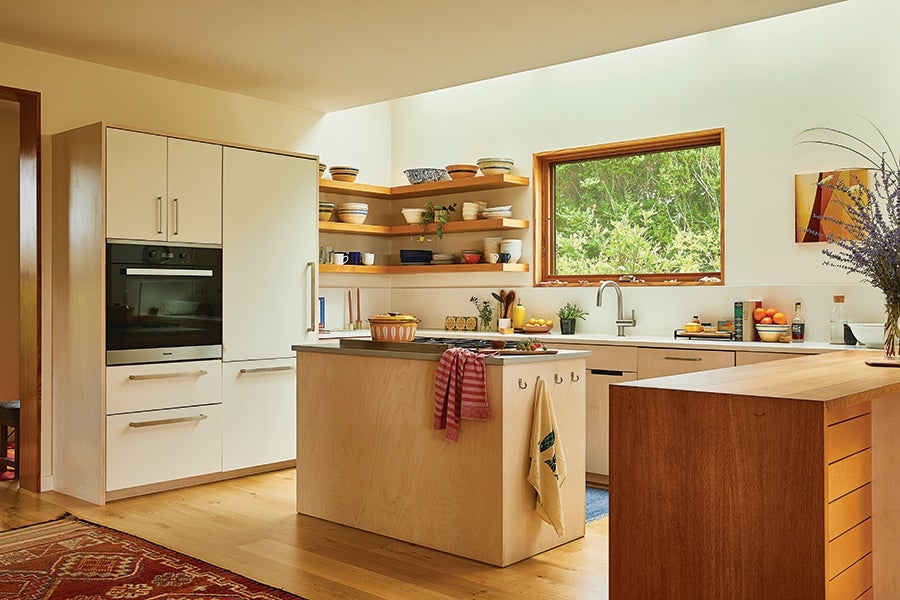
In the kitchen, which features open shelves instead of upper cabinets, wood tones and natural hues are paired with the homeowner’s vintage and thrifted pieces. / Photo by Matt Kisiday
“We wanted a house that fit in with the character of the road, that didn’t disrupt the natural, native landscape of Truro, that blended in and felt like it belonged here, like it has always been here,” the homeowner says. “The view is extraordinary. You walk into the house and you’re confronted with it, and it makes you feel like you’re in a wide-open, beautiful place.”
The multifunctional kitchen, living, and dining space takes full advantage of this fresh approach, with large windows on all sides and no walls to impede the view or the light that comes with it. Waldman maximized square footage here to expand this area for functionality and created a modern wall of skylights overhead to illuminate the cooking and eating zones. Floating shelves in white oak, in lieu of upper cabinets, maintain that buoyancy and show off the homeowners’ collection of midcentury vintage cookware and thrifted finds.
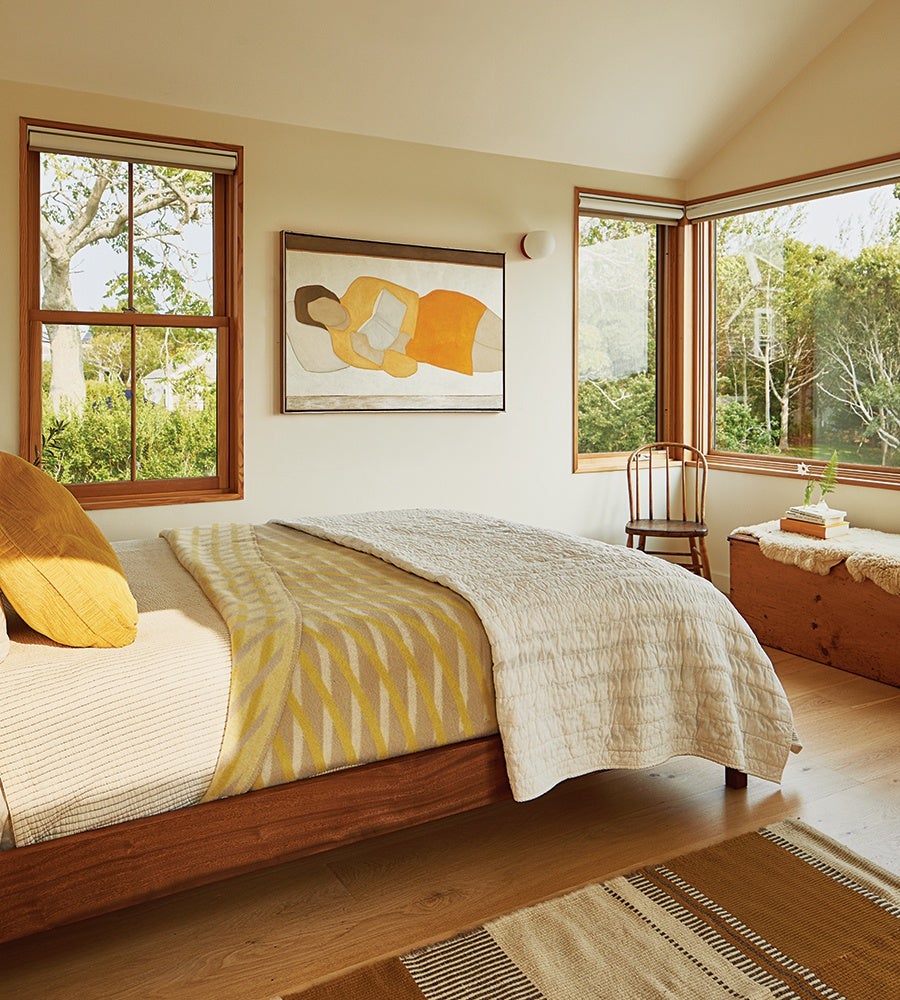
The primary suite takes advantage of water views with large Loewen windows and cathedral ceilings, while a warm palette sets a restful mood. / Photo by Matt Kisiday
“It’s loaded up with skylights, so that volume goes straight through here, which you can see in the elevations along this side,” Waldman points out. “The kitchen becomes part of the living room, with the same ceiling height, to reinforce that it’s all one space. The millwork itself does the job of creating the different ‘rooms.’”
Cathedral ceilings and picture windows on the second floor are a subtle bridge between bedroom privacy and light, making the entire abode positively radiant from the inside out. But from the outside in, it appears as if this modest rectangular cottage with its white-cedar shingles, traditional gabled roofline, and porches perfect for an afternoon sunset has been here all along.
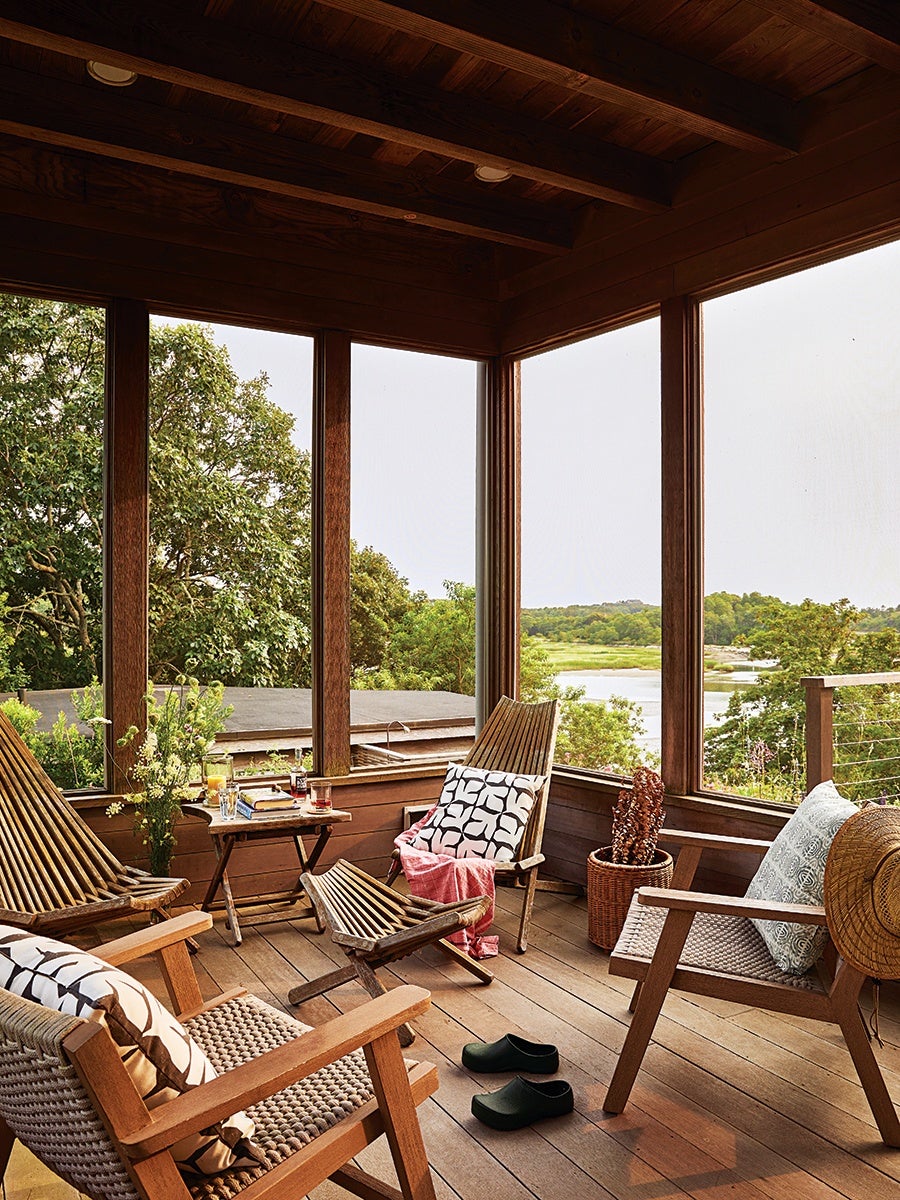
Teak seating and mahogany flooring on the all-wood screened porch speak to Truro’s coastal New England vibe. / Photo by Matt Kisiday
It was styled that way, too, the homeowner says. “It’s a mixture of old and new here, sort of a juxtaposition of an old vintage oriental rug or modern light fixture,” the homeowner says of their design style. “The lines of the house are spare and clean, and walls are painted white so we could add color with the items we found.”
Naturally, this captivating cottage has curated its next 100 years in the spirit of Truro’s historic charm, with scale, light, and an aesthetic that are true to this part of the Cape.
“The big thing that I like about this house is that everything is left to weather naturally,” Waldman says. “So not only is it a ubiquitous, appropriate material for the Cape, but it’ll last a long time and look beautiful when everything silvers out.”
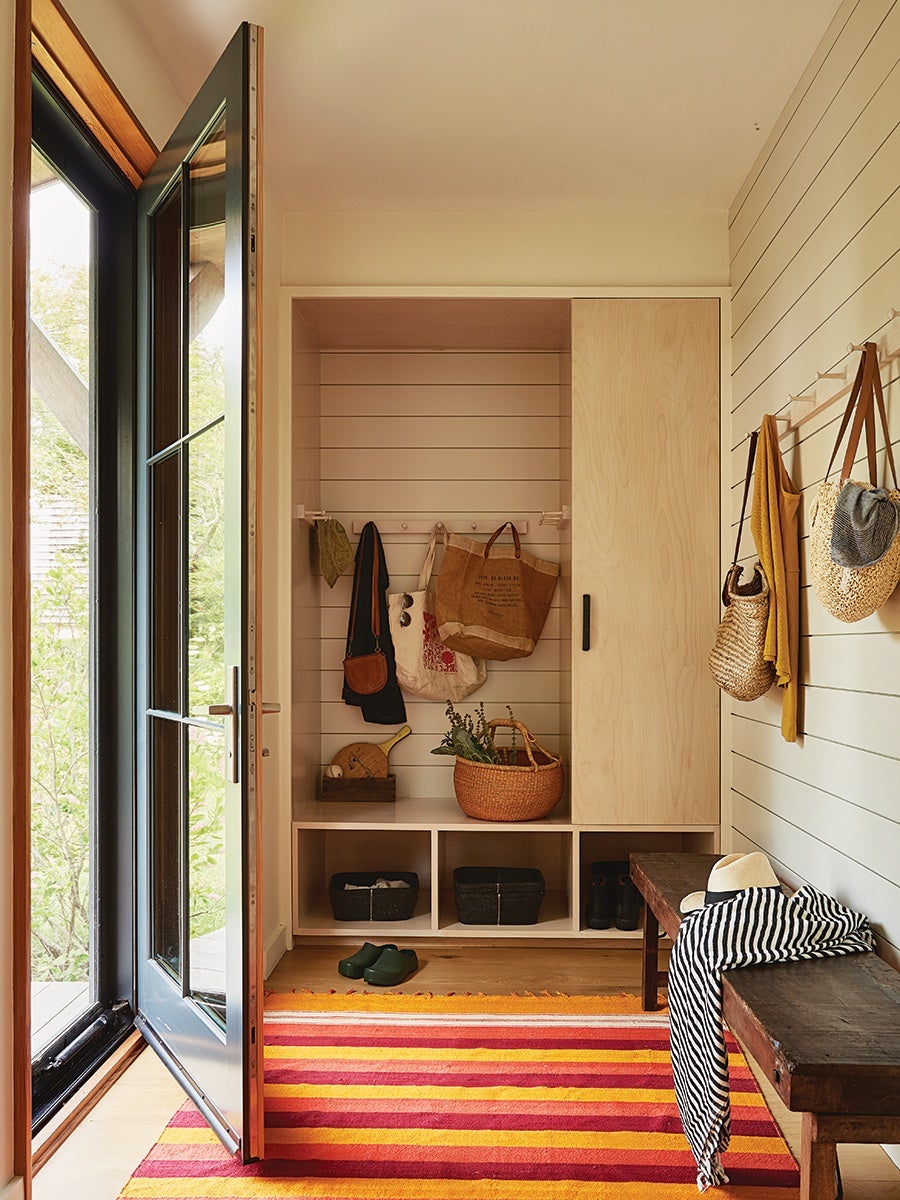
Custom cabinetry in Baltic birch and shiplap walls painted in Benjamin Moore’s “Cloud White” offer structure and style in the mudroom. / Photo by Matt Kisiday
Architectural Design Nick Waldman Studio
Contractor A.F. Hultin & Co.
Custom Millwork Shaw Woodworking
First published in the print edition of Boston Home’s Summer 2026 issue, with the headline “Built to Belong.”
The Nantucket Book Festival Wants to Send You Home Feeling Better About the World
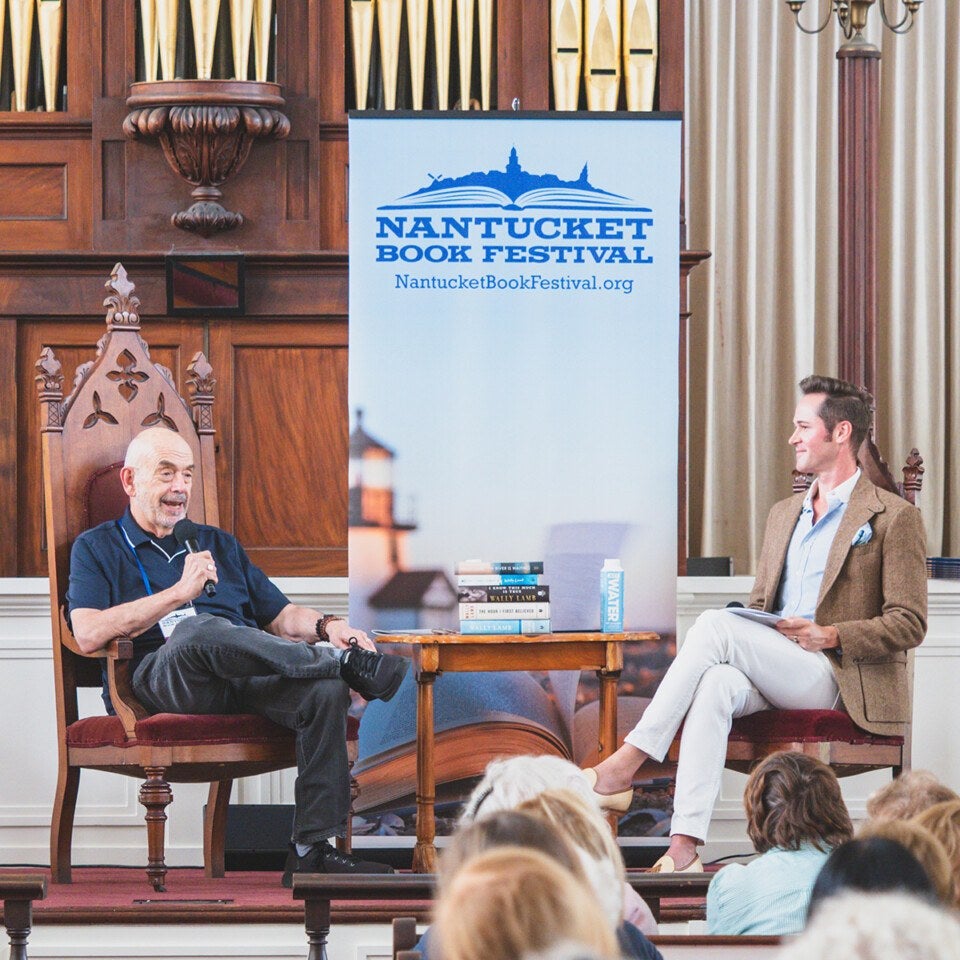
Author Wally Lamb talks with Tim Ehrenberg at the 2025 Nantucket Book Festival. / Courtesy
There was a moment at last year’s Nantucket Book Festival when it started to rain. The audience was gathered inside an old church, the kind of New England venue that already makes you feel like something important is about to happen, and poet and essayist Ocean Vuong was reading a newer work, “Theology,” before a packed holy house. (“Fitting,” Vuong noted at the start.) Something about the moment indeed felt celestial. Nobody moved. Nobody wanted to. “You could hear a pin drop,” says Tim Ehrenberg, president of the event, recalling the scene. “No one wanted to even move, because they were just so mesmerized by him reading his poetry. And you just can’t get that on your screen, on your phone, when you’re scrolling in bed—you don’t get that same human connection and experience. And that happens 32 times in our festival.”
That’s the case the Nantucket Book Festival has been quietly making for 15 years: that a room full of people listening to a writer they love is not only worth getting on a boat for, but worth making a special trip to savor. Next week, from June 11 through 14, the island event marks its crystal anniversary, and for anyone who’s never made the crossing—or who’s filed Nantucket away under “not for me”—the spectacular lineup of bold names (Norah O’Donnell, Richard Russo, Jenna Bush Hager) and cost (most events are free) makes a reasonable case for reconsideration.
The festival’s founding philosophy was never to go big. “Since we’re an island 30 miles to sea, we really want to host a small collection of authors, all different voices, all different genres, and give them their moment,” Ehrenberg says. “So each one has an event that’s pretty much just focused on their book. And then we host them—we have dinners, we have gatherings.” The result is something that feels more like a restorative retreat than a conference. As Ehrenberg notes, “you’ll see your favorite author, and then you’ll see them at the coffee shop.” That kind of casual proximity—the Pulitzer winner ordering a scone, the television anchor browsing shelves—is not something public events usually can deliver.

Jenna Bush Hager will appear with Shannon Garvey, Juliet Faithfull, and Emma Brodie, all authors with titles on the Today with Jenna & Sheinelle co-host’s imprint Thousand Voices. / Courtesy
This year’s roster reflects what Ehrenberg describes as “the full spectrum of the human experience.” Best-selling author Ann Patchett arrives with her brand-new novel Whistler, and sits down with Patrick Ryan, whose novel Buckeye (a “Read with Jenna” selection) became one of the quieter literary pleasures of 2025. The two are pals, and Ehrenberg is looking forward to that Saturday afternoon conversation. “If anyone ever wondered, ‘Do authors have friends; do they go to coffee and talk about their writing life?’ I think this is going to be an event where you see two writers just talking about the love of books and the love of their craft.” Elsewhere on the schedule: Tayari Jones, recently named one of Time’s 100 Most Influential People, discussing her novel Kin; Richard Russo, “a GOAT in the fiction world” as Ehrenberg puts it, in conversation about Empire Falls, which turns 25 this year; Jenna Bush Hager, whose book club has done as much as anyone’s in recent memory to keep literary culture alive on network television; and CBS News senior correspondent Norah O’Donnell, who’ll be in conversation with Linda Henry, co-owner and CEO or Boston Globe Media (which, full disclosure, also owns Boston magazine). And there’s also Belle Burden, whose controversial (and wildly popular) memoir Strangers has lately taken over group chats and will be in conversation with Elin Hilderbrand—a pairing that is, for anyone who knows how deeply Hilderbrand’s novels are woven into the fabric of Nantucket life, an event unto itself.
For the adventurous festivalgoer, Ehrenberg recommends a different strategy altogether: pick a name you don’t recognize and show up anyway. He points to Dr. Joshua Bennett, whose new poetry collection We (The People of the United States) carries particular resonance in 2026, and Massachusetts-raised writer Isaac Fitzgerald, whose American Rambler traces the trail of Johnny Appleseed. “Go to an event where you look at our schedule and you’re like, ‘I’ve never heard of that author,'” Ehrenberg says. “Just try it, and you will leave saying, ‘I just met my new favorite author.'”
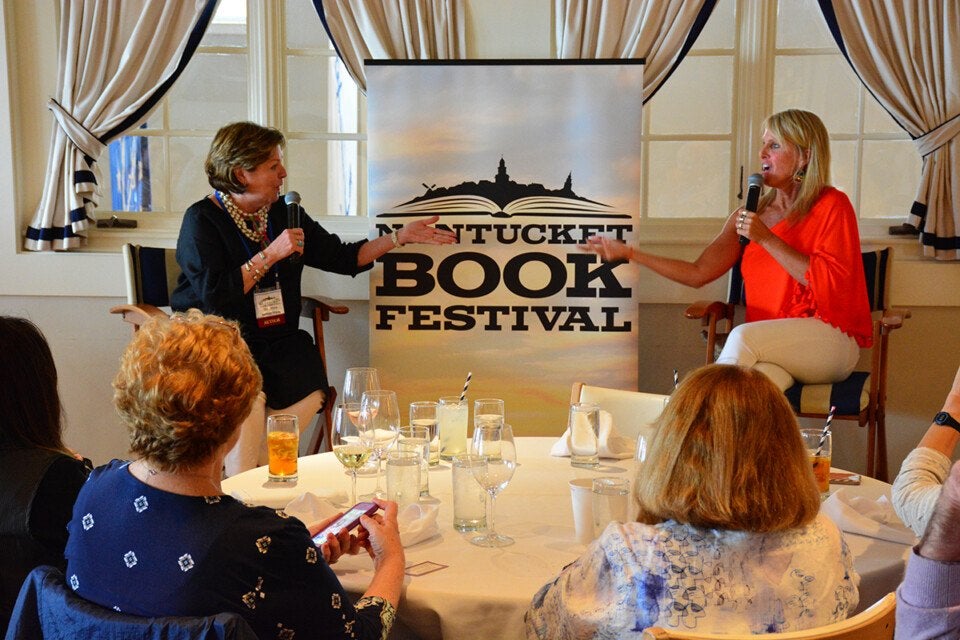
Novelists Dorothea Benton Frank and Elin Hilderbrand at the Nantucket Book Festival. / Courtesy
One more thing worth knowing, if you assume the festival requires an overnight stay: it doesn’t. Early morning boats from Hyannis arrive in plenty of time for the first sessions, and the last ferry departs after the final event. The logistics are more forgiving than Nantucket’s reputation suggests. And the price of admission, for nearly everything on the schedule, is nothing—a detail that Ehrenberg notes with evident satisfaction. “If you know Nantucket,” he says, “you know ‘free’ is not usually a word you correspond with it.”
By Sunday afternoon, when the weekend winds down at Cisco Brewers, something tends to happen to the people who came. “You leave the weekend going, ‘I learned so much,'” Ehrenberg says. “I just feel a little lighter, and a little bit more that we’re gonna be okay. A little bit more hopeful.” He pauses. “And that is not a political statement: I just think everyone says a little bit right now, ‘Oh, what is the world today?’ And after the weekend, you feel a little bit better about it.”
Yes, please.
Nantucket Book Festival takes place from Thursday, June 11 through Sunday, June, 14. Methodist Church and surrounding venues, downtown Nantucket. Most events free; nantucketbookfestival.org.
The complete author roster:

More about Nantucket:
The Nantucket Book Festival Will Send You Home Feeling Better About the World Ann Patchett, Jenna Bush Hager, Richard Russo head to the 48-square-mile island to help celebrate the island event’s 15th anniversary. What Happens When Two Swedes Design a Nantucket Beach House When Nordic interior designer Charlotte Save first met the owner of this home, the connection was immediate. Together, they designed an island haven to age beautifully. Nantucket by Design Celebrates Ten Years in July The Nantucket Historical Association’s premiere design event marks its decennial with a thoughtful exploration of creativity, craftsmanship, and cultural legacy. Why Is Everyone So Obsessed with Nantucket Right Now? Cocaine in the wastewater. Billionaires fighting over a clam shack. A Christmas brawl that landed on TMZ. Why can’t we look away when something happens on the island? Nantucket Boutique Birdie Soars with Color, Craft, and Island Charm Interior designer Nina Liddle brings her discerning eye to retail, debuting a retail space filled with vibrant finds. Inside a New Nantucket Home with Gucci Wallpaper and No Regrets A bespoke Brant Rock build becomes a joyful, pattern-rich escape designed with fun, fantasy, and family life in mind. This Lifestyle Editor Turned Her Nantucket Family Home Into a Quiet Luxury Brand With Steplane, Annie Davidson Watson blends Nantucket-rooted design and local craft to elevate the everyday. Maximalist Whimsy Lands at the Nantucket Hotel & Resort Lilly Pulitzer and Lee Jofa bring layered color, pattern, and personality to two reimagined cottages. Nantucket's Best Boutique Hotel Gets a Nostalgic Reboot The Beachside’s retro renovation exudes a cool, family-friendly vibe for a new generation of island travelers. Hunger in Paradise: Nantucket's Working Class Can't Afford to Eat Even $150,000 a year isn’t enough to buy groceries on America’s most exclusive island.



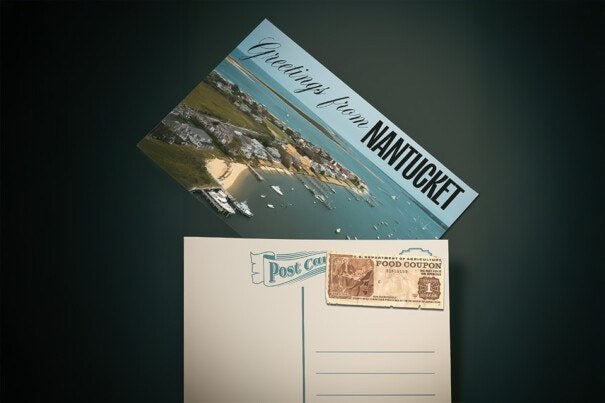
See all posts >>
A Woods Hole Pool House Where the Garden Is a Main Character
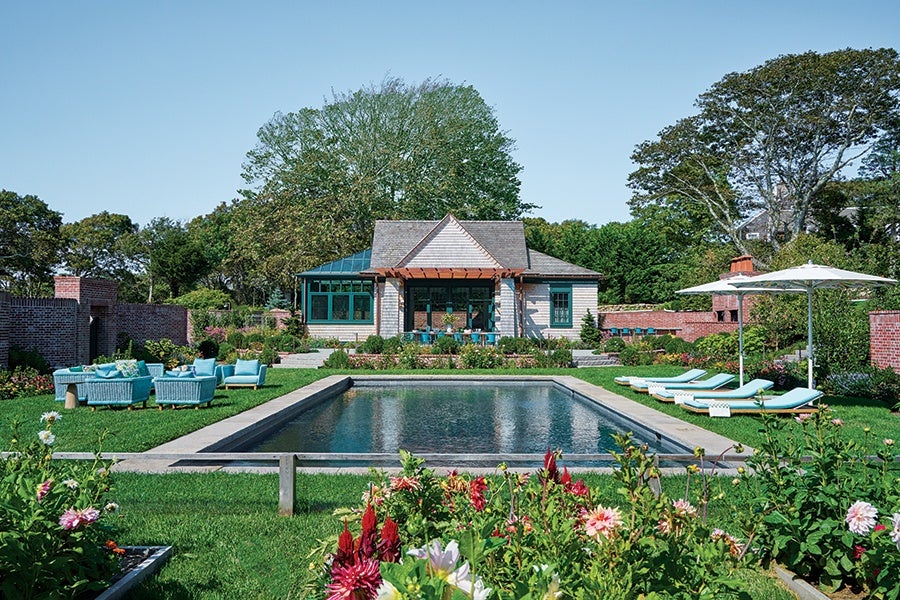
As avid gardeners, the greenhouse was a must for garden salad produce plants like tomatoes and cucumbers. / Photo by Jane Beiles
This article is from the summer 2026 issue of Boston Home. Sign up here to receive a subscription.
It isn’t often that an outdoor retreat feels both transportive and intentional—a place where architecture recedes just enough to let landscape and lifestyle take center stage. In a recent collaboration between interior designer Douglas Graneto, architect John Gassett of Shope Reno Wharton, and KVC Builders’ Jason Forino, that balance was the guiding principle from the start. “Our hope was to design buildings that had a supportive role to the landscape and the outdoor living we knew the clients would be doing in the summer months,” Gassett explains.
The result is a pool house—affectionately dubbed the “Clubhouse” by the homeowners’ two sons—that complements the main residence while establishing its own identity. Trimmed in dark green and tucked into abundant plantings, the structure sits quietly within a layered composition of dining terraces, colorful seating areas, an outdoor shower, and Argentine grills, all surrounded by cutting and vegetable gardens. The effect is less backyard amenity, more family retreat.
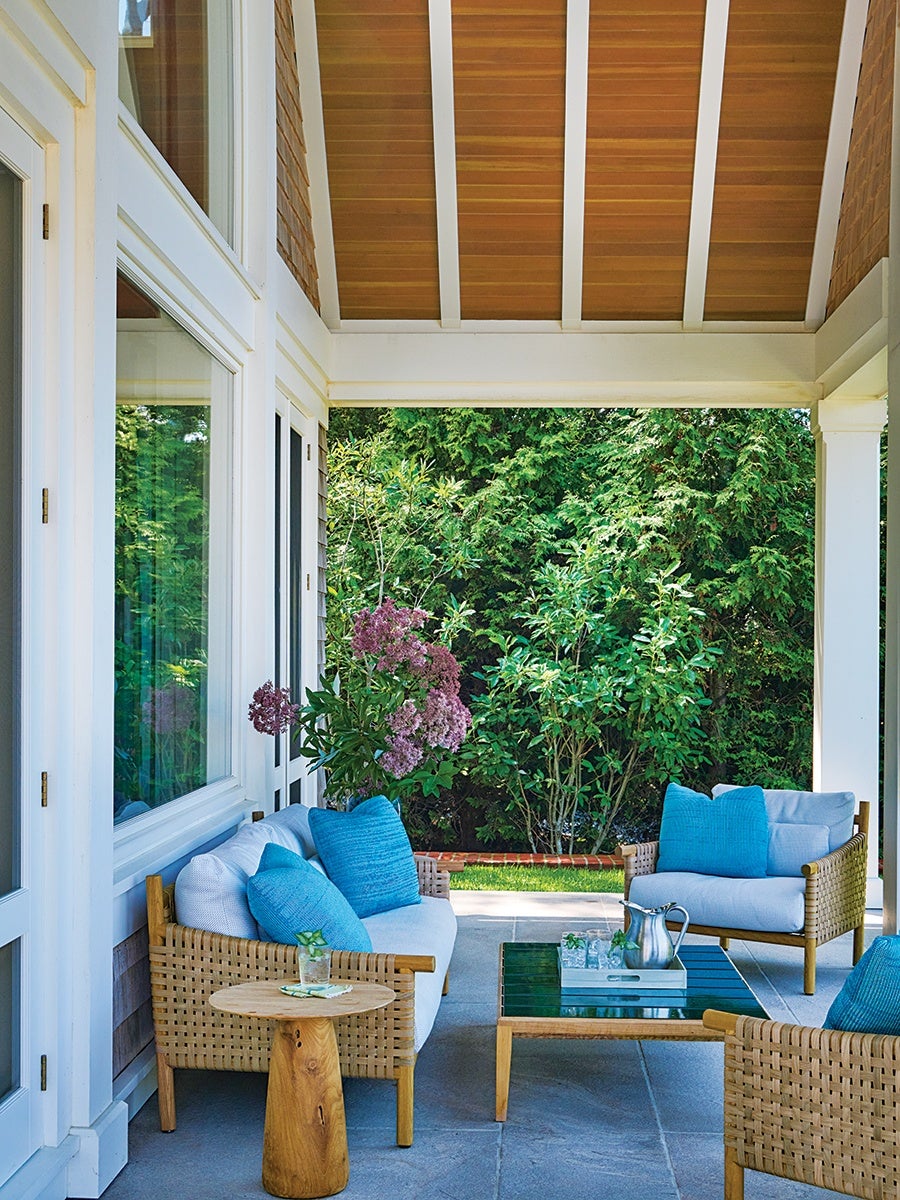
The property features a handful of outdoor living spaces for al fresco dinners, cocktail hours, family hangouts, and more. / Photo by Jane Beiles
“The main goal was to create something casual and welcoming that everyone could enjoy,” Graneto says. “They wanted to embrace color and create lush gardens filled with flowers and vegetables throughout the summer.”
That vision extends to the sleek greenhouse attached to the pool house—a working space as much as an aesthetic one. An avid gardening family, the homeowners use it to propagate seedlings in spring and shelter plants at season’s end. In peak summer, vegetable plants spill across the terrace, reinforcing the seamless connection between cultivation and gathering.
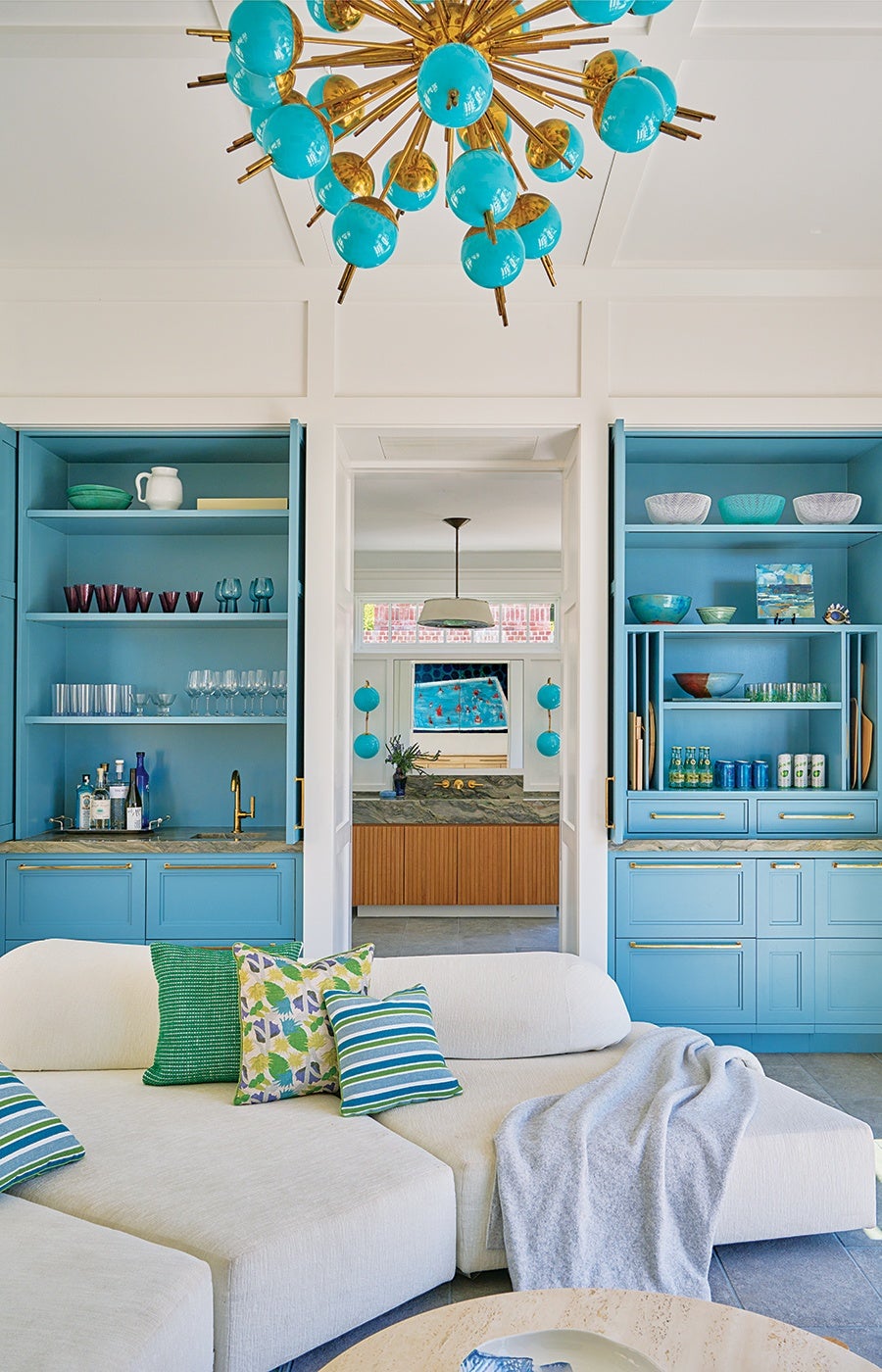
KVC Builders crafted two built-in shelves inside the pool house, painted a bright, dreamy blue, with refrigeration and storage for picnic items. / Photo by Jane Beiles
Inside the cabana, the design remains deliberately simple. In the main living area, built-ins painted in Farrow & Ball’s “Stone Blue” house refrigeration and storage for picnic plates and glassware, while a generous “On the Rocks” sectional from DDC anchors the seating area. Two walls of lift-and-slide glass doors dissolve the boundary between interior and exterior, flooding the space with natural light and maintaining constant sightlines to the pool and gardens beyond. “The layout is very open to the landscape,” Forino says. “You’re constantly connected to the yard and pool, and the space fills with natural light throughout the day.”
Overhead, a vintage sputnik chandelier with turquoise bulbs and brass rods from 1stDibs adds a note of playfulness, its palette echoing glimpses of the ocean visible in the distance. The color story continues outdoors, where Graneto layered Paola Lenti furnishings in tonal greens and blues, subtly referencing both the coastal setting and the family’s vibrant art collection inside the main house.
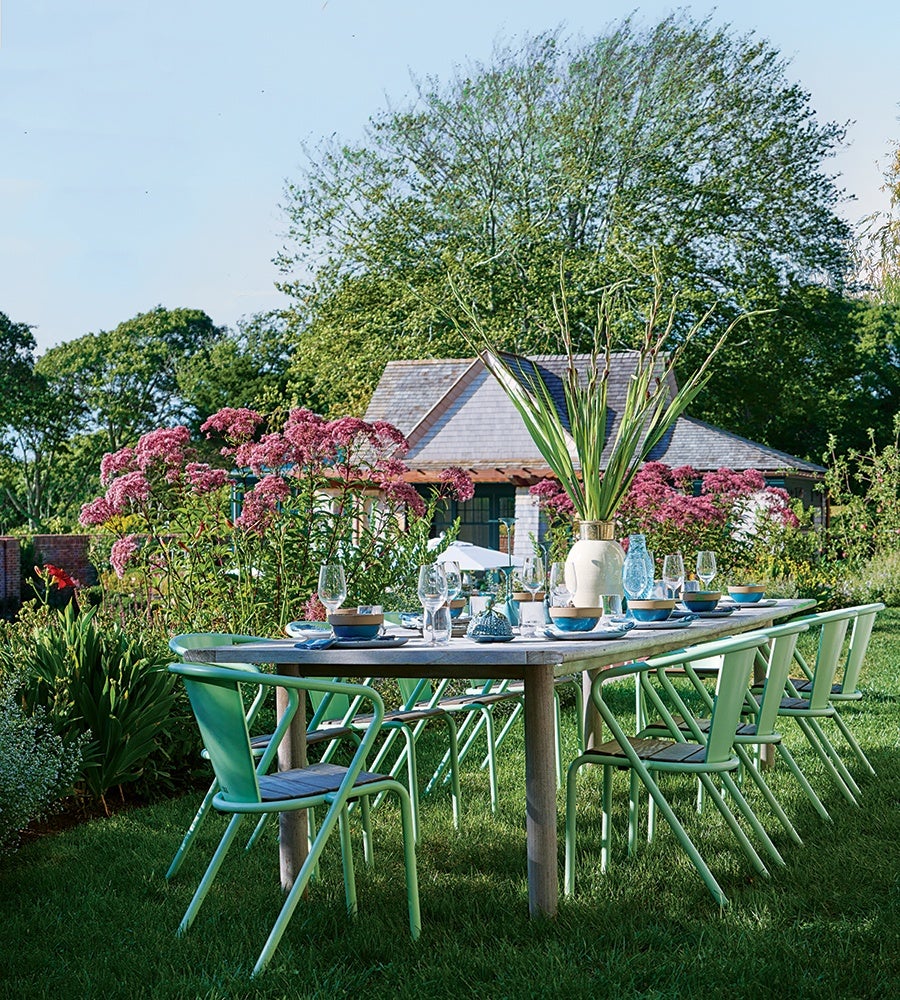
An informal dining space among the flowers is perfect for intimate meals during the warmer months. / Photo by Jane Beiles
Rather than compete with the gardens, the architecture frames them. Rather than dominate summer living, it supports it. The result is an environment designed not just for swimming or dining, but for lingering—from early planting season through the last warm evenings of fall.
“They [the homeowners] are incredibly thrilled. They’re not only thrilled with the preparation but also with the architecture of the space and the way everything was built,” says Graneto, noting that the process was an unusually collaborative one, with every decision guided by how the family truly lives—a shared focus that’s evident in the finished result.
Architect Shope Reno Wharton
Builder KVC Builders
Interior Designer Douglas Graneto Design
First published in the print edition of Boston Home’s Summer 2026 issue, with the headline “Garden Variety.”
Rosie DiMare Crashed Rhode Island’s Most Dramatic Friend Group

“I’m glad that people are seeing how entertaining it is here [in Rhode Island],” says Rosie DiMare. / Photo by Bronson Farr/Bravo
Before Rosie DiMare was a Real Housewife of Rhode Island, she was a hard-news reporter, which is to say she has been asking people uncomfortable questions for a living for some time now. These days, she asks them of her castmates—which is roughly how she ended up known as Nosy Rosie. Poking, prodding, and saying what nobody wants said is, as she puts it, “just kind of in my nature.” Whether that makes her the troublemaker or the only one paying attention is up for debate. She grew up in Massachusetts, went to Boston University, and interned at Kiss 108, where she also met her husband, Rich. With RHORI’s finale airing this month, we talked to her about Del’s lemonade, lip filler, and (hopefully) becoming best friends with Andy Cohen. —Jonathan Soroff
Five years ago, you were a Providence news anchor waking up at 2 a.m. What would you have said if I’d told you you’d be on Real Housewives?
I would have thought you were a crazy person. Not only that, I’d be like, “What do you mean? I’m in a news contract. There’s no way I’m gonna be on a show like that.” Keep in mind that five years ago, I was living in my apartment in Providence. I was single, and I was getting up at 2 o’clock in the morning to go to work every day on the news. In my mind, as a 30-year-old, I had totally made it. I was paying all my bills by myself. I had bought myself a condo. I was driving my dream car, which was my Jeep Wrangler. I was going out in Boston with my friends from BU, doing stuff in Providence, doing the news. I was one of the main faces of the number-one station in Rhode Island. How could it get any better than that? So I definitely didn’t see this coming.
Were you a Housewives fan before this?
I was a Kathy Hilton fan, so I would watch Real Housewives of Beverly Hills a little bit here and there. I just think she’s so funny. But I was getting up in the middle of the night for most of my career, going to work at 3 a.m., and I wasn’t able to tune in at 8 or 9 p.m. I was not not a fan, but I wasn’t an avid viewer.
Did your years as a hard-news reporter change the way you operated on the show?
One million percent. You also have to remember that I’m 35. I’ve been out of the news for 2.5 years, but I spent all of my twenties as a hard-news reporter. I didn’t start doing traffic or lifestyle until I was 30. Before that, I was going to crime scenes, interviewing politicians, asking hard questions, noticing inconsistencies, saying, “That doesn’t make sense. Explain this to me.” I’d be very blunt. I am very blunt. I’m also very logical, and a little bit too literal sometimes. Rich makes fun of me for it. But when you’re used to asking important politicians who are 60 years old very uncomfortable questions, sitting down with a group of girls is not uncomfortable.
Did you go in to filming RHORI with a plan?
No. I wish I had. I didn’t realize that I needed to do that, which is very naive. I thought you just go on the show, and you just be yourself, and everyone will like you, and everyone will get to know you, and everyone will want to hear what you have to say, and you’ll just all be friends. By about Episode 4 or 5, I learned that was not the case. And I know other people went into it with a plan or with a pact or whatever. Next year, maybe I’ll go in with a plan.

Rosie DiMare (center) with cast mates Elizabeth “Liz” McGraw and Alicia Carmody, on a RHORI girls’ weekend in Newport. / Photo by Scott Eisen/Bravo
How real is it, really?
I think it’s very real.
Do the producers push the drama, or do you all do that on your own?
I don’t think they encourage anything. It’s just: This is a show, and they’re watching your real life, and you know, we need drama for it to make sense.
Who was the peacekeeper?
Hmm. I think Alicia [Carmody] was trying her best to be neutral, but I don’t necessarily know if there was anyone who was a peacekeeper.
Who was the shit-stirrer?
They’ll tell you it was me. And I agree that sometimes it was, because I would ask questions they didn’t want asked or point out things that they didn’t want pointed out. I wasn’t ever doing it maliciously. It’s just kind of in my nature. But I think that as the show goes on, you see who’s actually just out there causing problems for no reason. You’ll see.
So you deny being the bad guy?
Maybe I’m the villain. Maybe I really am. Who knows?
Worst part of having cameras on you 24/7?
I actually didn’t mind the cameras. I didn’t always want the girls around, but I had no problem with the cameras. [Laughs.]
Anything you’d do differently?
I really just tried to be myself, and I think my only regret is that I should have fought back a lot sooner than I did. I’m not proud of the fact that I cried a lot. I would come home, and Rich would say, “We’ve been together for five years, and I’ve seen you cry like once, and this summer you’ve cried every day.” It was very overwhelming, and I was just trying to understand what was going on a lot of the time. I would say things, or point things out, or ask questions, and then I’d get beat up for it. And now [on RHORI], suddenly I’m thrown into a dynamic where there’s a secret language I don’t understand because I didn’t grow up with these people, and nothing I do is right. I also learned the hard way that you are not allowed to ask questions here. And instead of what I would normally do, which is fight back a little harder, I would kind of back down. So I would say my biggest regret was being a little soft.
You have been the subject of some wild rumors. In Episode 4, a castmate suggested you left NBC 10 because you were having an affair with a higher-up, but in that same Episode you clarified that you left because you had colitis.
They can accuse me of a bunch of things, but you will see—either on the show or in the [upcoming RHORI] reunion—that, like, corporate America has paper trails. They want to say I didn’t leave on medical leave, but why would I admit to having colitis? You can say whatever you want, but if it’s factually incorrect? I’ve only ever been on TV and told the truth, and so seeing that you can just say whatever you want was mind-boggling to me. Like, honestly, having an affair with someone that I worked with would have been far less embarrassing than admitting that I was bleeding out of my butt and wearing diapers.
What has the show gotten right about you, and what has it missed?
I do hope people get to know me more. I think what you see in Episode 5, of me talking about how much I love gay men, and how silly I’m being with my dog, Clemmy, in the confessionals. I say, “Don’t look at her cooch” or whatever, which was crazy. Why did I say that? But that stuff really does represent who I am. People don’t really know about my personal life or my marriage. They don’t really know what I do for work, other than what’s been made fun of on the show so far. So I think there’s a lot still to come. As for showing that I have a little bit of a messy side, and that I kind of clock everything that’s going on pretty quickly and will blurt out what is not supposed to be said, that’s also true. I’m somewhat socially awkward. I don’t always understand what’s going on in the group dynamic. They’re not my favorite qualities about myself, but they’re real.
Photo courtesy of Bravo
Favorite memory from doing the show?
On Episode 6 or 7, Ashley [Iaconetti] and I have the most fun on a waterslide. It was the best time. I also loved another scene, with Alicia and Alicia’s daughter in my Jeep. I had fun with the bouncy shoes. I tried my best to show that I’m just this silly girl who loves the Disney Channel and doesn’t take life too seriously. I’m so lucky to have Alicia and Ashley as my real-life close friends. I would never have met Rulla [Nehme Pontarelli] without this experience, and now we’re becoming really good friends. Even with all the drama and whatever, a lot of it was really fun.
Why do you think the Real Housewives are so popular?
You know, I see these memes and reels, and it’s like there’s something about seeing other people fight and have total chaos that somehow calms their nervous system as a viewer. It doesn’t calm my nervous system, but I think it calms theirs.
Your favorite thing about Rhode Island?
Probably the food, which is such a crazy thing to say, but Rhode Island has such good food, and I feel like the food scene isn’t appreciated enough.
Coffee milk, stuffies, Del’s—which of these are you actually eating?
Gotta love the Del’s lemonade! The production staff was obsessed with it all summer, which I found so odd. Every day after work, they had to get a Del’s lemonade, and I was like, “All right, sure.” I don’t really do coffee milk, but I love a pizza strip or a party pizza. It’s so funny, too, because I grew up in Massachusetts, right near the Rhode Island border, and yet I didn’t learn a lot of these things until I was living here.
Where are you eating when you’re not trying to impress anyone?
There are so many good spots. But right near our house, there’s a place called Safehouse in East Greenwich. It’s not the fanciest restaurant, but it’s probably my favorite because it’s close, like five minutes away. But when I tell you, they have some of the best chicken Parm and the best drinks.

DiMare at Red Sox Bravo night with castmates (left to right) Ashley Iaconetti and Alicia Carmody. / Via Getty
You grew up in Milton, Mass.?
We moved there when I was in middle school or so, but I like Milton. My parents live in Milton. My sister lives in Milton with her husband and their baby. The town square is so cute, right near the Canton border. I love Milton—we’re big Milton people.
The accents on this show are operatic. Anyone laying it on?
No, I think that’s really how they all talk. Alicia’s getting heat for her accent or the things she says. I can tell you with 100 percent certainty: She is 100 percent being herself, and she really does talk that way, and she really does act that way. As one of her close friends, I get voice memos on a daily basis that are so funny. If I put them on the Internet, they’d get a million views and a million likes. We are dealing with someone who’s actually hysterical and can’t help it.
Rhode Island is the smallest state and has the most regional accents. Explain.
It’s like a small little town, though. Everybody knows each other. But there are different sectors, and they all talk a certain way: Johnston, North Providence, Cranston, Newport, South County. But overall, I think of the Rhode Island accent as a mix between Boston and New York. I’ve said that since I started reporting here. Then there’s the added cultural thing, with a big Italian and Portuguese dynamic. And then there are people like me who have no accent because I had to go to speech school for journalism.
Walk me through your beauty regimen.
Hmm. My routine is so extravagant. My whole thing is that I do a lot so that I’m low maintenance in everyday life. I get the Botox. I get the lasers. I get the facials. I get the hair extensions. I get the lip filler. I get all the things so that even though I have to do all these things on different days, I actually wake up looking pretty, and that’s kind of my secret.

Rosie DiMare with her husband Rich on May 14, 2026 in New York City. / Photo by Slaven Vlasic/Getty Images for Food Bank for NYC
Does your husband, Rich, who’s also a performer, sing to you?
He never sings to me. Honestly, he sings to the dog more than he sings to me. But one of the things I love about Rich is that we’ll have sing-alongs in the car, and instead of it just being me being a weirdo, singing at the top of my lungs, he does it, too. Or we’ll go to karaoke, and I make him sing all the boy parts from something like Beauty and the Beast. I’m Belle, and he has to sing the Beast part. But I don’t need him to be singing to me on a daily basis. That would be weird.
You met Rich while you were interning at KISS 108 for Billy Costa. What was it like to start your career at the biggest morning show in Boston?
People don’t get it—this was, like, the biggest deal to me ever. I was 19 years old, like, “I made it, I’m a star now.” I’d listened to KISS 108 my whole life going to high school. We’d listen to “Matty in the Morning.” It was crazy that this was happening to me. I would go in early, stay late, trying to be the best intern ever. I just remember being at BU thinking, “Wow, I did it.” It was such a highlight. I loved working there. After I worked for the morning show for a year, I started working for the promo and production department and learned so much doing that too. It was my dream job and my first job.
For the record, I was not Rich’s intern. I was Billy Costa’s intern, but Rich helped me way more than Billy did. And you can tell Billy I said that. [Laughs.]
Thing you’re proudest of?
Being married to Rich, and being a good dog mom. I’m very proud of the house we’re building, and the fact that we’re doing it ourselves. I’m very proud of myself for my television career that I had for more than 10 years, and how hard I worked to get where I am.
What’s the show actually opened up for you?
I really don’t know. Even though the girls make fun of my little TV show, I’m very happy with my little TV show [Rhode Trippin’]. It’s on ABC 6, every Saturday at 6:30. I have a decent audience, and I get to help some local businesses. Now, it’s becoming a few national businesses, too, and I get to give them shout-outs or do commercial work for them. I don’t think I want to ever go back to being on the news or doing anything like that full time. I like being able to just do my little thing.

The Real Housewives of Rhode Island cast and friends (l-r): Liz McGraw, Dolores Catania, Ashley Iaconetti, Rosie DiMare, Rulla Nehme Pontarelli, Andy Cohen, Alicia Carmody, Kelsey Swanson, Jo-Ellen Tiberi in New York City on March 30, 2026. / Photo by: Noam Galai/Bravo
How has it changed you?
I’m very happy with my life. I was very happy with the way my life was before. I’m ecstatic to be able to do more DJing. I’m doing WeHo Pride, which would never have happened if it weren’t for the publicity. I’m a big ally to the gay community, and I love that. So it’s exciting to have more opportunities, but if I’m being honest, I’m very happy with the way things are.
Who do you get compared to?
I’ve been getting a lot of Katy Perry/Megan Fox mixtures online, like “She kinda looks like if they had a baby,” which I don’t hate at all. It’s very nice. I’ve been compared to Whitney Rose a lot, which I don’t really understand the comparison, but I’m here for it. That’s fine.
Tell me a secret about Andy Cohen.
I don’t really know Andy Cohen. He seems like a great guy. He went to BU, like me, but not at the same time. I haven’t spent that much time with him. I hope to make him my best friend. And he has great hair.
Additional reporting by Catarina Maia Amal and Camille Dodero.

Ashley Iaconetti and Rosie DiMare / Photo courtesy of Bravo
By the Numbers
Reality Check
The data behind the Housewives drama (including its newest New England hit).
2.7 million
Viewers across platforms in the first seven days of RHORI’s April 2 season premiere, Bravo’s biggest multiplatform debut since 2024.
3.75 million
YouTube views for The Real Housewives of South Boston (2011 to 2012), a three-episode send-up of townies and packies, featuring future Hacks’ cocreator Paul W. Downs as Marky Mark’s cousin.
179
Total Housewives across 11 U.S. regional franchises and 110 Bravo seasons, among them New Jersey, Beverly Hills, and Salt Lake City.
7
RHORI cast members (so far).
2
Years The Real Housewives of New York City breakout star Bethenny Frankel spent at Boston University.
0
Blond Housewives in RHORI Season 1—the first non-flaxen debut cast in the franchise’s 20-year history. —Catarina Maia Amaral and Camille Dodero
A version of this article was first published in the print edition of the June 2026 issue, with the headline,“Real Talk with Rosie.”
Related: New England Finally Has Its Own Real Housewives—and They’re Incredible
Welcome to a Gentler, Friendlier, More Inclusive World of Tennis

Getty Images
Walk into Court 16, the new indoor tennis center in Newton, and the first thing you notice is what isn’t there: no dress code, no country club etiquette, and no sense that you’re being quietly judged for your backhand. Tennis here, it turns out, is trying something different.
The New York–born concept is built around a simple idea: You shouldn’t have to be good at tennis to start playing tennis. Instead of one intimidating full-size court, there’s a mix of 44-foot, 60-foot, and full-size courts, so you can build up gradually instead of getting thrown onto a full court on day one. There’s programming for beginners and more advanced players alike, including ball-machine sessions that sharpen technique and precision. Family memberships, camps, and community events make it easy to keep coming back. The point isn’t just to teach you the game. It’s to get you to stick with it.
That same spirit of access has deeper roots in Boston. Founded in 1961 by a group of community members who believed in tennis as a tool for opportunity, the Sportsmen’s Tennis & Enrichment Center in Dorchester was the first indoor nonprofit tennis club built by and for the African-American community. More than 60 years later, a major $20 million campus expansion—backed in part by the New Balance Foundation—is pushing that work forward in a significant way. The project, in its final phase this year, includes new outdoor tennis courts to support growing demand for youth programs, adult play, and tournaments, alongside broader upgrades including a larger fitness center, new education spaces, and an accessible welcome center.
Public courts are evolving, too. In Brookline, the long-closed Amory Tennis Center is reopening this spring after a full reconstruction, debuting six new clay courts alongside programming and amenities. The project wasn’t without debate—pickleball advocates pushed to convert the space—but the town ultimately doubled down on tennis, preserving one of the region’s few public clay-court experiences.
With these upgrades to the local tennis scene, the sport may be easier to try now, but it still rewards the same things it always has: time, focus, and repetition. The difference is that getting started no longer feels out of reach.
This article was first published in the print edition of the June 2026 issue, with the headline,“Full Swing.”
More Wellness:
 News
NewsWelcome to a Gentler, Friendlier, More Inclusive World of Tennis
A new breed of the sport comes to Boston—no experience, preppy nonsense, or pleated skirts required.
 Guides
I Tried It: I Did Puppy Yoga
Seven doggies, one yoga mat, and the most effective stress-relief class in Boston. Our lifestyle editor went to investigate.
 News
NewsWellness Hangouts Are the New Happy Hours
So long, cocktails; hello, electrolyte drinks. Are group wellness events becoming the city’s preferred way to gather after dark?
 Guides
Eau Yeah: Five Clean Fragrances to Try
These clean fragrances skip the nasty stuff without sacrificing the good stuff.
 Personal Essay
It's Bad Out There. Can a Luxe Boston-Specific Massage Help?
What happens when a luxury hotel tries to channel the city into a massage? A stressed editor finds out.
 Opinion
I Tried It: I Had an AI-Powered Robot Massage
How smart are mechanical hands? Our style editor hits the table at the Seaport’s new wellness mecca Remedy Place to find out.
 Opinion
I Tried the Salmon Sperm Facial (and I Liked It)
Is the celeb-approved treatment worth all the hype? Our style editor dives in to find out.
 Guides
Five Wellness Memberships Redefining Members-Only Perks
Move over, bulk shopping—with golf simulator access and free childcare, these self-care and fitness memberships are redefining club benefits.
 News
NewsI Hate Cold Water. Can I Handle Contrast Therapy?
Our style editor tries to handle the heat—and the freeze—of this wellness technique.
 Guides
Five Eyelash and Brow Treatments—and Where to Get Them
Just in time for summer vacay, wake up your peepers with these Greater Boston services.
See all posts >>
Welcome to a Gentler, Friendlier, More Inclusive World of Tennis
A new breed of the sport comes to Boston—no experience, preppy nonsense, or pleated skirts required.
I Tried It: I Did Puppy Yoga
Seven doggies, one yoga mat, and the most effective stress-relief class in Boston. Our lifestyle editor went to investigate.
Wellness Hangouts Are the New Happy Hours
So long, cocktails; hello, electrolyte drinks. Are group wellness events becoming the city’s preferred way to gather after dark?
Eau Yeah: Five Clean Fragrances to Try
These clean fragrances skip the nasty stuff without sacrificing the good stuff.
It's Bad Out There. Can a Luxe Boston-Specific Massage Help?
What happens when a luxury hotel tries to channel the city into a massage? A stressed editor finds out.
I Tried It: I Had an AI-Powered Robot Massage
How smart are mechanical hands? Our style editor hits the table at the Seaport’s new wellness mecca Remedy Place to find out.
I Tried the Salmon Sperm Facial (and I Liked It)
Is the celeb-approved treatment worth all the hype? Our style editor dives in to find out.
Five Wellness Memberships Redefining Members-Only Perks
Move over, bulk shopping—with golf simulator access and free childcare, these self-care and fitness memberships are redefining club benefits.
I Hate Cold Water. Can I Handle Contrast Therapy?
Our style editor tries to handle the heat—and the freeze—of this wellness technique.
Five Eyelash and Brow Treatments—and Where to Get Them
Just in time for summer vacay, wake up your peepers with these Greater Boston services.
A Chess Cheating Scandal, Emma Stone, and My Next Book

Illustration by Jon Reinfurt
It began, as it usually did, as an unsettling feeling in the pit of my stomach. Not painful, really, but vaguely unpleasant—as though something was moving inside of me that wasn’t supposed to be there. I’m a generally anxious person, neurotic about germs, travel, food, and just about everything else, and I have a dozen rituals to get me through the day—but I knew for this, none of them was going to work. Because the feeling was utterly familiar, one that I had grown used to over a writing career that had now spanned 30 years: literary withdrawal, my own personal version of the DTs. It usually hit about three weeks after I’d finish a book—a sense of desperation that started in the pit of my stomach and, if left unchecked, would eventually turn into true panic.
No doubt, the sensation was left over from the decade at the beginning of my career that I spent struggling to become an overnight success. I was always broke then, and my books were the only thing that kept me afloat. Even after the publication of Bringing Down the House—the story of those six MIT kids who beat Vegas—launched my career in narrative nonfiction, it was a constant, never-ending battle to find that next project before my rent came due. At some point, the constant pressure to be writing, always writing, became internalized. I simply reached a point that if I wasn’t working on a story, if I wasn’t moving forward, chasing something, I began to feel physically ill.
April 2024 was no exception. The previous fall, the movie version of my book Dumb Money had hit theaters, and I’d simultaneously finished writing a different book, The Mistress and the Key, a continuation of a historical thriller that had begun with my project The Midnight Ride. I was locked in my basement office in Newton when that familiar desperation began clawing at me—so I started to Google.
This wasn’t how it usually worked. Ninety percent of the time, my stories came through pitches: random, unsolicited emails or text messages that landed in the middle of the night, sometimes from people I tangentially knew, often from complete strangers. That’s how the project I’m probably most known for, The Social Network, had begun—a 2 a.m. email from a total stranger who happened to be a Harvard senior, writing that his best friend had founded Facebook, and nobody had ever heard of him. That friend turned out to be Eduardo Saverin, whom I met two days later in a bar at the Westin in the Back Bay, where he uttered the fateful words that sent me right to my laptop: “Mark Zuckerberg fucked me.”
Sometimes, the pitches came in from Hollywood; producers, directors, even actors would send me ideas that they hoped to develop, attempting to reverse-engineer their way to IP, because successful IP could push film and TV projects incrementally closer to that magical state of being “greenlit,” which was becoming more and more elusive as the movie business continued to contract.
But once in a while, it started with Google.

Checkmate: Genius, Lies, Ambition, and the Biggest Scandal in Chess, published by Grand Central Publishing, is on sale now.
I couldn’t tell you exactly what I was searching for, because I didn’t know myself; there isn’t a blueprint for what makes the sort of story that compels me to submerge myself in its weeds for the six months to a year it takes to research and write. But there are things that I’m always looking for. Usually, that includes young geniuses who aren’t good with authority, battling through some sort of Shakespearean, personal drama in the gray area between right and wrong—but also with huge, public implications. Hopefully, there are also exotic locales, tons of money, pretty people, and at least the hint of real, physical danger. Throw in a dinosaur or a billionaire, and I’m on the phone with my agent.
That particular April, I started even simpler: I began scouring Google for stories that involved scams, heists, or cons that hadn’t been widely reported. Sifting through literally hundreds of news articles about things I’d either heard too much about already, or didn’t want to hear any more about, I stumbled on something that pricked at me: not a scam, or a heist, but a cheating scandal. It just so happened to take place in the growing-more-popular-by-the-day arena of chess.
According to my search, in September 2022, Magnus Carlsen, the “Mozart of Chess,” widely regarded as the greatest player in history, who had a 53-game undefeated streak at the time, had been utterly destroyed by a 19-year-old kid at the Sinquefield Cup in St. Louis—beaten, unceremoniously, by a brash, outspoken American named Hans Niemann, who had made a name for himself in a series of bizarre interviews and insane twitch streams. Shortly after, Carlsen accused Niemann of cheating, launching an explosive scandal that involved trashed hotel rooms, the billion-dollar rise of Chess.com, and the possible involvement of anal beads.
I was instantly hooked. There had been a few magazine features and some mainstream news stories, but nothing big and flashy and commercial—no book, movie, or major streaming doc. The question became, How close to the story could I get?

Magnus Carlsen plays against Hans Niemann during the FIDE World Rapid and Blitz Championships in Doha, December 28, 2025. / Photo by MAHMUD HAMS / AFP via Getty Images
My first stop was Instagram and Hans Niemann’s DMs. The Social Network is a hell of an icebreaker, and although he was wary, he agreed to meet with me. After a few phoners, I was on a train to New York. We met in the dark, empty lounge of his Lower Manhattan apartment building, and he was everything I could hope for: angry as hell about what had happened, and raving about what he saw as a chess mafia aligned against him. He spoke about how evil and cruel Carlsen had been in trying to destroy a “kid in his prime,” about how one day, he would be the world champion and show everyone that he hadn’t needed to cheat in the Sinquefield Cup. He wasn’t always believable, and he was clearly spiraling at points into true paranoia, but I genuinely felt for him. And the truth was, I liked him, as I end up liking most of the people I write about. It’s a flaw critics have pointed out again and again.
Tracking down Carlsen turned out to be much more difficult. Famous people have walls around walls. Working through my movie agency, I got a letter to Carlsen’s agent, which was promptly ignored. I turned my attention to Chess.com, which had risen from a dorm-room idea at Brigham Young University to a billion-dollar behemoth at the center of modern chess. Chess.com was also at the center of the story, because they were in the process of partnering with Carlsen in an $83 million deal when Carlsen made his cheating allegations—and it was Chess.com, headed by Danny Rensch and Erik Allebest, that had launched an investigation into the scandal, publishing a report that alleged that Niemann had likely cheated in more than a hundred games on the site. This, in turn, had led to Niemann suing them, Chess.com, and Carlsen for $100 million.
Luckily, Rensch and Allebest were easier to track down than Carlsen. A mutual friend on Facebook made an introduction, and very quickly, I was spending hours on Zoom with them both. Eventually, that led me to Carlsen and, even more usefully, to his father, Henrik, his always-present sometime-manager—a kind and brilliant Norwegian who seemed utterly befuddled by what had happened.
It had only been a few weeks since I’d stumbled into the story via Google, but now I was ready for what has become the most important part of my career: the Hollywood pitch. I hadn’t written a word of the book, but I had enough research for a treatment—a 15-page proposal that laid out the story as I would write it. This process—attempting to sell the movie (or TV show) before the book was something that had begun with The Social Network, and quite by accident.
At that time, after meeting Saverin in that bar at the Westin, I’d crafted a treatment and sent it to my agents. A day later, it leaked onto the Internet; Gawker had decided it was scandalous enough to put on the front page of its website, and within a few hours, all hell had broken loose. Facebook settled with Saverin to try and stop whatever book I was writing. As part of his settlement agreement, he could never speak to me again. At the same time, screenwriter Aaron Sorkin read my proposal and decided he wanted to write it as his next movie. David Fincher also read the proposal and said he wanted to direct it as his next movie—but only if we did it immediately, because this was 2009, and who knew if Facebook would still be around in a year?
The only problem was, I hadn’t written a book yet. So I locked myself up—back in the Westin Hotel—and wrote the book in 11 weeks. Sorkin joined me next door and wrote the script in the three weeks that followed. The book and movie came out simultaneously, which almost never happens, and I realized then and there that reversing the process—selling the movie before the book—made more sense, as long as I could continue to find stories that read like movies, and I could write them like I was on fire.
The movie treatment for Checkmate went out wide to Hollywood on a Wednesday. By Friday, we had a dozen studios, producers, actors, and directors chasing; the following Monday, it was time to make a hard decision. But after a Zoom call with Emma Stone, Nathan Fielder, and A24, I knew where we had to end up. Fielder and Stone understood the story the same way I did: It wasn’t just about cheating in chess; it was Shakespearean and generational, about a wild upstart facing off against an Old World champion, and about how quickly AI is going to change everything—chess being the canary in the coal mine, because now any 12-year-old with a cell phone can beat Magnus Carlsen.
AI is going to change everything—chess being the canary in the coal mine, because now any 12-year-old with a cell phone can beat Magnus Carlsen.
A day after that, it was time to start writing. And traveling—because though this story had started in St. Louis, it went all over the world, concluding in a rematch in Paris, where Niemann and Carlsen went head-to-head once more at, ironically enough, a Chess.com event. I couldn’t have pitched a better ending on my own: Paris is one of my favorite places, because I’ve always been obsessed with The Sun Also Rises—when I was younger, I used to reread it the first of every month, and when I used to drink (I mean really drink) I went to Paris with my dog-eared copy and tried to hit every place Jake drank in the book. It’s a big part of the reason I don’t drink anymore.
So I packed up my laptop and headed to Paris, my wife, Tonya, in tow because she’s my secret weapon. Not only does she speak French, know Paris like the back of her hand, and help me when my plots have stalled or my dialogue is weak, she’s better than I am at getting people like Niemann, Henrik, Rensch, and even Carlsen to talk to the anxiety-ridden, nebbishy writer in the corner of the room.
A month later, the book was finished, the movie with Fielder and Stone was in development, and I was back in my basement in Newton, hoping, for once, the literary withdrawal would defer; that the feeling in the pit of my stomach would hold off long enough for me to be able to simply relax and enjoy having finished a book—before chasing the next one. I mean, that could happen. Couldn’t it?
Isn’t it pretty to think so?
This article was first published in the print edition of the June 2026 issue, with the headline,“Eye on the Game.”
The Governor Bradford Is Back—and Provincetown Can Exhale

A spread of dishes at Governor Bradford. / Courtesy photo
During a mid-May grand opening party, the new Governor Bradford in Provincetown feels remarkably like the old Governor Bradford. The interior is a bit different, sure: new floors, a new bar with a tile backsplash, a new wood ceiling in the main restaurant area, windows that let in lots more natural light. But that seaside watering hole vibe still permeates the decades-old place at the corner of Commercial and Standish Streets—an enviable spot so bustling that a police officer directs foot and car traffic during busy season—and thankfully.
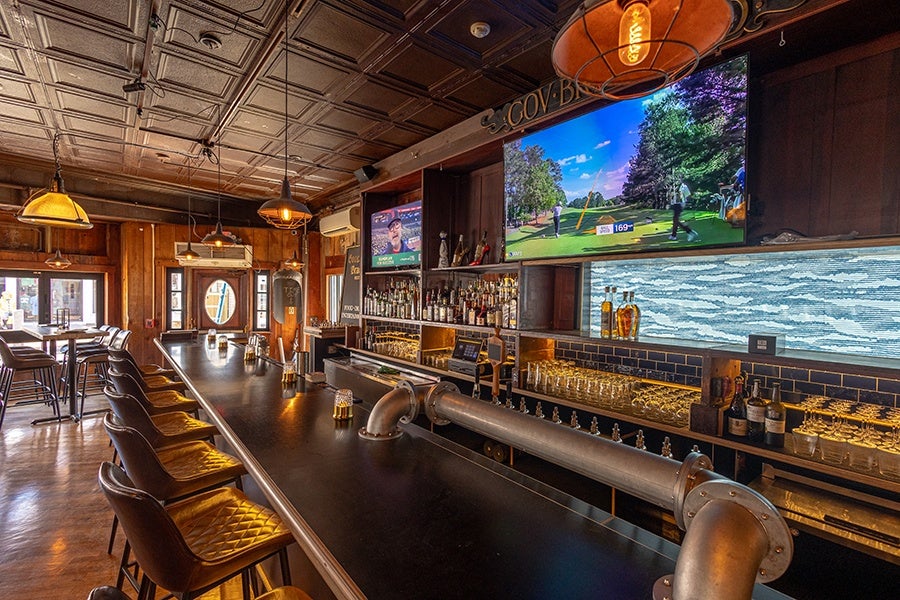
Governor Bradford. / Courtesy photo
Familiar sights for anyone who’s frequented the tavern abound: the pool table, albeit sporting fresh blue felt to match the refinished chair cushions; the same black and white sign bearing the iconic spot’s name on the wall of the stage that has seen memorable karaoke performances over the past 20-odd years. And because it’s Provincetown, some TVs play the Sox game while others are tuned to RuPaul’s Drag Race. Not that you can hear much over the pleasant hubbub as servers pass around free bites from the new comfort-food-focused menu, including chicken pot pie croquettes and bang bang shrimp. In other words, even if the spot’s handsome wood detailing now boasts a bit of shine, new management (again, following the 2022 changing of the guard) doesn’t change the fact that the Bradford is still a favorite townie bar in the very best possible way.
See also: The Top Restaurants in Provincetown Right Now
“We are big on saying that we are custodians, we are not owners,” says Joe Johnston—the director of operations of Coastal Hospitality Group, which now leases the building—a few hours ahead of the opening party. “I’m not coming into the Bradford and whitewashing it.”
Whitewashing, no—except maybe the new literally gleaming white exterior siding. Another upscale perk: Seats by the new giant accordion windows will be future people-watching spots for the Carnival parade in August and other town events, too. But despite the newness, customers can still sip cocktails in a space full of charm, history, and just the right amount of kitsch.

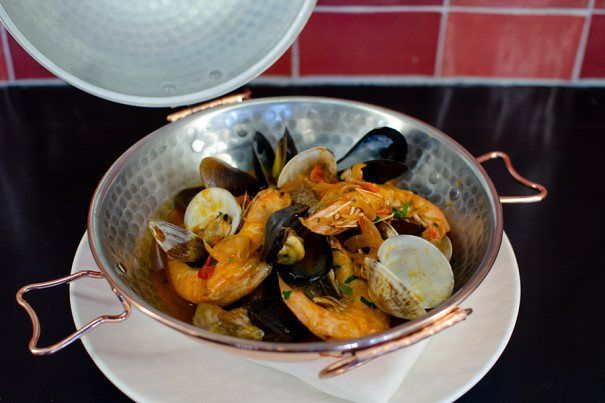
Mussels Lisbon at Governor Bradford. / Courtesy photo
What helps, surely, is that the staff knows Provincetown. When word came late last year that the building’s owner, Lexvest Group, had found a new tenant for a fifteen-year lease, the town collectively held its breath. Surely, this was another sign of Provincetown’s corporatization—another hospitality giant coming in to kill the local charm. And, yes, Coastal Hospitality Group is, indeed, a group, with four Cape Cod restaurants under its belt (Chapin’s Bayside in Dennis; the Chatham Cut, Codo Mexican Kitchen, and Pate’s in Chatham). “That just means that we have the support to give the buildings what they need,” Johnston says. In Bradford’s case, that means upgraded TVs and a new sound system, a new forthcoming patio, and—hallelujah!—goodbye to the tiny old bathrooms.
Like the restaurant that’s been called the Governor Bradford since 1960, Johnston has been kicking around Provincetown for a while. He was the general manager of seafood-focused Fanizzi’s for two decades. Governor Bradford’s new general manager, Vincent Bosely, worked with Johnston at Fanizzi’s and managed Codo last year. Most of the staff stayed on from the previous incarnation of the Bradford that featured chef/co-owner Collin Kolisko at the helm, serving an izakaya-inspired menu. (Kolisko and his team took over in 2022.)

Clam chowder with a prosciutto straw at Governor Bradford. / Courtesy photo
“It was like a hidden gem,” Johnston says of Kolisko’s concept. “All of our industry was like, ‘Oh, it’s great. You gotta go.’ But it was tough in a tourist town where you walk into this [building] and you don’t necessarily expect that concept.” (Kolisko previously told the Provincetown Independent that he’s looking for a smaller spot in town, and we can’t wait.) “The building dictates what works,” Johnston says. As in, most people walk into a pub and expect pub food.
Johnston developed the new menu of elevated diner-type food himself over about four months and describes it as “comfort chic” and “elevated enough, but still approachable.” Think: a beef Wellington/shepherd’s pie hybrid, branded with the bar’s name on the puff pastry; hearty meatloaf with creamy, garlicky potatoes dauphinoise; shake-and-bake pork schnitzel; and burrata-topped chicken, cod, or shrimp parmigiana. Some particularly retro favorites make the cut, like deviled eggs, oysters Rockefeller, and fondue, not to mention laidback classics like burgers and fried chicken. “We wanted to give you that grandma’s cooking feel,” he says. “The emotional strings that come attached with the food—we really wanted to tug on those.”

Portuguese kale soup at Governor Bradford. / Courtesy photo
Other dishes lean into Provincetown’s Portuguese heritage and the building’s history as a Portuguese fisherman hangout: Portuguese kale soup, for one, as well as cod, seafood stew, and a seven-cheese version of mac and cheese with spicy pork sausage and a garnish of crumbled bolo lêvedo (a slightly sweet Azorean roll that’s like the lovechild of an English muffin and cake).
The bar program boasts some surprises. Johnston is excited to offer wines on draft, including beauties like a rosé from Provence, France; sauvignon blanc from Marlborough, New Zealand; and prosecco—all dispensed from a temperature-controlled system that’s free of potentially wine-spoiling exposures to sunlight and air. “It’s not too prevalent in town,” he says. “It’s a huge up-and-coming trend in Europe. A lot of people think draft wine is like boxed wine, but it’s totally different.” The draft wine program allows easy sampling of different varietals without committing to a whole bottle. Highlights of the cocktail menu, meanwhile, include a blueberry basil smash with gin and a reimagined mint julep with butter-washed whiskey and matcha syrup. Boozy milkshakes and zero-proof offerings (an espresso cocktail with orange zest syrup and a cream float; smoked tea with maple, orange, and club soda) are on offer, too.
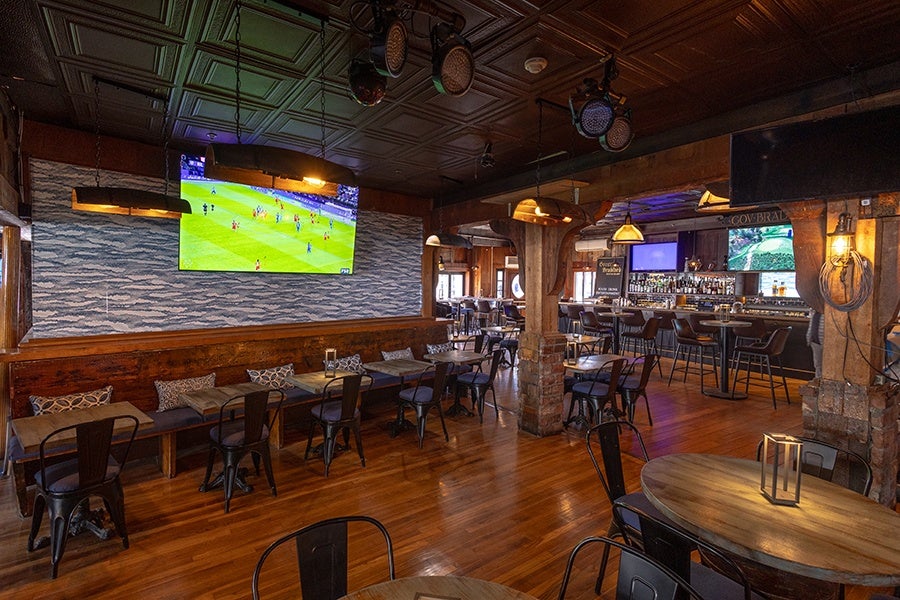
Governor Bradford. / Courtesy photo
Governor Bradford, like other spots on Commercial Street, has always pulled triple duty—at once a bar, restaurant, and entertainment venue. The legendary drag karaoke isn’t going anywhere. And at least five nights a week, diners can come in for live music. “In such a huge art community, we wanted to give performers a chance to get their face out there,” Johnston says. And like a heckler in the concert crowd, there are always going to be naysayers when something new—or sort of new—happens in town. That packed first night of service, though, saw Johnston, Bosely, and familiar staff working in harmony. “It put people at ease, seeing Vince and I,” Johnston says. “We’ve worked here [in Provincetown] forever. We’re not strangers.”
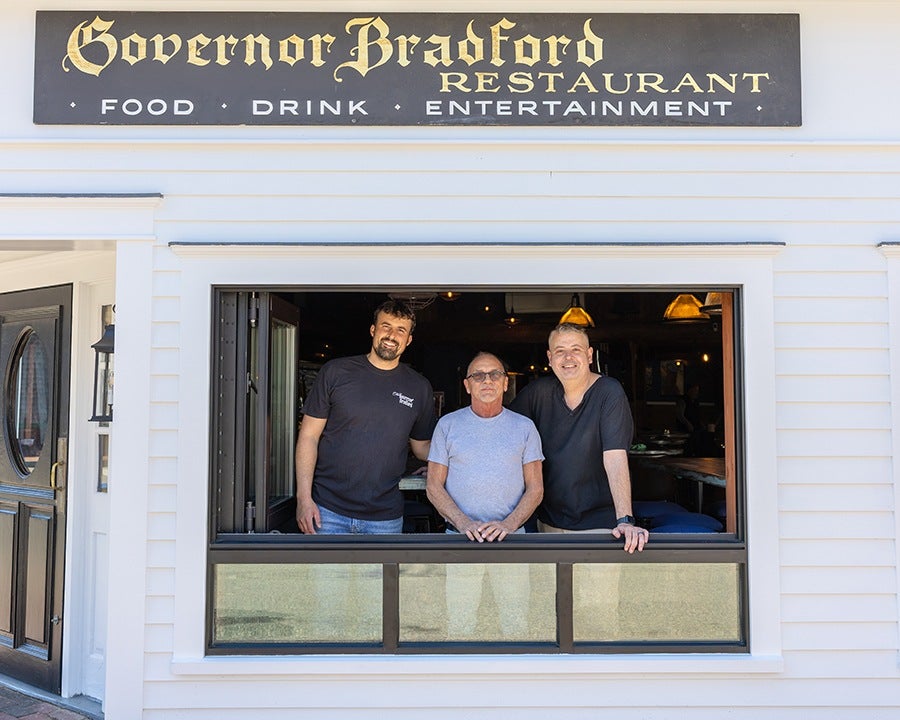
Governor Bradford. From left: Ryne Tillman, bar manager; Vincent Boseley, general manager; Joe Johnston, director of operations. / Courtesy photo
312 Commercial St., Provincetown, thegovernorbradford.com.
More Cape Cod dining

The Governor Bradford Is Back—and Provincetown Can Exhale
Familiar faces bring “grandma’s cooking” bites like chicken pot pie croquettes to a stalwart spot, now under new management (again).

12 Must-Visit Restaurants on Cape Cod
When you’ve had your fill of fish and chips, these spots are where Cape Cod’s dining scene shines.
Where to Find Excellent Portuguese Food in Boston and Beyond
In Greater Boston and the South Coast of Massachusetts, dive into seafood-heavy, flavorful cuisine from the Azores to Madeira to Avó’s house.
A James Beard-Winning Chef Brings Big Butch Energy to Provincetown
Kelly Fields merges New England favorites with southern comfort, all while establishing a new anchor point for the community.
Chatham Bars Inn’s Famed Farm Dinners Are Back
The family-style meals in the Brewster field happen every Wednesday through September.