A Chess Cheating Scandal, Emma Stone, and My Next Book
Or, how I ended up writing Checkmate about one of the most bizarre controversies in sports, which may or may not have involved anal beads.
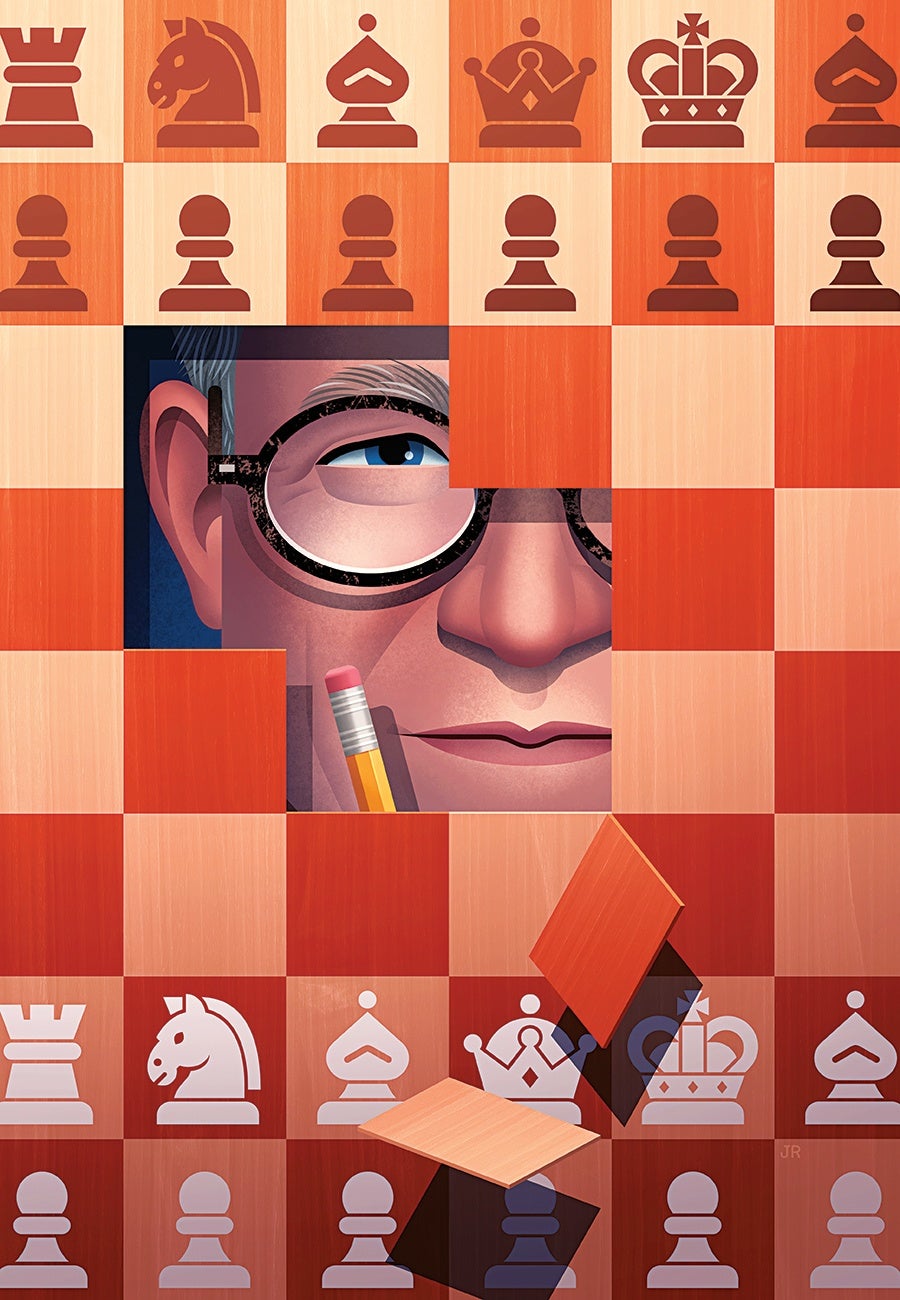
Illustration by Jon Reinfurt
It began, as it usually did, as an unsettling feeling in the pit of my stomach. Not painful, really, but vaguely unpleasant—as though something was moving inside of me that wasn’t supposed to be there. I’m a generally anxious person, neurotic about germs, travel, food, and just about everything else, and I have a dozen rituals to get me through the day—but I knew for this, none of them was going to work. Because the feeling was utterly familiar, one that I had grown used to over a writing career that had now spanned 30 years: literary withdrawal, my own personal version of the DTs. It usually hit about three weeks after I’d finish a book—a sense of desperation that started in the pit of my stomach and, if left unchecked, would eventually turn into true panic.
No doubt, the sensation was left over from the decade at the beginning of my career that I spent struggling to become an overnight success. I was always broke then, and my books were the only thing that kept me afloat. Even after the publication of Bringing Down the House—the story of those six MIT kids who beat Vegas—launched my career in narrative nonfiction, it was a constant, never-ending battle to find that next project before my rent came due. At some point, the constant pressure to be writing, always writing, became internalized. I simply reached a point that if I wasn’t working on a story, if I wasn’t moving forward, chasing something, I began to feel physically ill.
April 2024 was no exception. The previous fall, the movie version of my book Dumb Money had hit theaters, and I’d simultaneously finished writing a different book, The Mistress and the Key, a continuation of a historical thriller that had begun with my project The Midnight Ride. I was locked in my basement office in Newton when that familiar desperation began clawing at me—so I started to Google.
This wasn’t how it usually worked. Ninety percent of the time, my stories came through pitches: random, unsolicited emails or text messages that landed in the middle of the night, sometimes from people I tangentially knew, often from complete strangers. That’s how the project I’m probably most known for, The Social Network, had begun—a 2 a.m. email from a total stranger who happened to be a Harvard senior, writing that his best friend had founded Facebook, and nobody had ever heard of him. That friend turned out to be Eduardo Saverin, whom I met two days later in a bar at the Westin in the Back Bay, where he uttered the fateful words that sent me right to my laptop: “Mark Zuckerberg fucked me.”
Sometimes, the pitches came in from Hollywood; producers, directors, even actors would send me ideas that they hoped to develop, attempting to reverse-engineer their way to IP, because successful IP could push film and TV projects incrementally closer to that magical state of being “greenlit,” which was becoming more and more elusive as the movie business continued to contract.
But once in a while, it started with Google.
Checkmate: Genius, Lies, Ambition, and the Biggest Scandal in Chess, published by Grand Central Publishing, is on sale now.
I couldn’t tell you exactly what I was searching for, because I didn’t know myself; there isn’t a blueprint for what makes the sort of story that compels me to submerge myself in its weeds for the six months to a year it takes to research and write. But there are things that I’m always looking for. Usually, that includes young geniuses who aren’t good with authority, battling through some sort of Shakespearean, personal drama in the gray area between right and wrong—but also with huge, public implications. Hopefully, there are also exotic locales, tons of money, pretty people, and at least the hint of real, physical danger. Throw in a dinosaur or a billionaire, and I’m on the phone with my agent.
That particular April, I started even simpler: I began scouring Google for stories that involved scams, heists, or cons that hadn’t been widely reported. Sifting through literally hundreds of news articles about things I’d either heard too much about already, or didn’t want to hear any more about, I stumbled on something that pricked at me: not a scam, or a heist, but a cheating scandal. It just so happened to take place in the growing-more-popular-by-the-day arena of chess.
According to my search, in September 2022, Magnus Carlsen, the “Mozart of Chess,” widely regarded as the greatest player in history, who had a 53-game undefeated streak at the time, had been utterly destroyed by a 19-year-old kid at the Sinquefield Cup in St. Louis—beaten, unceremoniously, by a brash, outspoken American named Hans Niemann, who had made a name for himself in a series of bizarre interviews and insane twitch streams. Shortly after, Carlsen accused Niemann of cheating, launching an explosive scandal that involved trashed hotel rooms, the billion-dollar rise of Chess.com, and the possible involvement of anal beads.
I was instantly hooked. There had been a few magazine features and some mainstream news stories, but nothing big and flashy and commercial—no book, movie, or major streaming doc. The question became, How close to the story could I get?
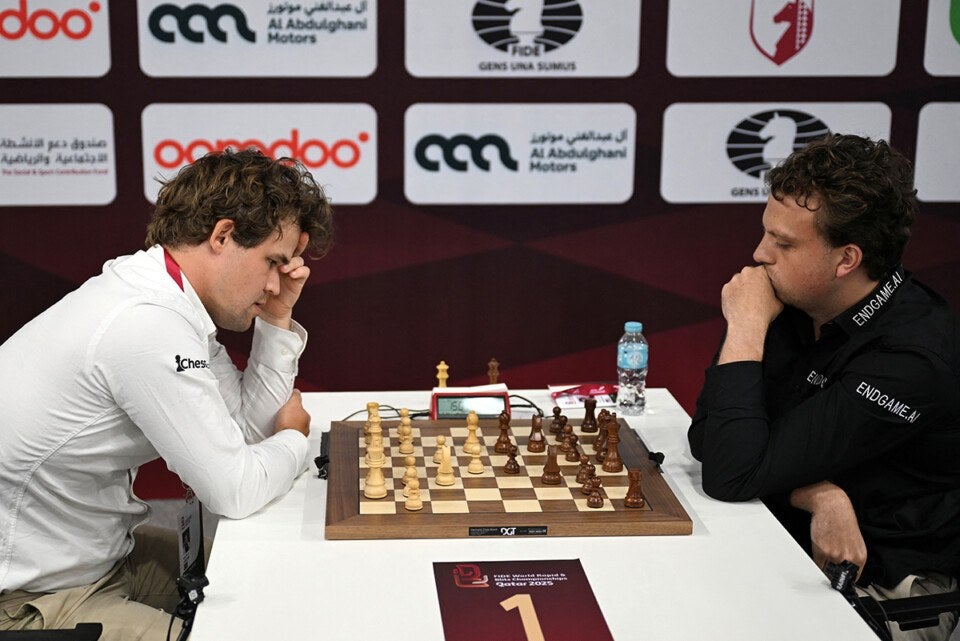
Magnus Carlsen plays against Hans Niemann during the FIDE World Rapid and Blitz Championships in Doha, December 28, 2025. / Photo by MAHMUD HAMS / AFP via Getty Images
My first stop was Instagram and Hans Niemann’s DMs. The Social Network is a hell of an icebreaker, and although he was wary, he agreed to meet with me. After a few phoners, I was on a train to New York. We met in the dark, empty lounge of his Lower Manhattan apartment building, and he was everything I could hope for: angry as hell about what had happened, and raving about what he saw as a chess mafia aligned against him. He spoke about how evil and cruel Carlsen had been in trying to destroy a “kid in his prime,” about how one day, he would be the world champion and show everyone that he hadn’t needed to cheat in the Sinquefield Cup. He wasn’t always believable, and he was clearly spiraling at points into true paranoia, but I genuinely felt for him. And the truth was, I liked him, as I end up liking most of the people I write about. It’s a flaw critics have pointed out again and again.
Tracking down Carlsen turned out to be much more difficult. Famous people have walls around walls. Working through my movie agency, I got a letter to Carlsen’s agent, which was promptly ignored. I turned my attention to Chess.com, which had risen from a dorm-room idea at Brigham Young University to a billion-dollar behemoth at the center of modern chess. Chess.com was also at the center of the story, because they were in the process of partnering with Carlsen in an $83 million deal when Carlsen made his cheating allegations—and it was Chess.com, headed by Danny Rensch and Erik Allebest, that had launched an investigation into the scandal, publishing a report that alleged that Niemann had likely cheated in more than a hundred games on the site. This, in turn, had led to Niemann suing them, Chess.com, and Carlsen for $100 million.
Luckily, Rensch and Allebest were easier to track down than Carlsen. A mutual friend on Facebook made an introduction, and very quickly, I was spending hours on Zoom with them both. Eventually, that led me to Carlsen and, even more usefully, to his father, Henrik, his always-present sometime-manager—a kind and brilliant Norwegian who seemed utterly befuddled by what had happened.
It had only been a few weeks since I’d stumbled into the story via Google, but now I was ready for what has become the most important part of my career: the Hollywood pitch. I hadn’t written a word of the book, but I had enough research for a treatment—a 15-page proposal that laid out the story as I would write it. This process—attempting to sell the movie (or TV show) before the book was something that had begun with The Social Network, and quite by accident.
At that time, after meeting Saverin in that bar at the Westin, I’d crafted a treatment and sent it to my agents. A day later, it leaked onto the Internet; Gawker had decided it was scandalous enough to put on the front page of its website, and within a few hours, all hell had broken loose. Facebook settled with Saverin to try and stop whatever book I was writing. As part of his settlement agreement, he could never speak to me again. At the same time, screenwriter Aaron Sorkin read my proposal and decided he wanted to write it as his next movie. David Fincher also read the proposal and said he wanted to direct it as his next movie—but only if we did it immediately, because this was 2009, and who knew if Facebook would still be around in a year?
The only problem was, I hadn’t written a book yet. So I locked myself up—back in the Westin Hotel—and wrote the book in 11 weeks. Sorkin joined me next door and wrote the script in the three weeks that followed. The book and movie came out simultaneously, which almost never happens, and I realized then and there that reversing the process—selling the movie before the book—made more sense, as long as I could continue to find stories that read like movies, and I could write them like I was on fire.
The movie treatment for Checkmate went out wide to Hollywood on a Wednesday. By Friday, we had a dozen studios, producers, actors, and directors chasing; the following Monday, it was time to make a hard decision. But after a Zoom call with Emma Stone, Nathan Fielder, and A24, I knew where we had to end up. Fielder and Stone understood the story the same way I did: It wasn’t just about cheating in chess; it was Shakespearean and generational, about a wild upstart facing off against an Old World champion, and about how quickly AI is going to change everything—chess being the canary in the coal mine, because now any 12-year-old with a cell phone can beat Magnus Carlsen.
AI is going to change everything—chess being the canary in the coal mine, because now any 12-year-old with a cell phone can beat Magnus Carlsen.
A day after that, it was time to start writing. And traveling—because though this story had started in St. Louis, it went all over the world, concluding in a rematch in Paris, where Niemann and Carlsen went head-to-head once more at, ironically enough, a Chess.com event. I couldn’t have pitched a better ending on my own: Paris is one of my favorite places, because I’ve always been obsessed with The Sun Also Rises—when I was younger, I used to reread it the first of every month, and when I used to drink (I mean really drink) I went to Paris with my dog-eared copy and tried to hit every place Jake drank in the book. It’s a big part of the reason I don’t drink anymore.
So I packed up my laptop and headed to Paris, my wife, Tonya, in tow because she’s my secret weapon. Not only does she speak French, know Paris like the back of her hand, and help me when my plots have stalled or my dialogue is weak, she’s better than I am at getting people like Niemann, Henrik, Rensch, and even Carlsen to talk to the anxiety-ridden, nebbishy writer in the corner of the room.
A month later, the book was finished, the movie with Fielder and Stone was in development, and I was back in my basement in Newton, hoping, for once, the literary withdrawal would defer; that the feeling in the pit of my stomach would hold off long enough for me to be able to simply relax and enjoy having finished a book—before chasing the next one. I mean, that could happen. Couldn’t it?
Isn’t it pretty to think so?
This article was first published in the print edition of the June 2026 issue, with the headline,“Eye on the Game.”