The Experiential Retail Strategy of Newbury Street Jewelers
These luxury Back Bay boutiques aren’t just selling anymore. They’re curating immersive moments—and hoping you’ll hang around.
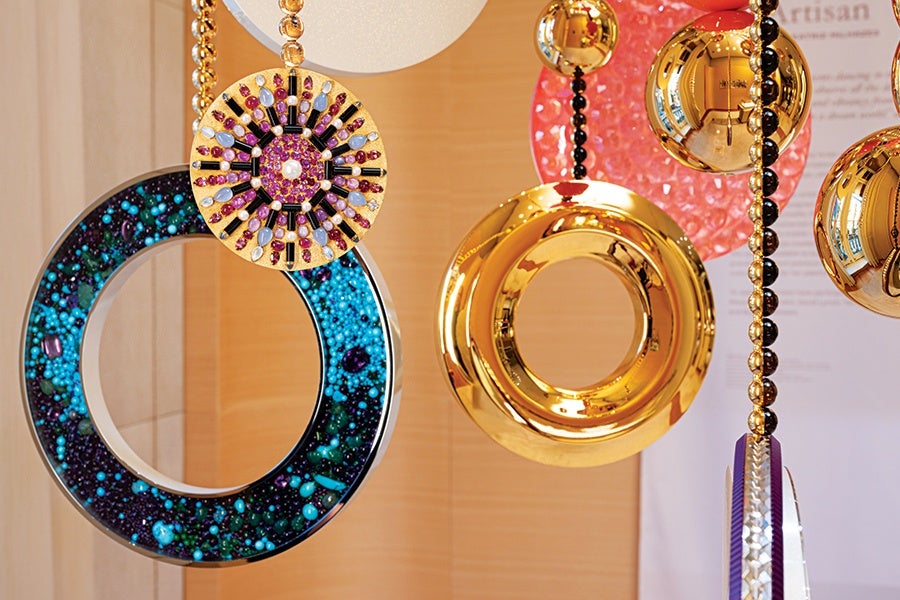
Beatriz Milhazes’s “Aquarium” is a mobile composed of 15 strands of precious, semi-precious, and ornamental stones. / Photo by Daniel Salemi, courtesy of Cartier
At Cartier’s Newbury Street boutique, the first thing you notice isn’t what’s in the cases—it’s what’s suspended from the ceiling.
An 8-foot-tall mobile of diamonds, emeralds, opals, sapphires, and other precious and ornamental stones shifts gently above the boutique floor. Created by Brazilian artist Beatriz Milhazes as part of the brand’s “Artist Meets Artisan” project that was recently on view, the piece transforms the space into something closer to a museum than a store. It’s not there to be sold; it’s there to stop you in your tracks.
And that’s exactly the point. In an era when even the rarest pieces can be purchased online, jewelers are rethinking what it means to walk into a store—and why anyone would.
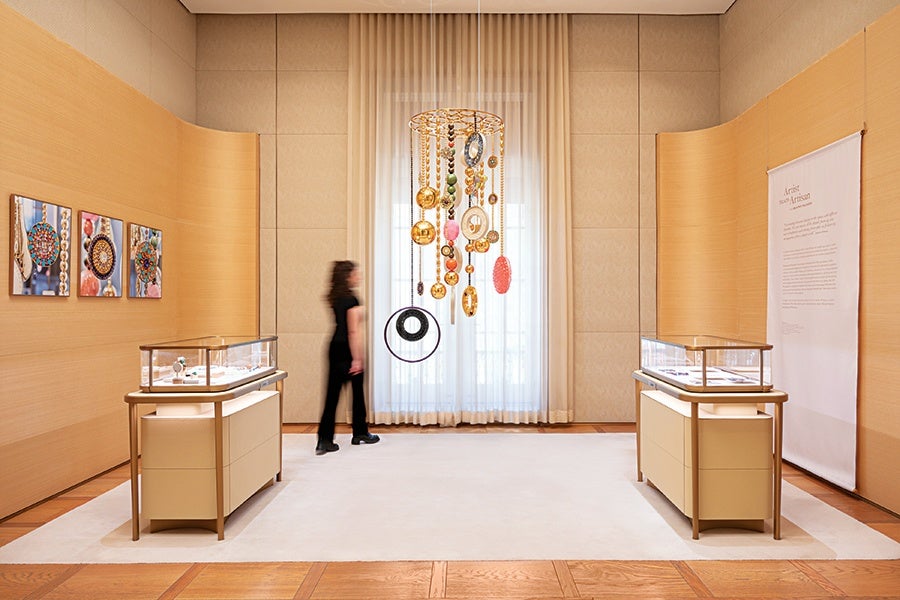
Cartier’s interior, where the 8-foot-tall mobile is suspended from the ceiling. / Photo by Daniel Salemi, courtesy of Cartier
It’s a stark contrast to the historic Jewelers Exchange Building downtown, where transactions have long unfolded across glass counters in a maze of small shops—efficient, but impersonal. Today, that model is fading, replaced by something more immersive, more curated, and far more considered. Across the street, Material Good, a New York–based concept that opened its 2,500-plus-square-foot Boston outpost earlier this year, is designed less like a showroom and more like a refined residence finished with marble, suede, brass, and green velvet. There’s a fireplace flanked by vintage chairs, a communal dining table, and a private salon, where a tightly curated mix of high-end jewelry and vintage and independent-brand watches encourages clients to stay awhile. A bar area inspired by Fenway Park’s iconic Green Monster is a nod, cofounder Rob Ronen says, to both his Massachusetts roots and “the spirit” of the city. “Growing up, Newbury Street defined great shopping for me—never Fifth or Madison Avenue,” he says. “I love everything about Boston: the people, the sports, the culture, and I couldn’t think of a better place to open Material Good.”
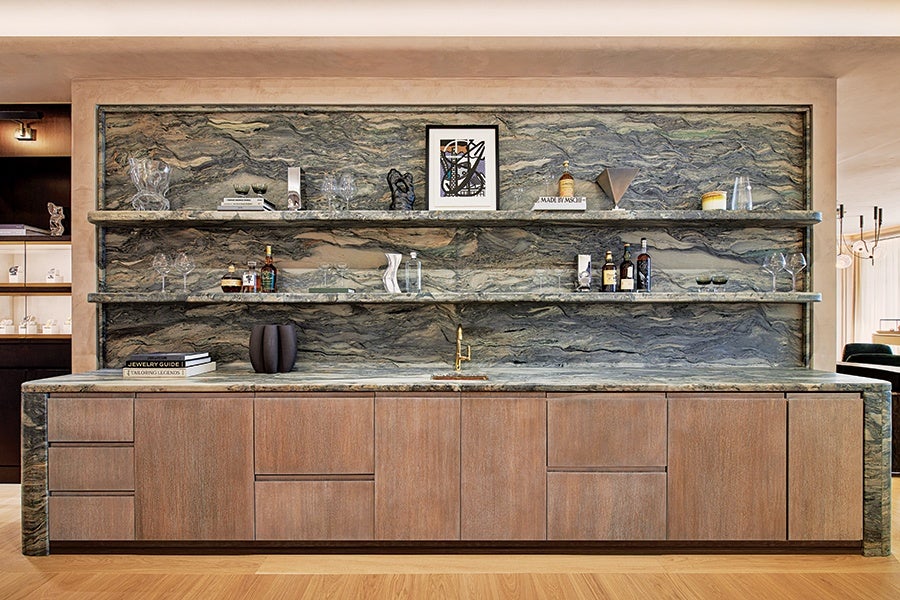
At Material Good, green marble was used to create a bar inspired by Fenway’s Green Monster. / Photo courtesy of Material Good
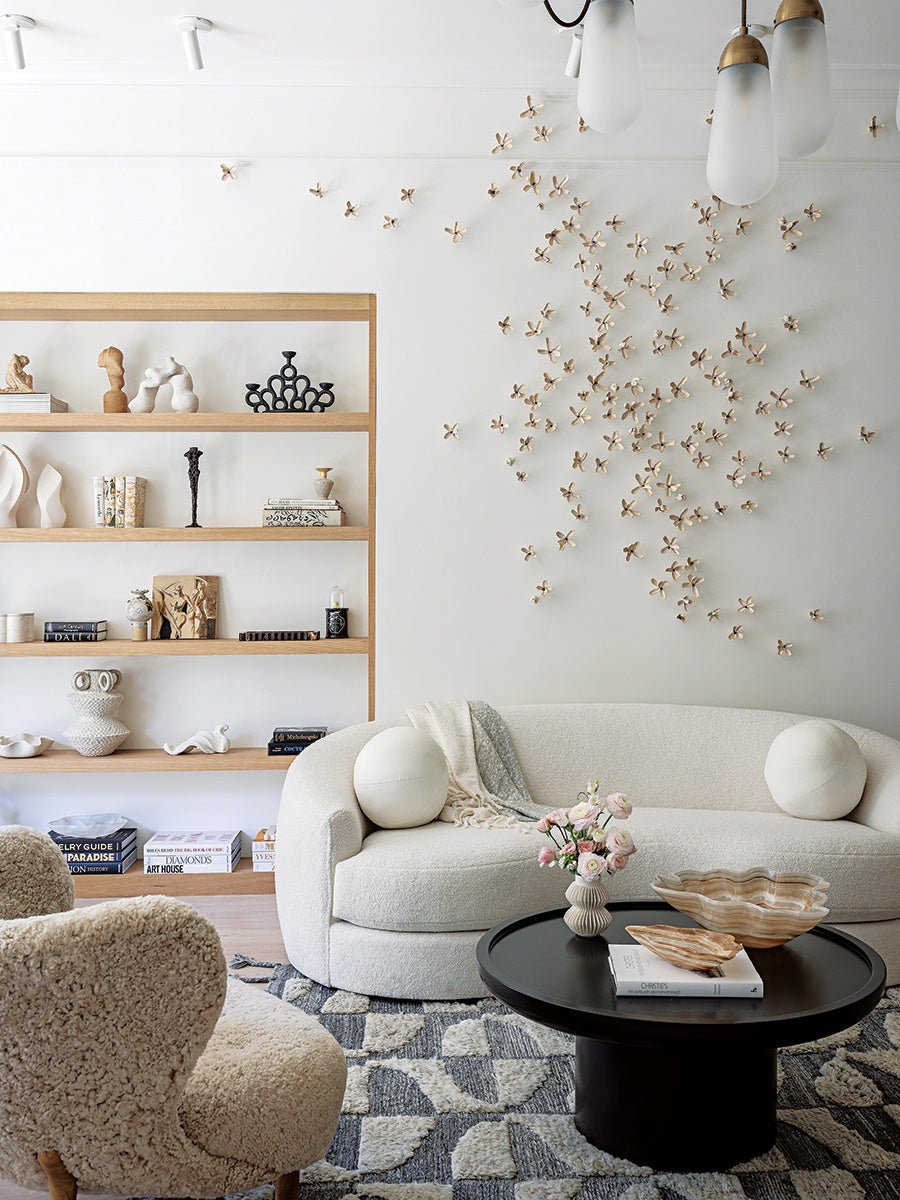
Art installations and considered décor give Hannah Florman’s showroom a residential feel. / Photo by Michael J. Lee
A few blocks away, jewelry designer Hannah Florman had long set her sights on Newbury Street. She opened her namesake boutique there in 2023, leaning into a model that feels decidedly more residential than retail. The space reflects that ethos: Prioritizing privacy and connection, it features handglazed walls, sculptural designer lighting, and furnishings you might expect in a well-appointed living room. Only a handful of pieces are on display at once; the rest are brought out slowly, deliberately. The boutique also doubles as a gathering place, hosting everything from bridal trunk shows to business events and intimate nights out—sometimes with no focus on jewelry at all. “I always had this concept—I wanted it to feel like an apartment or a home, not sales-oriented,” she says. But if you do end up buying something? Well, that’s by design, too.
This article was first published in the print edition of the May 2026 issue, with the headline,“Strings Attached.”