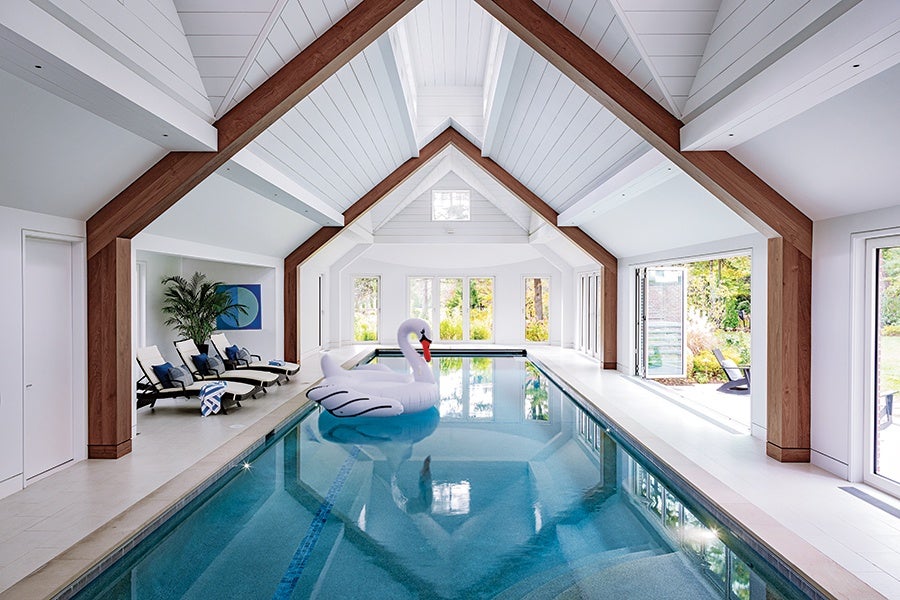
Hometown Girl Georgia Zikas Returns to Her Boston Roots
At a former warehouse in South Boston, the interior designer creates a studio that doubles as a living portfolio.
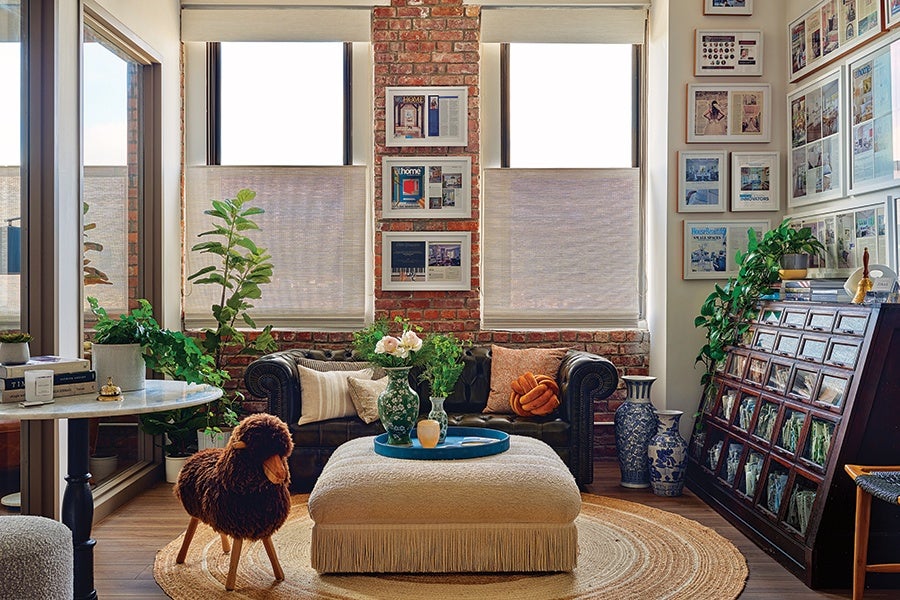
The entry layers history and whimsy. It features framed press accolades lining the walls and a verde green Chesterfield sofa from Paris’s Paul Bert Serpette flea market anchoring the space. / Photo by Sean Litchfield
This article is from the summer 2026 issue of Boston Home. Sign up here to receive a subscription.
After years of cutting her teeth in New York and building a thriving firm in Connecticut, interior designer Georgia Zikas has come home. Her new 2,700-square-foot South Boston studio on the fourth floor of 60 K Street, housed in a former warehouse, marks much more than an expansion. It’s what she proudly describes as a “hometown girl comes home” moment.
Zikas first tested the Boston market with what she calls a “little postage stamp of an office” in the Seaport to gauge demand. It quickly proved there was plenty—and that the studio was too small. When a broker suggested a location in South Boston “0.2 miles down the street,” Zikas hesitated. All four of her grandparents had arrived in the area from Ireland, England, and Scotland in the 1920s, so she carried an older image of the neighborhood. But the industrial terminal buildings, originally designed to service the railroad, offered abundant light and room for reinvention.
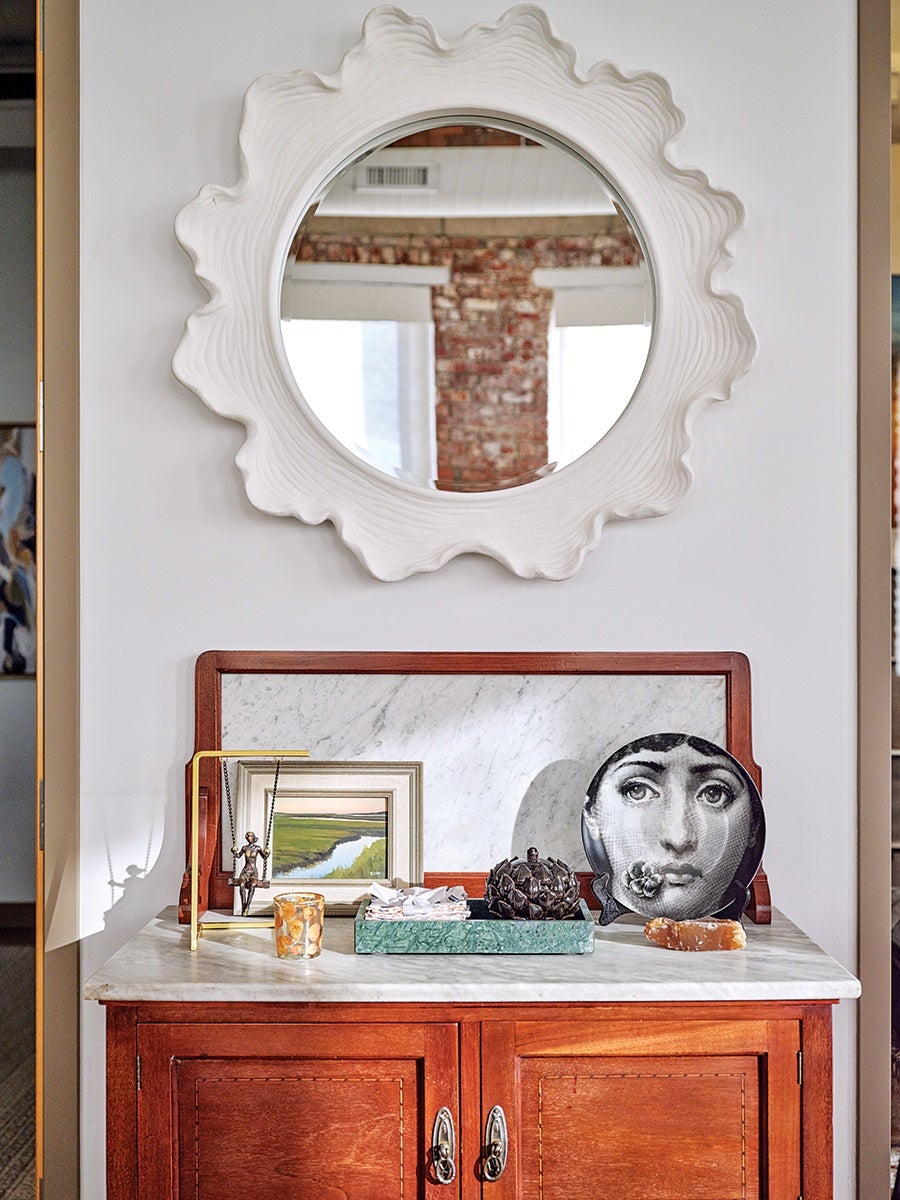
An antique English washstand anchors the vignette, paired with a plaster-framed mirror with pie-crust detailing. A Fornasetti plate, collected objects, and a small painting by a Stonington, Connecticut, artist add personality and a local touch. / Photo by Sean Litchfield
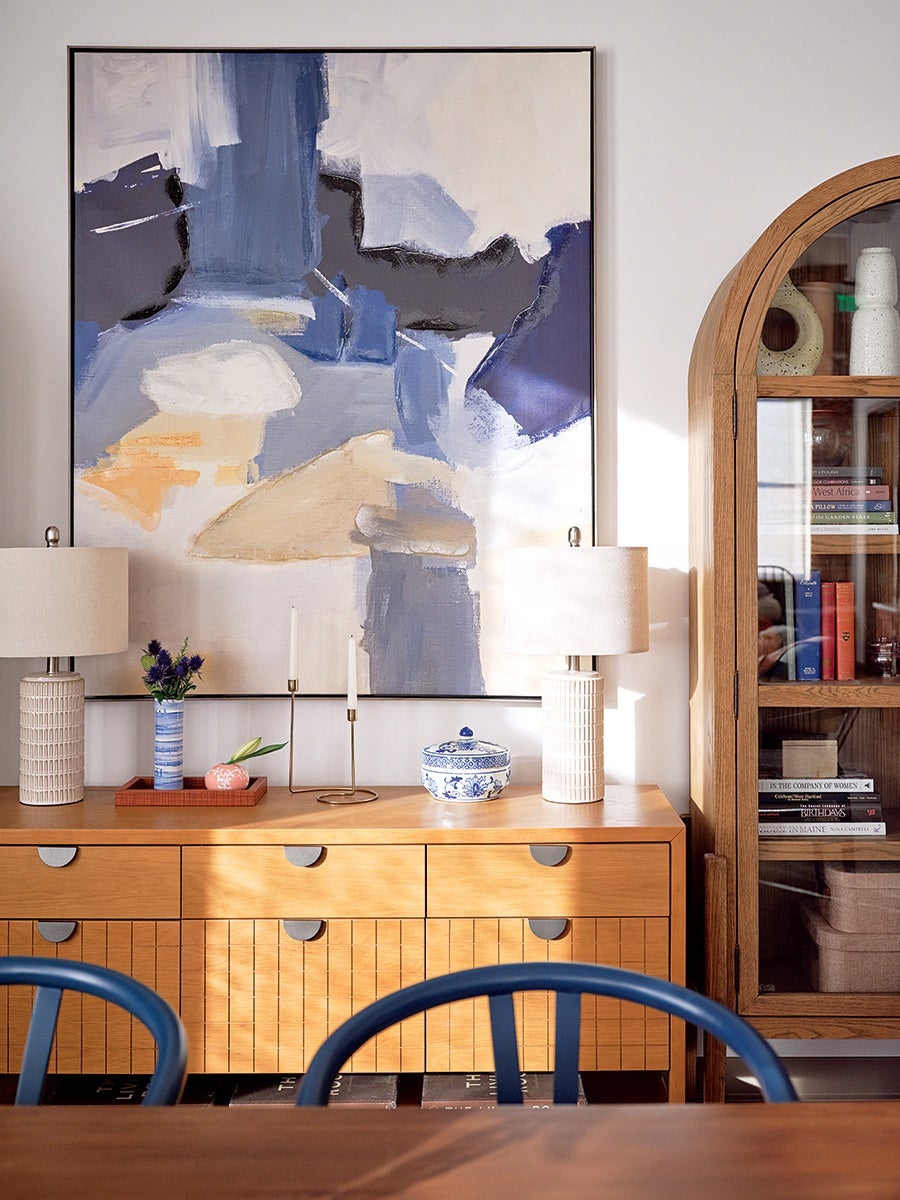
A striking abstract painting from a vintage shop in Connecticut sets the tone above a hardworking sideboard, while arched glass-door cabinets display collected pieces. A pair of cream ceramic lamps cast a soft glow, and vases by Boston ceramicist Jill Rosenwald add a local accent. / Photo by Sean Litchfield
Though the space was in rough shape, that didn’t dissuade her. Instead, she imagined something more immersive than a conventional office. “When we’re in the business of creating beautiful homes, why not aspire to work in one?” she says. Visitors now enter through a foyer-like reception area that doubles as a sample library, layered with vintage pieces, each with its own story. A green leather Chesterfield sofa anchors the room, sourced from a Paris flea market while Zikas was testing overseas purchasing for clients.
Offices line one side of a central corridor, each fully equipped so team members can “just move in and put their family picture on the desk.” At the far end, the studio opens into three distinct vignettes: a dining-room-inspired collaboration space, a cozy family-room nook, and a living-room-style presentation area. Anchored by rugs and upholstered pieces from her private North Carolina–manufactured collection, the layout reflects how Zikas approaches client projects. “We started with the rug foundation,” she says, noting that the neutral palette allows pieces to rotate—especially since clients occasionally purchase items directly off the floor.
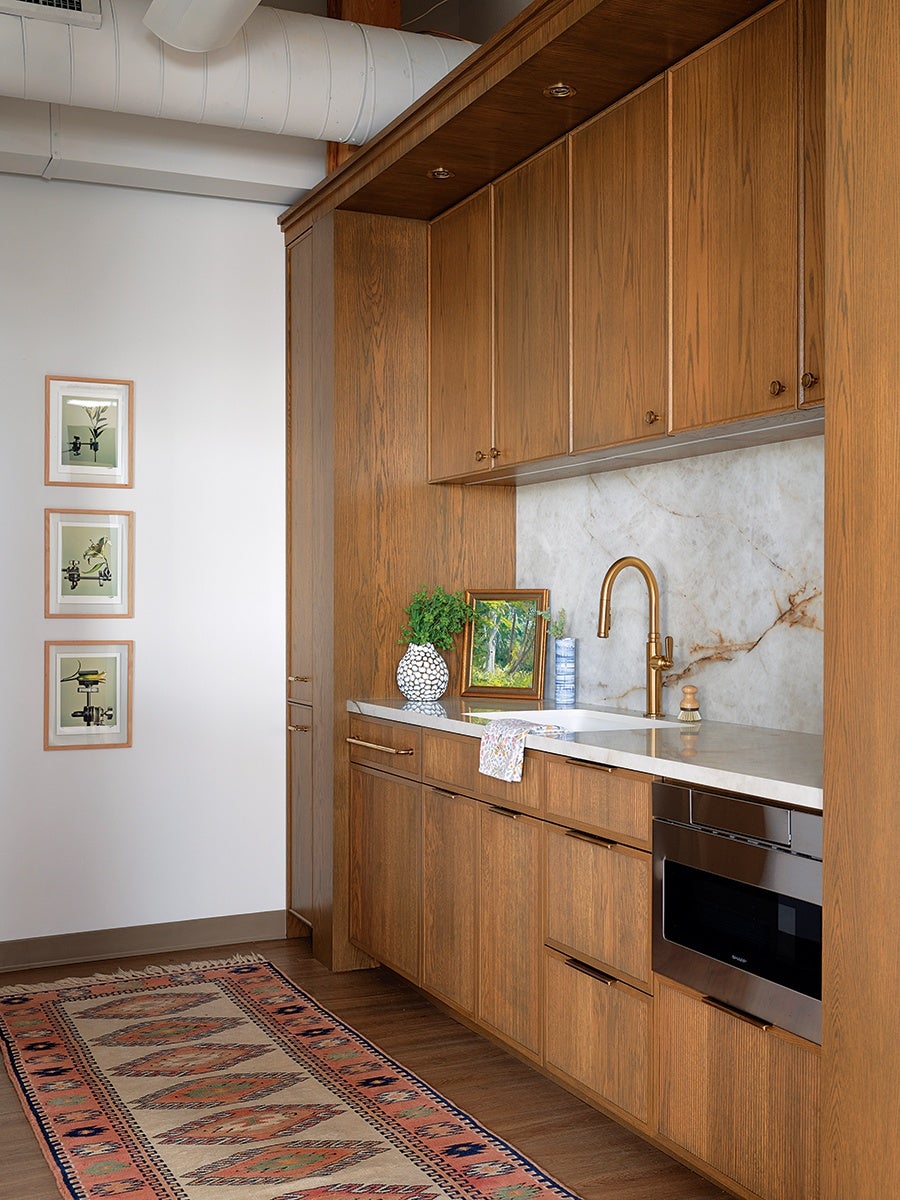
Designer Georgia Zikas envisioned a studio that feels more like a home, where clients are welcomed as guests. The kitchen—a natural gathering spot and testing ground—features high-end materials, some she hadn’t yet used in a residential project. / Photo by Sean Litchfield
The aesthetic is intentionally eclectic. A blue velvet sofa brought from Connecticut sits alongside lacquered side tables and traditional silhouettes. Here, meetings unfold on sectionals, fabric schemes spread across an antique dining table, and presentations appear on a Samsung Frame TV disguised as art. Even the kitchen—finished in high-end materials—serves as both gathering space and testing ground. “We wanted to experiment there, too,” she says, explaining that some finishes were new to her practice.
Community also factors into the studio’s purpose. As vice president of education for the IFDA New England chapter, Zikas envisioned the space as a venue for meetings and industry events; she recently hosted the organization’s 2026 strategic planning session there. “It’s almost like buying a house and hosting Christmas or Thanksgiving,” she says.
For Zikas, returning to Boston carries emotional weight. Shaped by her time in New York and the firm she built in Connecticut, bringing that experience back to the city feels like a natural evolution. “My smile couldn’t be bigger,” she says. “My soul is so full here.”
First published in the print edition of Boston Home’s Summer 2026 issue, with the headline “Where Practice Meets Place.”